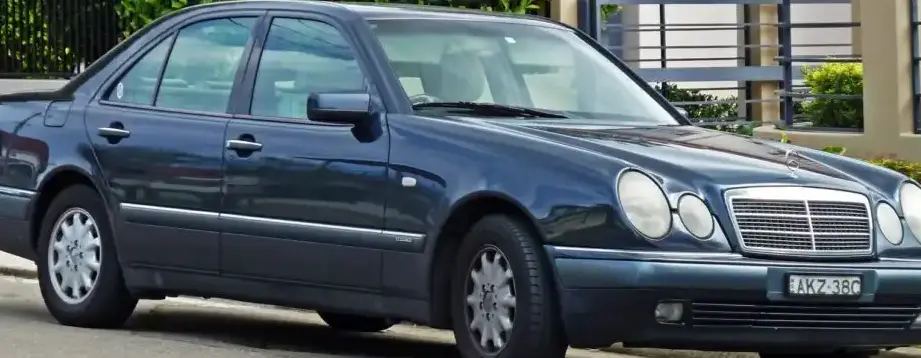
The Mercedes-Benz E 320, produced between June 1994 and June 1997, was a significant variant within the W210 E-Class range. Representing a step up in performance and refinement from the base E 220 models, the E 320 aimed to deliver a more premium driving experience while remaining accessible to a broader customer base than the flagship E 420. Positioned as a mid-range offering, it bridged the gap between affordability and luxury within the W210 lineup, which was a complete redesign of the previous W124 generation. The W210 E-Class, known for its technological advancements and increased safety features, quickly became a popular choice in the executive car segment, particularly in Europe and North America.
Technical Specifications
| Brand | Mercedes-Benz |
| Model | E-class |
| Generation | E-class (W210) |
| Type (Engine) | E 320 (220 Hp) Automatic |
| Start of production | June, 1994 |
| End of production | June, 1997 |
| Powertrain Architecture | Internal Combustion engine |
| Body type | Sedan |
| Seats | 5 |
| Doors | 4 |
| Fuel consumption (urban) | 13.1 l/100 km (18 US mpg, 21.6 UK mpg) |
| Fuel consumption (extra urban) | 7.6 l/100 km (30.9 US mpg, 37.2 UK mpg) |
| Fuel Type | Petrol (Gasoline) |
| Acceleration 0 – 100 km/h | 7.8 sec |
| Acceleration 0 – 62 mph | 7.8 sec |
| Acceleration 0 – 60 mph | 7.4 sec |
| Maximum speed | 235 km/h (146.02 mph) |
| Weight-to-power ratio | 7.3 kg/Hp |
| Weight-to-torque ratio | 5.1 kg/Nm |
| Power | 220 Hp @ 5500 rpm |
| Power per litre | 68.8 Hp/l |
| Torque | 315 Nm @ 3850 rpm (232.33 lb.-ft. @ 3850 rpm) |
| Engine layout | Front, Longitudinal |
| Engine Model/Code | M 104 E 32 / 104.995 |
| Engine displacement | 3199 cm3 (195.21 cu. in.) |
| Number of cylinders | 6 |
| Engine configuration | Inline |
| Cylinder Bore | 89.9 mm (3.54 in.) |
| Piston Stroke | 84 mm (3.31 in.) |
| Compression ratio | 10:1 |
| Number of valves per cylinder | 4 |
| Fuel injection system | Multi-port manifold injection |
| Engine aspiration | Naturally aspirated engine |
| Valvetrain | DOHC |
| Engine oil capacity | 7.5 l (7.93 US qt | 6.6 UK qt) |
| Coolant | 9 l (9.51 US qt | 7.92 UK qt) |
| Kerb Weight | 1600 kg (3527.4 lbs.) |
| Max. weight | 2130 kg (4695.85 lbs.) |
| Max load | 530 kg (1168.45 lbs.) |
| Trunk (boot) space – minimum | 500 l (17.66 cu. ft.) |
| Fuel tank capacity | 80 l (21.13 US gal | 17.6 UK gal) |
| Length | 4795 mm (188.78 in.) |
| Width | 1799 mm (70.83 in.) |
| Height | 1439 mm (56.65 in.) |
| Wheelbase | 2833 mm (111.54 in.) |
| Front track | 1534 mm (60.39 in.) |
| Rear (Back) track | 1528 mm (60.16 in.) |
| Drivetrain Architecture | The Internal combustion engine (ICE) drives the rear wheels of the vehicle. |
| Drive wheel | Rear wheel drive |
| Number of gears and type of gearbox | 5 gears, automatic transmission |
| Front suspension | Double wishbone |
| Rear suspension | Independent multi-link spring suspension with stabilizer |
| Front brakes | Ventilated discs |
| Rear brakes | Disc |
| Assisting systems | ABS (Anti-lock braking system) |
| Steering type | Steering rack and pinion |
| Power steering | Hydraulic Steering |
| Tires size | 215/55 R16 |
| Wheel rims size | 7.5J x 16 |
Powertrain & Engine Architecture
The heart of the E 320 was the M104 E 32 inline-six engine. This 3.2-liter powerplant was a sophisticated design for its time, featuring a cast iron block and aluminum cylinder head. The M104 family was known for its smoothness and durability. The E 320 variant utilized Bosch Motronic engine management, controlling a multi-port fuel injection system. This system delivered precise fuel metering for optimal performance and efficiency. The engine boasted a double overhead camshaft (DOHC) valvetrain with four valves per cylinder, contributing to its strong power output. Paired with the engine was a 5-speed automatic transmission, offering smooth and relatively quick shifts. This transmission was designed to balance performance with comfort, making it well-suited for long-distance cruising. The automatic transmission was a key component of the E 320’s appeal, particularly in the North American market where automatics were overwhelmingly preferred.
Driving Characteristics
The E 320 Automatic offered a refined and comfortable driving experience. While not as overtly sporty as the manual transmission versions or the higher-output E 420, it provided ample power for everyday driving and confident highway passing. The automatic transmission, while smooth, did result in a slight reduction in acceleration compared to the 5-speed manual. The gear ratios were tuned for relaxed cruising, prioritizing fuel economy and minimizing engine noise. The 0-60 mph time of around 7.4 seconds was respectable for the era, and the engine’s 315 Nm (232 lb-ft) of torque provided strong mid-range acceleration. The rear-wheel drive configuration contributed to balanced handling, although it lacked the all-weather capability of some competitors.
Equipment & Trim Levels
The E 320 typically came well-equipped, reflecting its position as a mid-range luxury vehicle. Standard features included power windows, power locks, a sunroof, and air conditioning. Interior upholstery was typically cloth, but leather was available as an option. Dashboard configuration was generally consistent across the W210 range, featuring a wood trim and a clear, functional layout. Optional extras included a premium sound system, heated seats, automatic climate control, and a driver-side airbag (later models included passenger airbags as standard). The E 320 could be further customized with various exterior options, such as alloy wheels and different paint colors.
Chassis & Braking
The W210 E-Class featured a robust chassis with a double wishbone front suspension and an independent multi-link rear suspension. This suspension setup provided a comfortable ride while maintaining good handling characteristics. The E 320 typically came equipped with ventilated disc brakes at the front and solid disc brakes at the rear. Anti-lock braking system (ABS) was standard, enhancing safety and control during emergency braking. The steering was a rack-and-pinion system with hydraulic power assistance, providing precise and responsive steering feel. Stabilizer bars were fitted to both the front and rear axles to reduce body roll during cornering.
Market Reception & Comparison
The E 320 was generally well-received by automotive critics. It was praised for its smooth engine, comfortable ride, and refined interior. Compared to the base E 220, the E 320 offered a significant performance upgrade without the higher price tag of the E 420. Fuel economy was reasonable for a vehicle of its size and performance, although it was not as fuel-efficient as the smaller E 220 or the diesel-powered E 300 TDI. Reliability was generally good, although some owners reported issues with the automatic transmission and electrical components. The E 320 competed with other mid-size luxury sedans such as the BMW 5 Series and the Audi A6.
Legacy
The M104 engine found in the E 320 is considered a durable and reliable powerplant. Well-maintained examples can still provide years of service. The W210 E-Class, including the E 320, has gained a reputation as a solid and dependable used car. However, age-related issues such as corrosion and wear and tear on rubber components are common. The automatic transmission, while generally reliable, can require occasional servicing. Today, the E 320 represents a good value for those seeking a classic Mercedes-Benz with a comfortable ride and a refined driving experience. Its blend of performance, luxury, and reliability has ensured its continued popularity among enthusiasts and collectors.