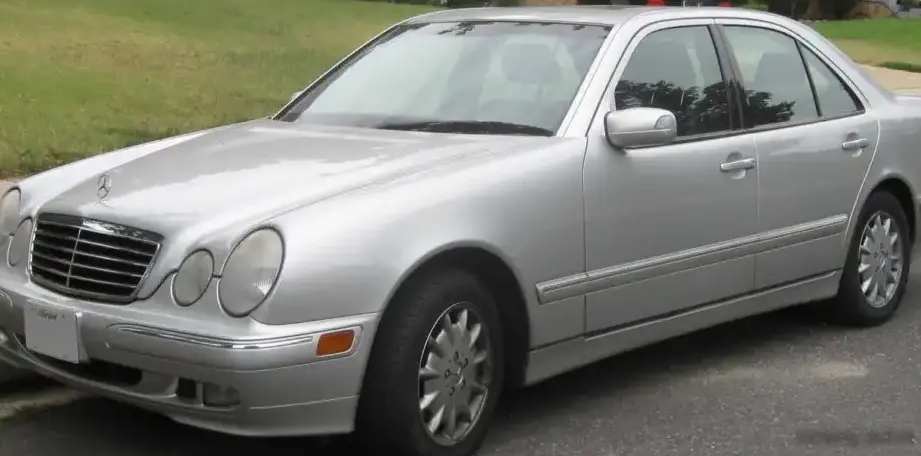
The Mercedes-Benz E 200, produced between July 1999 and June 2000, was a key variant within the W210 facelifted E-Class range. Positioned as an entry-level offering in many markets, particularly in Europe, it provided a balance of Mercedes-Benz luxury and reasonable running costs. This iteration of the E 200 utilized a 2.0-liter inline-four engine paired with a five-speed automatic transmission, catering to buyers prioritizing comfort and ease of driving over outright performance. The W210 facelift, introduced in 1999, addressed many criticisms of the pre-facelift models, improving build quality and refining the overall design.
Technical Specifications
| Brand | Mercedes-Benz |
| Model | E-class |
| Generation | E-class (W210, facelift 1999) |
| Type (Engine) | E 200 (136 Hp) Automatic |
| Start of production | July, 1999 |
| End of production | June, 2000 |
| Powertrain Architecture | Internal Combustion engine |
| Body type | Sedan |
| Seats | 5 |
| Doors | 4 |
| Fuel consumption (urban) | 13.5 l/100 km (17.4 US mpg, 20.9 UK mpg, 7.4 km/l) |
| Fuel consumption (extra urban) | 7.5 l/100 km (31.4 US mpg, 37.7 UK mpg, 13.3 km/l) |
| Fuel consumption (combined) | 9.6 l/100 km (24.5 US mpg, 29.4 UK mpg, 10.4 km/l) |
| Fuel Type | Petrol (Gasoline) |
| Acceleration 0 – 100 km/h | 12.3 sec |
| Acceleration 0 – 62 mph | 12.3 sec |
| Acceleration 0 – 60 mph | 11.7 sec |
| Maximum speed | 202 km/h (125.52 mph) |
| Weight-to-power ratio | 11.1 kg/Hp, 90.1 Hp/tonne |
| Weight-to-torque ratio | 7.9 kg/Nm, 125.8 Nm/tonne |
| Power | 136 Hp @ 5500 rpm |
| Power per litre | 68.1 Hp/l |
| Torque | 190 Nm @ 3700 rpm (140.14 lb.-ft. @ 3700 rpm) |
| Engine layout | Front, Longitudinal |
| Engine Model/Code | M 111 E 20 / 111.945 |
| Engine displacement | 1998 cm3 (121.93 cu. in.) |
| Number of cylinders | 4 |
| Engine configuration | Inline |
| Cylinder Bore | 89.9 mm (3.54 in.) |
| Piston Stroke | 78.7 mm (3.1 in.) |
| Compression ratio | 9.6:1 |
| Number of valves per cylinder | 4 |
| Fuel injection system | Multi-port manifold injection |
| Engine aspiration | Naturally aspirated engine |
| Valvetrain | DOHC |
| Engine oil capacity | 5.5 l (5.81 US qt | 4.84 UK qt) |
| Coolant | 8.5 l (8.98 US qt | 7.48 UK qt) |
| Kerb Weight | 1510 kg (3328.98 lbs.) |
| Max. weight | 2010 kg (4431.29 lbs.) |
| Max load | 500 kg (1102.31 lbs.) |
| Trunk (boot) space – minimum | 520 l (18.36 cu. ft.) |
| Fuel tank capacity | 65 l (17.17 US gal | 14.3 UK gal) |
| Length | 4818 mm (189.69 in.) |
| Width | 1799 mm (70.83 in.) |
| Height | 1440 mm (56.69 in.) |
| Wheelbase | 2833 mm (111.54 in.) |
| Front track | 1542 mm (60.71 in.) |
| Rear (Back) track | 1536 mm (60.47 in.) |
| Drag coefficient (Cd) | 0.27 |
| Drivetrain Architecture | The Internal combustion engine (ICE) drives the rear wheels of the vehicle. |
| Drive wheel | Rear wheel drive |
| Number of gears and type of gearbox | 5 gears, automatic transmission |
| Front suspension | Double wishbone |
| Rear suspension | Independent multi-link spring suspension with stabilizer |
| Front brakes | Ventilated discs |
| Rear brakes | Disc |
| Assisting systems | ABS (Anti-lock braking system) |
| Steering type | Steering rack and pinion |
| Power steering | Hydraulic Steering |
| Tires size | 205/65 R15 |
| Wheel rims size | 7J x 15 |
Powertrain & Engine Architecture
The E 200’s engine, designated the M 111 E 20 (internal code 111.945), was a 1998cc inline-four cylinder unit. This engine featured multi-port fuel injection and a double overhead camshaft (DOHC) valvetrain, contributing to its relatively smooth operation and respectable power output for its displacement. The compression ratio was set at 9.6:1. The five-speed automatic transmission, a common unit in Mercedes-Benz vehicles of the era, was designed for smooth shifts and comfortable cruising. While not a particularly advanced transmission by modern standards, it was known for its reliability. The engine’s longitudinal mounting and rear-wheel-drive configuration were typical for Mercedes-Benz sedans of this period, providing a balanced driving experience.
Driving Characteristics
The E 200 Automatic offered a comfortable and refined driving experience, prioritizing ease of use over sporty performance. With 136 horsepower and 190 Nm (140 lb-ft) of torque, acceleration was adequate for everyday driving, with a 0-60 mph time of around 11.7 seconds. The automatic transmission, while smooth, did contribute to some power loss compared to the available manual transmission. Gear ratios were tuned for fuel efficiency and relaxed cruising, rather than aggressive acceleration. Compared to the more powerful E 230 or E 280 models, the E 200 felt noticeably less responsive, but it offered a more economical option for buyers who didn’t require the extra performance.
Equipment & Trim Levels
The E 200 typically came equipped with a respectable level of standard features, including power windows, central locking, and air conditioning. Interior upholstery was usually cloth, although leather was available as an option. The dashboard layout was typical of the W210 facelift, featuring a wood trim and a straightforward instrument cluster. Optional extras included a sunroof, upgraded audio system, and automatic climate control. The E 200 was often seen as a stepping stone into the E-Class range, offering a taste of Mercedes-Benz luxury without the higher price tag of the more premium models.
Chassis & Braking
The W210 E-Class featured a double wishbone front suspension and an independent multi-link rear suspension, providing a comfortable ride and good handling characteristics. The E 200 typically came equipped with ventilated disc brakes at the front and solid discs at the rear. Anti-lock braking system (ABS) was standard, enhancing safety and stability during braking. The suspension was tuned for comfort, prioritizing a smooth ride over sporty handling. Stabilizer bars were fitted to both the front and rear axles to reduce body roll during cornering.
Market Reception & Comparison
The E 200 Automatic was generally well-received as a practical and comfortable entry-level E-Class variant. Critics praised its smooth ride and refined interior, but noted its relatively modest performance. Fuel economy was considered reasonable for a vehicle of its size and class, averaging around 24.5 US mpg in combined driving. Compared to the E 230 Kompressor, the E 200 offered lower running costs but lacked the extra power and responsiveness. Reliability was generally good, although like all vehicles of this era, regular maintenance was essential.
Legacy
The M 111 engine family, including the 111.945 found in the E 200, is known for its durability and relatively straightforward maintenance. While not without its potential issues (such as oil leaks and occasional sensor failures), the engine is generally considered reliable if properly maintained. Today, the W210 E 200 Automatic can be found on the used car market at relatively affordable prices. It represents a good value for buyers seeking a comfortable and reliable classic Mercedes-Benz, although potential buyers should be aware of the age-related maintenance requirements.