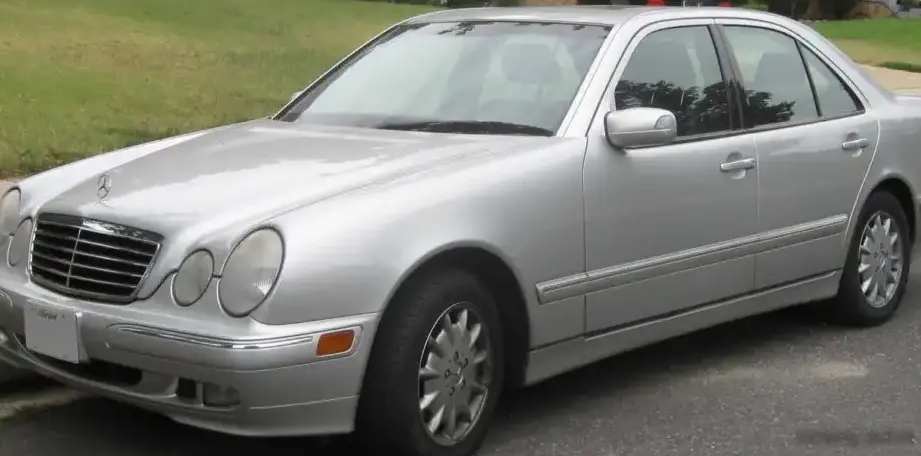
The Mercedes-Benz E 200 Kompressor, produced from February 2000 to March 2002, was a key variant within the W210 E-Class facelift range. Positioned as a mid-range offering, it aimed to bridge the gap between the entry-level E 180 and the more powerful E 230/E 280 models. This version of the E-Class, benefitting from the 1999 facelift, addressed many of the criticisms leveled at the pre-facelift W210, improving perceived quality and addressing electrical gremlins. The E 200 Kompressor’s appeal lay in its blend of reasonable performance, improved fuel economy thanks to the supercharger, and the prestige associated with the Mercedes-Benz brand. It was primarily marketed towards buyers seeking a comfortable and refined executive sedan.
Technical Specifications
| Brand | Mercedes-Benz |
| Model | E-class |
| Generation | E-class (W210, facelift 1999) |
| Type (Engine) | E 200 Kompressor (163 Hp) Automatic |
| Start of production | February, 2000 |
| End of production | March, 2002 |
| Powertrain Architecture | Internal Combustion engine |
| Body type | Sedan |
| Seats | 5 |
| Doors | 4 |
| Fuel consumption (urban) | 13.6 l/100 km (17.3 US mpg, 20.8 UK mpg) |
| Fuel consumption (extra urban) | 7.3 l/100 km (32.2 US mpg, 38.7 UK mpg) |
| Fuel consumption (combined) | 9.6 l/100 km (24.5 US mpg, 29.4 UK mpg) |
| Fuel Type | Petrol (Gasoline) |
| Acceleration 0 – 100 km/h | 10.2 sec |
| Acceleration 0 – 62 mph | 10.2 sec |
| Acceleration 0 – 60 mph | 9.7 sec |
| Maximum speed | 219 km/h (136.08 mph) |
| Weight-to-power ratio | 9.4 kg/Hp |
| Weight-to-torque ratio | 6.7 kg/Nm |
| Power | 163 Hp @ 5300 rpm |
| Power per litre | 81.6 Hp/l |
| Torque | 230 Nm @ 2500-4800 rpm (169.64 lb.-ft. @ 2500-4800 rpm) |
| Engine layout | Front, Longitudinal |
| Engine Model/Code | M 111 E 20 ML EVO / 111.957 |
| Engine displacement | 1998 cm3 (121.93 cu. in.) |
| Number of cylinders | 4 |
| Engine configuration | Inline |
| Cylinder Bore | 89.9 mm (3.54 in.) |
| Piston Stroke | 78.7 mm (3.1 in.) |
| Compression ratio | 9.5:1 |
| Number of valves per cylinder | 4 |
| Fuel injection system | Multi-port manifold injection |
| Engine aspiration | Supercharger, Intercooler |
| Valvetrain | DOHC |
| Engine oil capacity | 5.5 l (5.81 US qt | 4.84 UK qt) |
| Coolant | 8.5 l (8.98 US qt | 7.48 UK qt) |
| Kerb Weight | 1540 kg (3395.12 lbs.) |
| Max. weight | 2040 kg (4497.43 lbs.) |
| Max load | 500 kg (1102.31 lbs.) |
| Fuel tank capacity | 65 l (17.17 US gal | 14.3 UK gal) |
| Length | 4818 mm (189.69 in.) |
| Width | 1799 mm (70.83 in.) |
| Height | 1440 mm (56.69 in.) |
| Wheelbase | 2833 mm (111.54 in.) |
| Front track | 1542 mm (60.71 in.) |
| Rear track | 1536 mm (60.47 in.) |
| Drivetrain Architecture | Rear wheel drive |
| Drive wheel | Rear wheel drive |
| Number of gears | 5 gears, automatic transmission |
| Front suspension | Double wishbone |
| Rear suspension | Independent multi-link spring suspension with stabilizer |
| Front brakes | Ventilated discs |
| Rear brakes | Disc |
| Assisting systems | ABS (Anti-lock braking system) |
| Steering type | Steering rack and pinion |
| Power steering | Hydraulic Steering |
| Tires size | 205/65 R15 |
| Wheel rims size | 7J x 15 |
Powertrain & Engine Architecture
The heart of the E 200 Kompressor is the M111 E 20 ML EVO engine, a 1.998-liter inline-four cylinder powerplant. This engine is notable for its use of a Lysholm-type mechanical supercharger, a feature that significantly boosted low-end torque compared to naturally aspirated alternatives. The supercharger, coupled with an intercooler, provided increased air density for improved combustion. Fuel delivery was handled by a multi-port fuel injection system, ensuring precise fuel metering. The engine featured a double overhead camshaft (DOHC) valvetrain with four valves per cylinder, optimizing gas flow for enhanced performance. The engine code, 111.957, is crucial for identifying specific parts and service information. The five-speed automatic transmission (typically the 722.6) was chosen for its smooth operation and suitability for the car’s intended market. This transmission was known for its reliability, but could exhibit occasional issues with the torque converter or electronic control unit.
Driving Characteristics
The E 200 Kompressor offered a noticeably different driving experience compared to the naturally aspirated E 180. The supercharger provided a strong surge of torque from low RPMs, making it feel more responsive in everyday driving situations. While not a sports car, the E 200 Kompressor could accelerate from 0 to 60 mph in around 9.7 seconds, and reach a top speed of 136 mph. The automatic transmission, while smooth, wasn’t particularly sporty, and often held onto gears for longer than a manual transmission would. Compared to the E 230 or E 280, the E 200 Kompressor offered less outright power, but its fuel economy was superior. The gear ratios were optimized for comfortable cruising and reasonable acceleration, rather than outright performance.
Equipment & Trim Levels
The E 200 Kompressor typically came equipped with a respectable level of standard features. These included automatic climate control, power windows and mirrors, central locking, and an audio system. Interior upholstery was usually cloth, but leather was available as an option. Common optional extras included a sunroof, upgraded audio systems, and parking sensors. The dashboard layout was typical of the W210 facelift, featuring a wood trim and a clear instrument cluster. Trim levels were relatively standardized, with options packages adding features like heated seats and automatic dimming mirrors.
Chassis & Braking
The W210 E-Class featured a double wishbone front suspension and an independent multi-link rear suspension, providing a comfortable and controlled ride. The E 200 Kompressor, being a mid-range model, typically came with ventilated disc brakes at the front and solid discs at the rear. Anti-lock braking system (ABS) was standard. Stabilizer bars were fitted to both the front and rear axles to reduce body roll. The suspension was tuned for comfort, prioritizing ride quality over sharp handling. The steering was hydraulic power-assisted, providing a light and easy steering feel.
Market Reception & Comparison
The E 200 Kompressor was generally well-received by automotive critics. It was praised for its smooth engine, comfortable ride, and relatively good fuel economy. However, some critics noted that the automatic transmission could feel sluggish at times, and that the interior, while well-built, lacked the visual flair of some competitors. Compared to the E 180, the E 200 Kompressor offered a significant performance upgrade. Compared to the E 230, it offered similar fuel economy but less power. The E 200 Kompressor represented a good value proposition for buyers seeking a comfortable and refined executive sedan.
Legacy
The M111 engine, particularly the supercharged variants like the one found in the E 200 Kompressor, proved to be a reliable and durable powerplant. While not immune to age-related issues, these engines are generally known for their longevity. The automatic transmission, if properly maintained, can also provide years of reliable service. Today, the W210 E 200 Kompressor is a relatively affordable used car, offering a comfortable and reliable driving experience. However, potential buyers should be aware of potential issues such as corrosion, electrical problems, and wear and tear on suspension components. The E 200 Kompressor represents a solid example of Mercedes-Benz engineering from the late 1990s and early 2000s.