Technical Specifications
| Brand | Mercedes-Benz |
| Model | E-class |
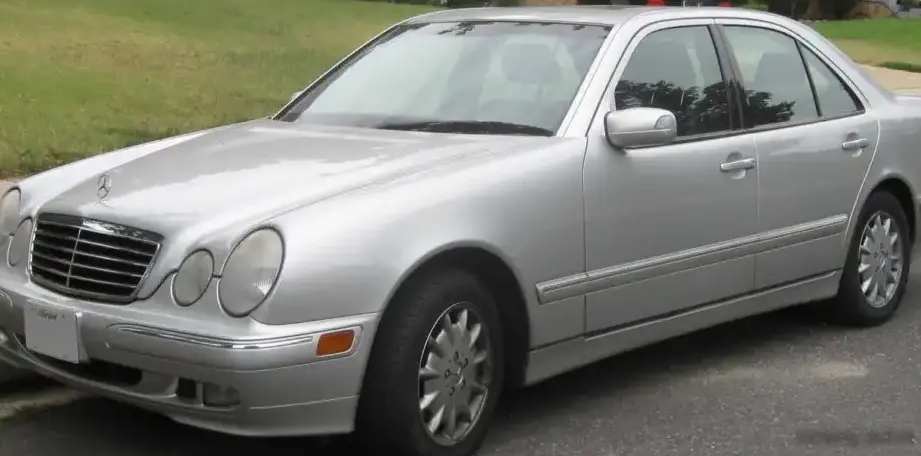
| Generation | E-class (W210, facelift 1999) |
| Type (Engine) | E 240 2.6 V6 (170 Hp) |
| Start of production | November, 1999 |
| End of production | February, 2002 |
| Powertrain Architecture | Internal Combustion engine |
| Body type | Sedan |
| Seats | 5 |
| Doors | 4 |
| Fuel consumption (urban) | 15.9 l/100 km (14.8 US mpg, 17.8 UK mpg, 6.3 km/l) |
| Fuel consumption (extra urban) | 7.9 l/100 km (29.8 US mpg, 35.8 UK mpg, 12.7 km/l) |
| Fuel consumption (combined) | 10.8 l/100 km (21.8 US mpg, 26.2 UK mpg, 9.3 km/l) |
| Fuel Type | Petrol (Gasoline) |
| Acceleration 0 – 100 km/h | 9.3 sec |
| Acceleration 0 – 62 mph | 9.3 sec |
| Acceleration 0 – 60 mph | 8.8 sec |
| Maximum speed | 229 km/h (142.29 mph) |
| Weight-to-power ratio | 9.4 kg/Hp, 106.9 Hp/tonne |
| Weight-to-torque ratio | 6.6 kg/Nm, 150.9 Nm/tonne |
| Power | 170 Hp @ 5700 rpm |
| Power per litre | 65.5 Hp/l |
| Torque | 240 Nm @ 4500 rpm (177.01 lb.-ft. @ 4500 rpm) |
| Engine layout | Front, Longitudinal |
| Engine Model/Code | M 112 E 26 / 112.914 |
| Engine displacement | 2597 cm3 (158.48 cu. in.) |
| Number of cylinders | 6 |
| Engine configuration | V-engine |
| Cylinder Bore | 89.9 mm (3.54 in.) |
| Piston Stroke | 68.2 mm (2.69 in.) |
| Compression ratio | 10.5:1 |
| Number of valves per cylinder | 3 |
| Fuel injection system | Multi-port manifold injection |
| Engine aspiration | Naturally aspirated engine |
| Valvetrain | SOHC |
| Engine oil capacity | 8 l (8.45 US qt | 7.04 UK qt) |
| Coolant | 10 l (10.57 US qt | 8.8 UK qt) |
| Kerb Weight | 1590 kg (3505.35 lbs.) |
| Max. weight | 2090 kg (4607.66 lbs.) |
| Max load | 500 kg (1102.31 lbs.) |
| Trunk (boot) space – minimum | 520 l (18.36 cu. ft.) |
| Fuel tank capacity | 65 l (17.17 US gal | 14.3 UK gal) |
| Length | 4818 mm (189.69 in.) |
| Width | 1799 mm (70.83 in.) |
| Height | 1440 mm (56.69 in.) |
| Wheelbase | 2833 mm (111.54 in.) |
| Front track | 1542 mm (60.71 in.) |
| Rear (Back) track | 1536 mm (60.47 in.) |
| Drag coefficient (Cd) | 0.28 |
| Drivetrain Architecture | The Internal combustion engine (ICE) drives the rear wheels of the vehicle. |
| Drive wheel | Rear wheel drive |
| Number of gears and type of gearbox | 6 gears, manual transmission |
| Front suspension | Double wishbone |
| Rear suspension | Independent multi-link spring suspension with stabilizer |
| Front brakes | Ventilated discs |
| Rear brakes | Disc |
| Assisting systems | ABS (Anti-lock braking system) |
| Steering type | Steering rack and pinion |
| Power steering | Hydraulic Steering |
| Tires size | 205/65 R15 |
| Wheel rims size | 7J x 15 |
The W210 Mercedes-Benz E-Class, launched in 1995, represented a significant departure from its predecessor, the W124. The facelifted version, introduced in 1999, addressed many of the initial criticisms regarding build quality and styling. The E 240 2.6 V6, introduced with the facelift, was a key model in the range, offering a compelling blend of performance and refinement. Powered by the M112 engine, a modern all-aluminum V6, it provided a smoother and more efficient driving experience than the older inline-six engines. This model aimed to appeal to buyers who desired the prestige of a Mercedes-Benz E-Class but didn’t require the higher price point or performance of the E 320.
Powertrain & Engine Architecture
The heart of the E 240 is the M112 E 26 engine, a 2.6-liter (2597 cc) naturally aspirated V6. This engine, designated with the code 112.914, features a 60-degree V-angle and utilizes a single overhead camshaft (SOHC) design per cylinder bank. The M112 was a groundbreaking engine for Mercedes-Benz, being one of the first mass-produced all-aluminum V6 engines. It employs multi-port fuel injection and a compression ratio of 10.5:1. The engine produces 170 horsepower at 5700 rpm and 240 Nm (177 lb-ft) of torque at 4500 rpm. The E 240 was typically paired with a 5-speed automatic transmission, although a 6-speed manual transmission was also available, though less common. The automatic transmission was designed for smooth shifts and comfortable cruising, prioritizing refinement over outright performance.
Driving Characteristics
The E 240 2.6 V6 offered a comfortable and refined driving experience. While not a sports sedan, the engine provided adequate power for everyday driving and highway cruising. Acceleration from 0 to 60 mph took approximately 8.8 seconds, and the car had a top speed of 142 mph. The automatic transmission, while smooth, could feel somewhat sluggish during quick acceleration. Compared to the more powerful E 320, the E 240 felt less responsive, but it offered better fuel economy. The suspension, tuned for comfort, absorbed bumps and imperfections in the road well, providing a smooth ride. The rear-wheel-drive configuration provided balanced handling, although it wasn’t particularly sporty.
Equipment & Trim Levels
The E 240 came standard with a respectable level of equipment, including automatic climate control, power windows and locks, a multi-function steering wheel, and an audio system. Upholstery was typically cloth, but leather was available as an option. Optional extras included a sunroof, heated seats, a navigation system, and upgraded audio systems. The interior design was typical of Mercedes-Benz at the time, emphasizing quality materials and a luxurious feel. Trim levels were relatively simple, with options packages adding features rather than distinct model designations.
Chassis & Braking
The W210 E-Class featured a robust chassis with a double wishbone front suspension and an independent multi-link rear suspension. This setup provided a comfortable ride and good handling characteristics. The E 240 was equipped with ventilated disc brakes at the front and solid disc brakes at the rear. Anti-lock braking system (ABS) was standard. The steering was a hydraulic power-assisted rack and pinion system, providing precise and responsive steering feel. The standard tire size was 205/65 R15, mounted on 7J x 15 alloy wheels.
Market Reception & Comparison
The E 240 2.6 V6 was generally well-received by automotive critics. It was praised for its smooth engine, comfortable ride, and refined interior. However, some critics noted that the performance was not as exhilarating as some of its competitors. Compared to the E 320, the E 240 offered a more affordable entry point into the E-Class range, but at the expense of some performance. The E 300 TDI, a diesel-powered variant, offered superior fuel economy but lacked the refinement of the E 240. The E 240 struck a balance between these two extremes, appealing to buyers who prioritized comfort and refinement over outright performance or fuel economy.
Legacy
The M112 engine proved to be a reliable and durable powerplant. The E 240 2.6 V6, while not the most sought-after variant of the W210 E-Class, remains a popular choice in the used car market due to its affordability and reliability. Regular maintenance, including oil changes and coolant flushes, is crucial for ensuring the longevity of the engine and transmission. Common issues include problems with the electronic ignition system and occasional leaks from the engine’s valley pan gasket. Despite these potential issues, the E 240 2.6 V6 remains a well-regarded and capable luxury sedan, offering a taste of Mercedes-Benz prestige at a reasonable price.