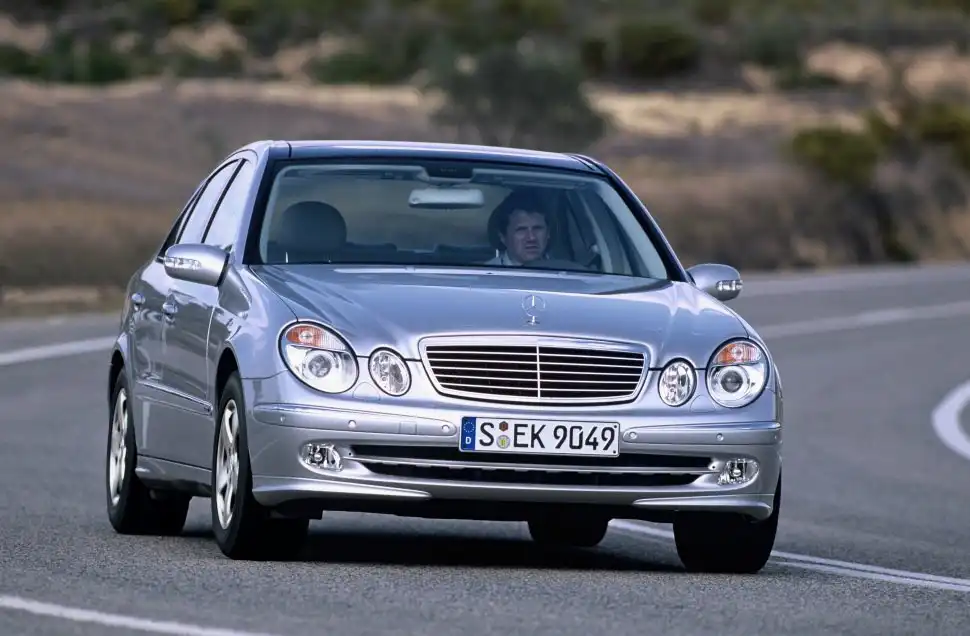
The Mercedes-Benz E 200 Kompressor, produced between 2002 and 2006 as part of the W211 E-Class generation, represented an entry point into the mid-size luxury sedan market for Mercedes-Benz. Positioned below the E 240 and E 320 models, the E 200 Kompressor aimed to offer a balance of affordability, fuel efficiency, and the renowned Mercedes-Benz driving experience. This variant was primarily sold in European markets, where smaller displacement engines were favored due to tax regulations and fuel costs. It served as a popular choice for buyers seeking a comfortable and well-equipped sedan without the higher price tag of its more powerful siblings.
Technical Specifications
| Brand | Mercedes-Benz |
| Model | E-class |
| Generation | E-class (W211) |
| Type (Engine) | E 200 Kompressor (163 Hp) |
| Start of production | 2002 year |
| End of production | 2006 year |
| Powertrain Architecture | Internal Combustion engine |
| Body type | Sedan |
| Seats | 5 |
| Doors | 4 |
| Fuel consumption (economy) – urban | 11.6 l/100 km (20.3 US mpg, 24.4 UK mpg, 8.6 km/l) |
| Fuel consumption (economy) – extra urban | 6.1 l/100 km (38.6 US mpg, 46.3 UK mpg, 16.4 km/l) |
| Fuel consumption (economy) – combined | 8.4 l/100 km (28 US mpg, 33.6 UK mpg, 11.9 km/l) |
| Fuel Type | Petrol (Gasoline) |
| Acceleration 0 – 100 km/h | 9.6 sec |
| Acceleration 0 – 62 mph | 9.6 sec |
| Acceleration 0 – 60 mph | 9.1 sec |
| Maximum speed | 230 km/h (142.92 mph) |
| Weight-to-power ratio | 9.6 kg/Hp, 103.8 Hp/tonne |
| Weight-to-torque ratio | 6.5 kg/Nm, 152.9 Nm/tonne |
| Power | 163 Hp @ 5500 rpm |
| Power per litre | 90.8 Hp/l |
| Torque | 240 Nm @ 3000 rpm (177.01 lb.-ft. @ 3000 rpm) |
| Engine layout | Front, Longitudinal |
| Engine Model/Code | M 271.941 |
| Engine displacement | 1796 cm3 (109.6 cu. in.) |
| Number of cylinders | 4 |
| Engine configuration | Inline |
| Cylinder Bore | 82 mm (3.23 in.) |
| Piston Stroke | 85 mm (3.35 in.) |
| Compression ratio | 9.5:1 |
| Number of valves per cylinder | 4 |
| Fuel injection system | Multi-port manifold injection |
| Engine aspiration | Supercharger, Intercooler |
| Engine oil capacity | 5.5 l (5.81 US qt | 4.84 UK qt) |
| Coolant | 9.2 l (9.72 US qt | 8.09 UK qt) |
| Kerb Weight | 1570 kg (3461.26 lbs.) |
| Max. weight | 2105 kg (4640.73 lbs.) |
| Max load | 535 kg (1179.47 lbs.) |
| Trunk (boot) space – minimum | 540 l (19.07 cu. ft.) |
| Fuel tank capacity | 65 l (17.17 US gal | 14.3 UK gal) |
| Permitted trailer load with brakes (12%) | 1900 kg (4188.78 lbs.) |
| Permitted trailer load without brakes | 750 kg (1653.47 lbs.) |
| Length | 4818 mm (189.69 in.) |
| Width | 1822 mm (71.73 in.) |
| Height | 1452 mm (57.17 in.) |
| Wheelbase | 2854 mm (112.36 in.) |
| Front track | 1577 mm (62.09 in.) |
| Rear (Back) track | 1570 mm (61.81 in.) |
| Drag coefficient (Cd) | 0.27 |
| Minimum turning circle (turning diameter) | 11.4 m (37.4 ft.) |
| Drivetrain Architecture | The Internal combustion engine (ICE) drives the rear wheels of the vehicle. |
| Drive wheel | Rear wheel drive |
| Number of gears and type of gearbox | 6 gears, manual transmission |
| Front suspension | Independent multi-link suspension |
| Rear suspension | Independent multi-link spring suspension with stabilizer |
| Front brakes | Ventilated discs |
| Rear brakes | Disc |
| Assisting systems | ABS (Anti-lock braking system) |
| Steering type | Steering rack and pinion |
| Power steering | Hydraulic Steering |
| Tires size | 205/60 R16 |
| Wheel rims size | 16 |
INTRODUCTION
The W211 Mercedes-Benz E-Class, launched in 2002, represented a significant leap forward in technology and design for the brand. The E 200 Kompressor, introduced within this generation, was powered by the M271 engine, a 1.8-liter inline-four cylinder engine featuring a mechanically driven supercharger. This configuration allowed for increased torque at lower engine speeds, providing a more responsive driving experience than a naturally aspirated engine of similar displacement. The E 200 Kompressor was primarily aimed at the European market, where it offered a compelling combination of luxury, efficiency, and performance within the E-Class range.
Powertrain & Engine Architecture
At the heart of the E 200 Kompressor lies the M271.941 engine, a 1796cc (1.8L) inline-four cylinder powerplant. This engine is notable for its all-aluminum construction, contributing to a lighter overall weight. The “Kompressor” designation refers to the engine’s use of a Lysholm-type mechanically driven supercharger. Unlike turbochargers, which rely on exhaust gases, the supercharger is directly driven by the engine’s crankshaft via a belt, providing instant boost and eliminating turbo lag. An intercooler is integrated into the intake manifold to cool the compressed air, further enhancing performance. Fuel delivery is managed by a multi-port fuel injection system. The engine features four valves per cylinder and a compression ratio of 9.5:1. The E 200 Kompressor was typically paired with a 6-speed manual transmission, although a 5-speed automatic transmission was also available, and was a popular choice for buyers prioritizing comfort and ease of use.
Driving Characteristics
The E 200 Kompressor, with its 163 horsepower and 240 Nm (177 lb-ft) of torque, offered respectable performance for its class. Acceleration from 0 to 60 mph took approximately 9.1 seconds, and it could achieve a top speed of 230 km/h (143 mph). The supercharger provided a noticeable boost in low-end torque, making it feel more responsive in everyday driving situations compared to naturally aspirated alternatives. However, compared to the more powerful E 240 or E 320 models, the E 200 Kompressor lacked the outright acceleration and passing power of those variants. The automatic transmission, while smooth, could sometimes feel hesitant during quick downshifts. The overall driving experience was characterized by Mercedes-Benz’s signature comfort and refinement, with a well-damped ride and a quiet cabin.
Equipment & Trim Levels
The E 200 Kompressor typically came equipped with a generous array of standard features, reflecting Mercedes-Benz’s commitment to luxury. These included automatic climate control, power windows and mirrors, a multi-function steering wheel, and a high-quality audio system. Upholstery was typically cloth, although leather options were available. Optional extras included a sunroof, navigation system, premium sound system, and parking sensors. Trim levels varied depending on the market, but generally offered increasing levels of luxury and technology. The E 200 Kompressor was often seen as a well-equipped base model, providing a comfortable and refined experience without the expense of the higher-end trims.
Chassis & Braking
The W211 E-Class featured an independent multi-link suspension system at both the front and rear, providing a comfortable ride and good handling characteristics. The E 200 Kompressor, being the lighter variant, benefited from slightly more agile handling compared to its heavier siblings. The braking system consisted of ventilated discs at the front and solid discs at the rear, equipped with ABS (Anti-lock Braking System) as standard. The steering was a hydraulic power-assisted rack and pinion system, offering precise and responsive control. Standard tire size was 205/60 R16, mounted on 16-inch alloy wheels.
Market Reception & Comparison
The E 200 Kompressor was generally well-received by automotive critics, who praised its fuel efficiency, comfortable ride, and the responsive nature of the supercharged engine. However, some reviewers noted that it lacked the performance of the larger-engined models. Compared to the E 240, the E 200 Kompressor offered better fuel economy but less power. The E 200 Kompressor was also often compared to competing models from BMW and Audi, and generally held its own in terms of comfort and refinement. Its lower price point made it an attractive option for buyers seeking a luxury sedan without breaking the bank.
Legacy
The M271 engine, as used in the E 200 Kompressor, proved to be a relatively reliable powerplant, although some owners have reported issues with the supercharger clutch and the balance shaft. Regular maintenance, including oil changes and timing chain inspections, is crucial for long-term reliability. Today, the W211 E 200 Kompressor can be found on the used car market at affordable prices. It remains a popular choice for buyers seeking a comfortable, well-equipped, and relatively fuel-efficient luxury sedan. Its reputation for reliability and the availability of spare parts contribute to its continued appeal.