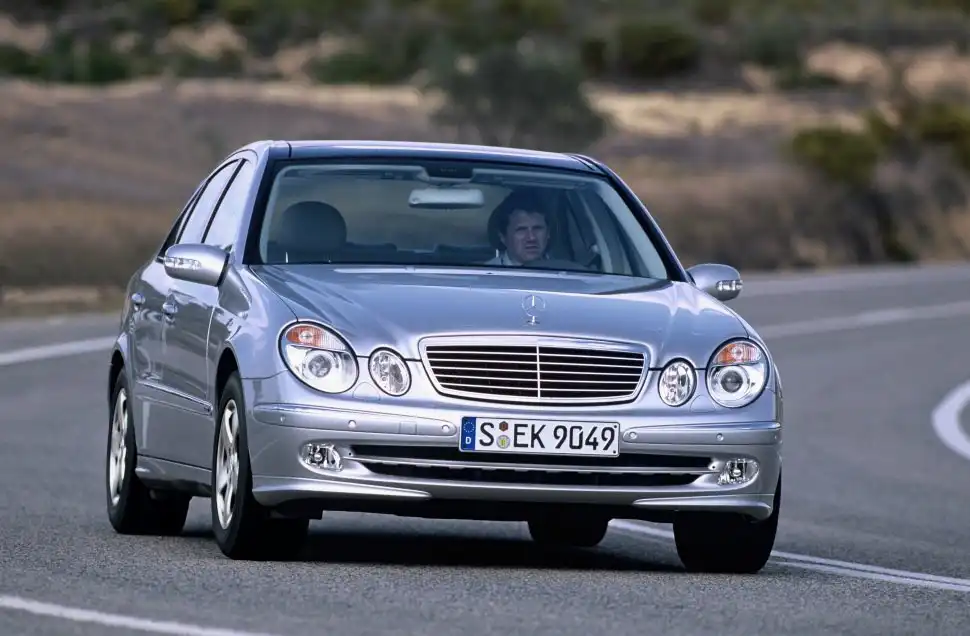
The Mercedes-Benz E 270 CDI, produced between 2003 and 2005, was a key variant within the W211 E-Class range. Positioned as a mid-range offering, it combined a potent diesel engine with a smooth-shifting automatic transmission, appealing to buyers seeking a balance of performance, economy, and comfort. This model represented Mercedes-Benz’s continued commitment to diesel technology in the European market, offering a sophisticated alternative to gasoline-powered vehicles. The W211 generation, launched in 2002, aimed to modernize the E-Class, incorporating advanced technology and a more contemporary design while maintaining the brand’s reputation for luxury and engineering excellence.
Technical Specifications
| Brand | Mercedes-Benz |
| Model | E-class |
| Generation | E-class (W211) |
| Type (Engine) | E 270 CDI (177 Hp) 5G-TRONIC |
| Start of production | 2003 |
| End of production | 2005 |
| Powertrain Architecture | Internal Combustion engine |
| Body type | Sedan |
| Seats | 5 |
| Doors | 4 |
| Fuel consumption (urban) | 10.1 l/100 km (23.3 US mpg) |
| Fuel consumption (extra urban) | 5.4 l/100 km (43.6 US mpg) |
| Fuel consumption (combined) | 7.1 l/100 km (33.1 US mpg) |
| Fuel Type | Diesel |
| Acceleration 0 – 100 km/h | 9.3 sec |
| Acceleration 0 – 62 mph | 9.3 sec |
| Acceleration 0 – 60 mph | 8.8 sec |
| Maximum speed | 232 km/h (144.16 mph) |
| Weight-to-power ratio | 9.6 kg/Hp |
| Weight-to-torque ratio | 4.2 kg/Nm |
| Power | 177 Hp @ 4200 rpm |
| Torque | 400 Nm @ 1800 rpm (295.02 lb.-ft. @ 1800 rpm) |
| Engine layout | Front, Longitudinal |
| Engine Model/Code | OM 647.961 |
| Engine displacement | 2685 cm3 (163.85 cu. in.) |
| Number of cylinders | 5 |
| Engine configuration | Inline |
| Cylinder Bore | 88 mm (3.46 in.) |
| Piston Stroke | 88.3 mm (3.48 in.) |
| Compression ratio | 18:1 |
| Number of valves per cylinder | 4 |
| Fuel injection system | Diesel Commonrail |
| Engine aspiration | Turbocharger, Intercooler |
| Engine oil capacity | 6.5 l (6.87 US qt | 5.72 UK qt) |
| Coolant | 11.7 l (12.36 US qt | 10.29 UK qt) |
| Kerb Weight | 1695 kg (3736.84 lbs.) |
| Max. weight | 2200 kg (4850.17 lbs.) |
| Max load | 505 kg (1113.33 lbs.) |
| Trunk (boot) space – minimum | 540 l (19.07 cu. ft.) |
| Fuel tank capacity | 65 l (17.17 US gal | 14.3 UK gal) |
| Permitted trailer load with brakes (12%) | 1900 kg (4188.78 lbs.) |
| Permitted trailer load without brakes | 750 kg (1653.47 lbs.) |
| Length | 4818 mm (189.69 in.) |
| Width | 1822 mm (71.73 in.) |
| Height | 1452 mm (57.17 in.) |
| Wheelbase | 2854 mm (112.36 in.) |
| Front track | 1577 mm (62.09 in.) |
| Rear (Back) track | 1570 mm (61.81 in.) |
| Drag coefficient (Cd) | 0.27 |
| Minimum turning circle (turning diameter) | 11.4 m (37.4 ft.) |
| Drivetrain Architecture | Rear wheel drive |
| Number of gears and type of gearbox | 5 gears, automatic transmission |
| Front suspension | Double wishbone |
| Rear suspension | Independent multi-link spring suspension with stabilizer |
| Front brakes | Ventilated discs |
| Rear brakes | Disc |
| Assisting systems | ABS (Anti-lock braking system) |
| Steering type | Steering rack and pinion |
| Power steering | Hydraulic Steering |
| Tires size | 225/55 R16 |
| Wheel rims size | 16 |
Powertrain & Engine Architecture
The heart of the E 270 CDI is the OM 647.961, a 2.7-liter inline-five cylinder diesel engine. This engine was a significant development for Mercedes-Benz, representing a move towards more refined and powerful diesel powertrains. It featured a common rail direct injection system, delivering fuel at extremely high pressure for improved combustion efficiency and reduced emissions. A variable geometry turbocharger with an intercooler further enhanced performance, providing increased power and torque across a wider rev range. The engine produced 177 horsepower at 4200 rpm and a substantial 400 Nm (295 lb-ft) of torque at just 1800 rpm. This torque output was a key characteristic, providing strong acceleration and effortless cruising. The engine was paired with Mercedes-Benz’s 5G-TRONIC automatic transmission, a five-speed unit known for its smooth and responsive shifts. This transmission was electronically controlled, adapting to driving conditions and driver input for optimal performance.
Driving Characteristics
The E 270 CDI Automatic offered a refined and comfortable driving experience. The abundance of low-end torque from the diesel engine meant that strong acceleration was readily available, making overtaking and merging onto highways easy. While not a sports car, the E 270 CDI could achieve 0-60 mph in around 8.8 seconds and reach a top speed of 144 mph. The 5G-TRONIC transmission contributed to the smooth driving experience, providing seamless gear changes. Compared to the manual transmission versions, the automatic offered greater convenience, particularly in urban traffic. However, it did slightly diminish the sense of driver engagement. Compared to higher-output E-Class models, such as the E 320 CDI or the gasoline-powered E 320, the E 270 CDI offered a more economical option without sacrificing a significant amount of performance.
Equipment & Trim Levels
The E 270 CDI typically came well-equipped, reflecting Mercedes-Benz’s commitment to luxury. Standard features included automatic climate control, power windows and mirrors, a multi-function steering wheel, and a high-quality audio system. Upholstery was typically a premium cloth or leatherette, with leather being an optional upgrade. Optional extras included a sunroof, navigation system, heated seats, and upgraded audio systems. The interior design was characterized by its elegant and understated style, with high-quality materials and meticulous attention to detail. The dashboard layout was functional and ergonomic, providing easy access to all controls.
Chassis & Braking
The W211 E-Class featured a sophisticated chassis design, prioritizing ride comfort and handling balance. The E 270 CDI utilized a double wishbone front suspension and an independent multi-link rear suspension, providing a smooth and controlled ride. Stabilizer bars were fitted to both axles to reduce body roll during cornering. The braking system consisted of ventilated discs at the front and solid discs at the rear, providing ample stopping power. Anti-lock braking system (ABS) was standard, enhancing safety and stability. The steering was a rack and pinion system with hydraulic power assistance, offering precise and responsive steering feel.
Market Reception & Comparison
The E 270 CDI was generally well-received by automotive critics. It was praised for its refined engine, comfortable ride, and luxurious interior. Fuel economy was a major selling point, with the diesel engine offering significantly better mileage than comparable gasoline engines. However, some critics noted that the engine could be somewhat noisy compared to gasoline alternatives. In terms of reliability, the OM 647 engine proved to be generally robust, although some issues with the fuel injectors and turbocharger were reported. Compared to other trims in the E-Class lineup, the E 270 CDI offered a compelling value proposition, providing a good balance of performance, economy, and luxury.
Legacy
The Mercedes-Benz E 270 CDI has become a popular choice in the used car market, particularly for buyers seeking a reliable and economical luxury sedan. The OM 647 engine, while requiring regular maintenance, is known for its longevity. However, potential buyers should be aware of the potential for issues with the fuel injectors and turbocharger. Today, the E 270 CDI represents a well-engineered and stylish vehicle that offers a comfortable and refined driving experience. Its combination of diesel efficiency and Mercedes-Benz luxury continues to appeal to a wide range of buyers.