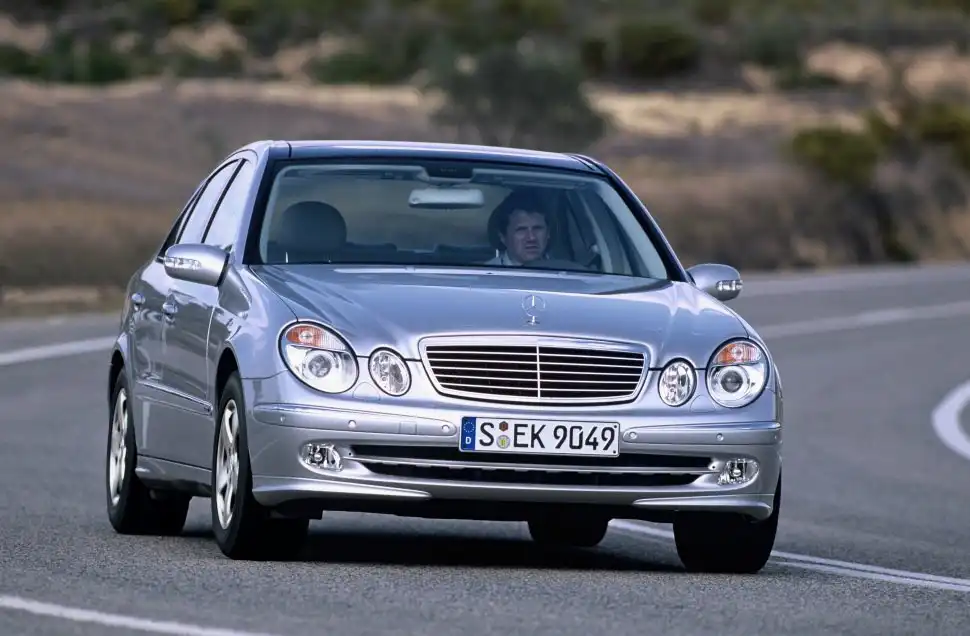
The Mercedes-Benz E 320 CDI, produced between September 2002 and April 2005, was a key variant within the W211 E-Class range. Positioned as a mid-to-upper trim level, it offered a compelling blend of performance and fuel efficiency thanks to its advanced common-rail diesel engine. This model represented Mercedes-Benz’s commitment to diesel technology, offering a sophisticated alternative to gasoline-powered E-Class models. The W211 generation, launched in 2002, aimed to modernize the E-Class, incorporating more advanced technology and a more contemporary design while maintaining the brand’s reputation for luxury and engineering excellence.
Technical Specifications
| Brand | Mercedes-Benz |
| Model | E-class |
| Generation | E-class (W211) |
| Type (Engine) | E 320 CDI (204 Hp) 5G-TRONIC |
| Start of production | September, 2002 |
| End of production | April, 2005 |
| Powertrain Architecture | Internal Combustion engine |
| Body type | Sedan |
| Seats | 5 |
| Doors | 4 |
| Fuel consumption (economy) – urban (NEDC) | 9.4 l/100 km (25 US mpg, 30.1 UK mpg, 10.6 km/l) |
| Fuel consumption (economy) – extra urban (NEDC) | 5.4 l/100 km (43.6 US mpg, 52.3 UK mpg, 18.5 km/l) |
| Fuel consumption (economy) – combined (NEDC) | 6.9 l/100 km (34.1 US mpg, 40.9 UK mpg, 14.5 km/l) |
| CO2 emissions (NEDC) | 183 g/km |
| Fuel Type | Diesel |
| Acceleration 0 – 100 km/h | 7.7 sec |
| Acceleration 0 – 62 mph | 7.7 sec |
| Acceleration 0 – 60 mph | 7.3 sec |
| Maximum speed | 243 km/h (150.99 mph) |
| Emission standard | Euro 3 |
| Weight-to-power ratio | 8.1 kg/Hp, 122.9 Hp/tonne |
| Weight-to-torque ratio | 3.3 kg/Nm, 301.2 Nm/tonne |
| Power | 204 Hp @ 4200 rpm |
| Power per litre | 63.3 Hp/l |
| Torque | 500 Nm @ 1800-2600 rpm (368.78 lb.-ft. @ 1800-2600 rpm) |
| Maximum engine speed | 4600 rpm |
| Engine layout | Front, Longitudinal |
| Engine Model/Code | OM 648.961 |
| Engine displacement | 3222 cm3 (196.62 cu. in.) |
| Number of cylinders | 6 |
| Engine configuration | Inline |
| Cylinder Bore | 88 mm (3.46 in.) |
| Piston Stroke | 88.3 mm (3.48 in.) |
| Compression ratio | 18:1 |
| Number of valves per cylinder | 4 |
| Fuel injection system | Diesel Commonrail |
| Engine aspiration | Turbocharger, Intercooler |
| Valvetrain | DOHC |
| Engine oil capacity | 7.5 l (7.93 US qt | 6.6 UK qt) |
| Coolant | 12.6 l (13.31 US qt | 11.09 UK qt) |
| Kerb Weight | 1660 kg (3659.67 lbs.) |
| Max. weight | 2260 kg (4982.45 lbs.) |
| Max load | 600 kg (1322.77 lbs.) |
| Trunk (boot) space – minimum | 540 l (19.07 cu. ft.) |
| Fuel tank capacity | 80 l (21.13 US gal | 17.6 UK gal) |
| Max. roof load | 100 kg (220.46 lbs.) |
| Permitted trailer load with brakes (12%) | 1900 kg (4188.78 lbs.) |
| Permitted trailer load without brakes | 750 kg (1653.47 lbs.) |
| Length | 4818 mm (189.69 in.) |
| Width | 1822 mm (71.73 in.) |
| Width including mirrors | 1990 mm (78.35 in.) |
| Height | 1452 mm (57.17 in.) |
| Wheelbase | 2854 mm (112.36 in.) |
| Front track | 1559 mm (61.38 in.) |
| Rear (Back) track | 1552 mm (61.1 in.) |
| Front overhang | 831 mm (32.72 in.) |
| Rear overhang | 1133 mm (44.61 in.) |
| Ride height (ground clearance) | 145 mm (5.71 in.) |
| Drag coefficient (Cd) | 0.27 |
| Minimum turning circle (turning diameter) | 11.4 m (37.4 ft.) |
| Approach angle | 16.7° |
| Departure angle | 17° |
| Ramp-over (brakeover) angle | 12.5° |
| Drivetrain Architecture | The Internal combustion engine (ICE) drives the rear wheels of the vehicle. |
| Drive wheel | Rear wheel drive |
| Number of gears and type of gearbox | 5 gears, automatic transmission G-TRONIC |
| Front suspension | Double wishbone, Transverse stabilizer |
| Rear suspension | Independent multi-link suspension, Transverse stabilizer |
| Front brakes | Ventilated discs, 312×28 mm |
| Rear brakes | Disc, 300×10 mm |
| Assisting systems | ABS (Anti-lock braking system) |
| Steering type | Steering rack and pinion |
| Power steering | Hydraulic Steering |
| Tires size | 225/55 R16; 245/45 R17 |
| Wheel rims size | 7.5J x 16; 8J x 17 |
INTRODUCTION
The Mercedes-Benz E 320 CDI, part of the W211 E-Class series produced from 2002 to 2005, represented a significant step forward in diesel engine technology. It was designed to appeal to drivers seeking a balance between luxury, performance, and fuel economy. The W211 platform itself was a substantial update over the preceding W208, featuring a redesigned interior, improved safety features, and a more refined driving experience. The E 320 CDI specifically utilized a 3.2-liter inline-six cylinder diesel engine, paired exclusively with Mercedes’ 5G-TRONIC automatic transmission. This combination aimed to deliver strong torque and smooth shifting, making it a comfortable and capable grand tourer.
Powertrain & Engine Architecture
At the heart of the E 320 CDI lies the OM 648.961 engine, a 3.2-liter inline-six cylinder diesel. This engine was a showcase of Mercedes-Benz’s diesel expertise, featuring common-rail direct injection, a turbocharger with an intercooler, and a double overhead camshaft (DOHC) valvetrain with four valves per cylinder. The common-rail system, operating at extremely high pressures, allowed for precise fuel metering and optimized combustion, resulting in improved power and reduced emissions. The turbocharger boosted power output, while the intercooler cooled the intake air, further enhancing performance. The engine produced 204 horsepower at 4200 rpm and a substantial 500 Nm (368.78 lb-ft) of torque between 1800 and 2600 rpm. The 5G-TRONIC automatic transmission, a five-speed unit, was specifically tuned to complement the engine’s torque characteristics, providing smooth and responsive gear changes. It featured a torque converter lock-up clutch to improve fuel efficiency at cruising speeds.
Driving Characteristics
The E 320 CDI offered a distinctly different driving experience compared to its gasoline-powered siblings. While not as overtly sporty as the E 320 or E 500 models, the CDI provided ample power for effortless cruising and confident overtaking. The high torque output meant strong acceleration from low engine speeds, making it particularly well-suited for highway driving. The 5G-TRONIC transmission contributed to a relaxed driving experience, with smooth shifts and a willingness to downshift when needed. Compared to the manual transmission options available on other E-Class models, the automatic prioritized comfort and ease of use. The gear ratios were optimized for fuel efficiency and relaxed cruising, rather than outright performance. While the 0-60 mph time of around 7.3 seconds was respectable, the E 320 CDI’s strength lay in its mid-range acceleration and overall refinement.
Equipment & Trim Levels
The E 320 CDI typically came well-equipped, reflecting its position as a mid-to-upper trim level. Standard features included leather upholstery, automatic climate control, power-adjustable front seats with memory function, a premium audio system, and a sunroof. Safety features were also comprehensive, including ABS, traction control, and multiple airbags. Optional extras included navigation system, upgraded audio systems, parking sensors, and various interior trim options. The interior design was characterized by Mercedes-Benz’s signature blend of luxury and functionality, with high-quality materials and a user-friendly layout. Dashboard configuration was generally consistent across the W211 range, with a focus on ergonomics and ease of use.
Chassis & Braking
The W211 E-Class featured a robust chassis designed for both comfort and handling. The E 320 CDI utilized a double wishbone front suspension and an independent multi-link rear suspension, both with transverse stabilizers. This setup provided a comfortable ride while maintaining good control and stability. Braking duties were handled by ventilated discs at the front and solid discs at the rear, with ABS providing enhanced stopping power and control. The E 320 CDI’s weight, approximately 1660 kg (3659.67 lbs), was relatively high, but the suspension and braking systems were adequately sized to handle the vehicle’s mass. Stabilizer bar thickness was typical for the E-Class range, prioritizing a balance between comfort and handling.
Market Reception & Comparison
The E 320 CDI was generally well-received by automotive critics, who praised its fuel efficiency, strong torque, and comfortable ride. It was often seen as a more sensible alternative to the more powerful, but less economical, gasoline-powered E-Class models. Compared to the E 200 CDI, the E 320 CDI offered significantly more power and performance, justifying its higher price tag. Against the E 320 gasoline variant, the CDI provided comparable performance with superior fuel economy. However, some critics noted that the diesel engine was slightly noisier than the gasoline engines. Fuel economy figures of around 34.1 US mpg combined were a major selling point, particularly in Europe where diesel fuel was more affordable than gasoline.
Legacy
The OM 648 engine family, including the OM 648.961 found in the E 320 CDI, proved to be relatively reliable, although some issues with swirl motors and injector seals have been reported over time. Today, well-maintained E 320 CDI models are sought after by enthusiasts who appreciate their blend of luxury, performance, and fuel efficiency. The 5G-TRONIC transmission, while generally reliable, can require servicing as it ages. The E 320 CDI represents a significant milestone in Mercedes-Benz’s diesel engine development, showcasing the potential of common-rail technology to deliver both power and efficiency. In the used car market, these models offer a compelling value proposition for buyers seeking a comfortable and capable luxury sedan.