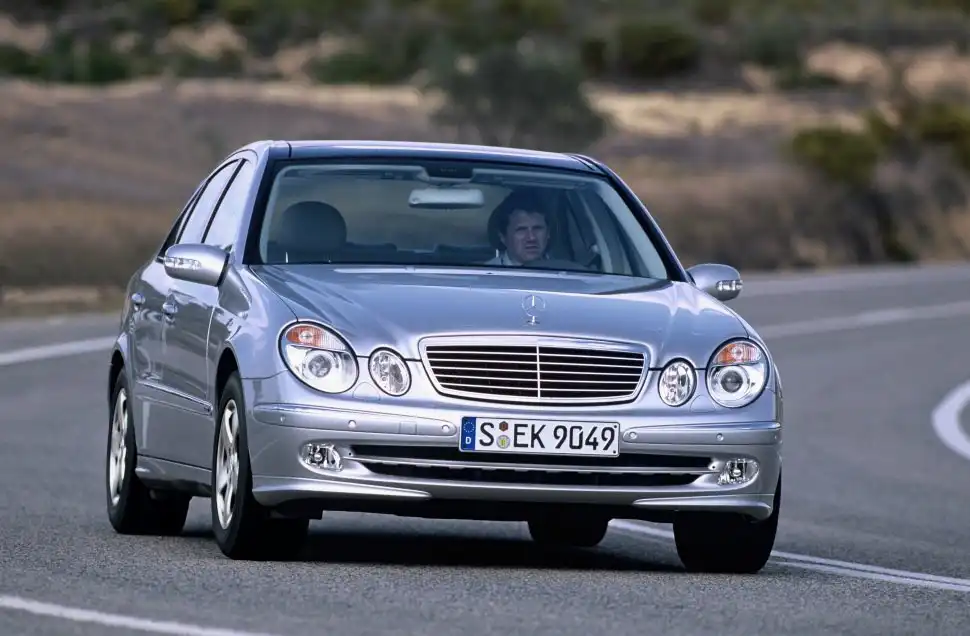
The Mercedes-Benz E 500, part of the W211 E-Class generation produced between 2003 and 2006, represented a compelling blend of luxury and performance. Positioned as a high-end variant within the W211 lineup, it offered a naturally aspirated V8 engine paired with Mercedes’ then-new 7G-TRONIC automatic transmission. This combination aimed to deliver a refined driving experience with substantial power, targeting buyers who desired a step up from the more common four and six-cylinder E-Class models. The W211 E-Class itself was a significant model for Mercedes-Benz, introducing numerous technological advancements and a more contemporary design language compared to its predecessor.
Technical Specifications
| Brand | Mercedes-Benz |
| Model | E-class |
| Generation | E-class (W211) |
| Type (Engine) | E 500 V8 (306 Hp) 7G-TRONIC |
| Start of production | 2003 |
| End of production | 2006 |
| Powertrain Architecture | Internal Combustion engine |
| Body type | Sedan |
| Seats | 5 |
| Doors | 4 |
| Fuel consumption (urban) | 17.3 l/100 km (13.6 US mpg, 16.3 UK mpg, 5.8 km/l) |
| Fuel consumption (extra urban) | 7.5 l/100 km (31.4 US mpg, 37.7 UK mpg, 13.3 km/l) |
| Fuel consumption (combined) | 11.1 l/100 km (21.2 US mpg, 25.4 UK mpg, 9 km/l) |
| Fuel Type | Petrol (Gasoline) |
| Acceleration 0 – 100 km/h | 6.5 sec |
| Acceleration 0 – 62 mph | 6.5 sec |
| Acceleration 0 – 60 mph | 6.2 sec |
| Maximum speed | 250 km/h (155.34 mph) |
| Weight-to-power ratio | 5.6 kg/Hp, 177.4 Hp/tonne |
| Weight-to-torque ratio | 3.8 kg/Nm, 266.7 Nm/tonne |
| Power | 306 Hp @ 5600 rpm |
| Power per litre | 61.6 Hp/l |
| Torque | 460 Nm @ 4250 rpm (339.28 lb.-ft. @ 4250 rpm) |
| Engine layout | Front, Longitudinal |
| Engine Model/Code | M 113.967 |
| Engine displacement | 4966 cm3 (303.04 cu. in.) |
| Number of cylinders | 8 |
| Engine configuration | V-engine |
| Cylinder Bore | 97 mm (3.82 in.) |
| Piston Stroke | 84 mm (3.31 in.) |
| Compression ratio | 10:1 |
| Number of valves per cylinder | 3 |
| Fuel injection system | Multi-port manifold injection |
| Engine aspiration | Naturally aspirated engine |
| Engine oil capacity | 7.5 l (7.93 US qt | 6.6 UK qt) |
| Coolant | 11.3 l (11.94 US qt | 9.94 UK qt) |
| Kerb Weight | 1725 kg (3802.97 lbs.) |
| Max. weight | 2250 kg (4960.4 lbs.) |
| Max load | 525 kg (1157.43 lbs.) |
| Trunk (boot) space – minimum | 540 l (19.07 cu. ft.) |
| Fuel tank capacity | 80 l (21.13 US gal | 17.6 UK gal) |
| Permitted trailer load with brakes (12%) | 1900 kg (4188.78 lbs.) |
| Permitted trailer load without brakes | 750 kg (1653.47 lbs.) |
| Length | 4818 mm (189.69 in.) |
| Width | 1822 mm (71.73 in.) |
| Height | 1452 mm (57.17 in.) |
| Wheelbase | 2854 mm (112.36 in.) |
| Front track | 1577 mm (62.09 in.) |
| Rear (Back) track | 1570 mm (61.81 in.) |
| Drag coefficient (Cd) | 0.28 |
| Drivetrain Architecture | The Internal combustion engine (ICE) drives the rear wheels of the vehicle. |
| Drive wheel | Rear wheel drive |
| Number of gears and type of gearbox | 7 gears, automatic transmission G-TRONIC |
| Front suspension | Double wishbone |
| Rear suspension | Independent multi-link spring suspension with stabilizer |
| Front brakes | Ventilated discs |
| Rear brakes | Disc |
| Assisting systems | ABS (Anti-lock braking system) |
| Steering type | Steering rack and pinion |
| Power steering | Hydraulic Steering |
| Tires size | 245/55 R16 |
| Wheel rims size | 16 |
Powertrain & Engine Architecture
The heart of the E 500 was the M113.967 5.0-liter V8 engine. This engine, a naturally aspirated powerplant, featured a three-valve-per-cylinder design (two intake, one exhaust) and multi-port fuel injection. The M113 engine family was well-regarded for its smoothness and reliability. The 7G-TRONIC automatic transmission, a seven-speed unit, was a key technological feature. It offered smoother shifts and improved fuel efficiency compared to the five-speed automatic it replaced. The transmission’s wider gear spread allowed for both strong acceleration and relaxed highway cruising. The engine’s longitudinal mounting and rear-wheel-drive configuration were typical for a performance-oriented luxury sedan of the era.
Driving Characteristics
The E 500 delivered a noticeably different driving experience compared to the four and six-cylinder E-Class models. The V8 provided ample torque throughout the rev range, resulting in strong acceleration. While not a sports car, the E 500 offered a confident and composed feel on the road. The 7G-TRONIC transmission contributed to this by providing seamless gear changes. Compared to a manual transmission, the automatic prioritized comfort and ease of use, making it well-suited for long-distance driving. The gear ratios were tuned for a balance between acceleration and fuel economy, though the V8’s thirst for fuel was still considerable.
Equipment & Trim Levels
The E 500 typically came well-equipped, reflecting its position as a premium variant. Standard features often included leather upholstery, wood trim, automatic climate control, and a premium sound system. Optional extras could include features like a sunroof, navigation system, and upgraded wheels. The interior design was characterized by Mercedes-Benz’s traditional emphasis on luxury and refinement. The E 500’s trim level generally sat above the E 320 and E 430, offering a more luxurious and powerful experience.
Chassis & Braking
The W211 E-Class featured a double wishbone front suspension and an independent multi-link rear suspension, providing a comfortable ride and good handling. The E 500, due to its higher weight, often received slightly stiffer suspension components to maintain control. Braking duties were handled by ventilated disc brakes at all four corners, providing ample stopping power. Anti-lock braking system (ABS) was standard. The E 500’s chassis was designed to balance comfort and handling, offering a refined driving experience without sacrificing stability.
Market Reception & Comparison
The E 500 was generally well-received by automotive critics, who praised its powerful engine, smooth transmission, and luxurious interior. However, its fuel consumption was often noted as a drawback. Compared to the E 320 and E 430, the E 500 offered significantly more performance but at a higher price point. The E 500 also faced competition from other luxury sedans, such as the BMW 5 Series and Audi A6, which offered similar levels of performance and refinement.
Legacy
The M113 V8 engine proved to be a durable and reliable powerplant, and many E 500 models continue to be driven today. While maintenance costs can be higher than those of the four and six-cylinder models, the E 500’s robust construction and strong performance have made it a desirable classic. In the used car market, the E 500 commands a premium compared to other W211 E-Class variants, appealing to enthusiasts who appreciate its combination of luxury, performance, and build quality. The 7G-TRONIC transmission, while generally reliable, can require occasional servicing to maintain optimal performance.