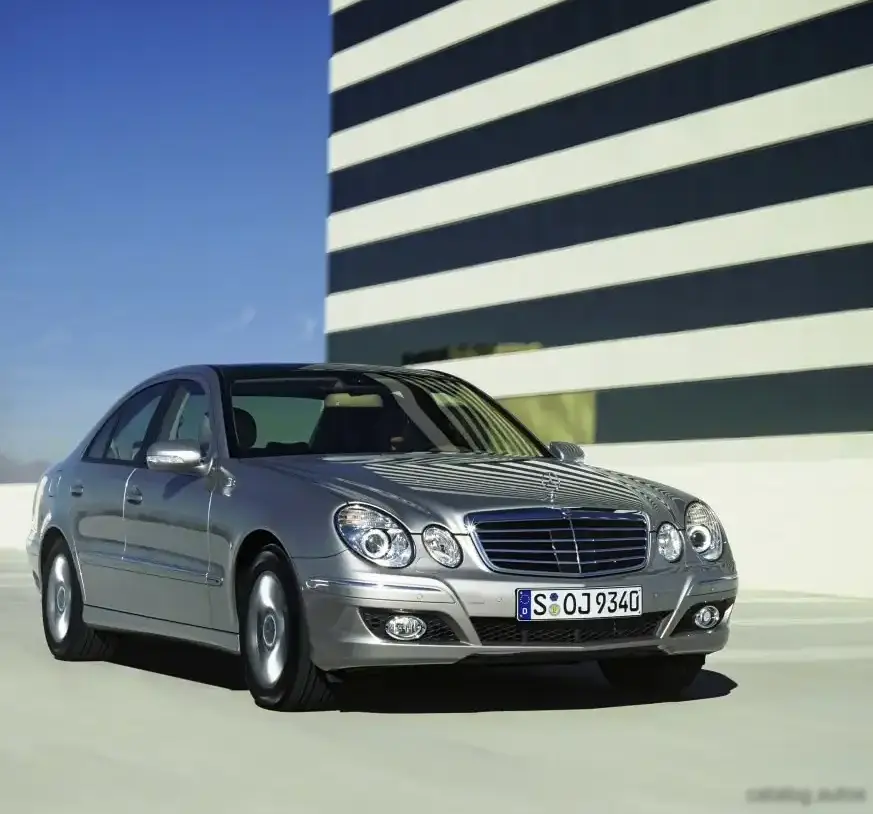
The Mercedes-Benz E 280 CDI, part of the W211 E-Class facelift introduced in 2006, represented a significant offering in the executive car segment, particularly in European markets. Produced through 2009, this variant combined a powerful diesel engine with a focus on refinement and long-distance comfort. It occupied a middle ground within the W211 lineup, positioned above the entry-level E 200 CDI and E 220 CDI, but below the more potent E 320 CDI. The E 280 CDI aimed to deliver a balance of performance, fuel efficiency, and luxury features appealing to business travelers and families alike.
Technical Specifications
| Brand | Mercedes-Benz |
| Model | E-class |
| Generation | E-class (W211, facelift 2006) |
| Type (Engine) | E 280 CDI V6 (190 Hp) |
| Start of production | 2006 |
| End of production | 2009 |
| Powertrain Architecture | Internal Combustion engine |
| Body type | Sedan |
| Seats | 5 |
| Doors | 4 |
| Fuel consumption (economy) – urban (NEDC) | 9.5-9.7 l/100 km (24.8 – 24.2 US mpg, 29.7 – 29.1 UK mpg, 10.5 – 10.3 km/l) |
| Fuel consumption (economy) – extra urban (NEDC) | 5.4-5.6 l/100 km (43.6 – 42 US mpg, 52.3 – 50.4 UK mpg, 18.5 – 17.9 km/l) |
| Fuel consumption (economy) – combined (NEDC) | 6.9-7.1 l/100 km (34.1 – 33.1 US mpg, 40.9 – 39.8 UK mpg, 14.5 – 14.1 km/l) |
| CO2 emissions (NEDC) | 183-189 g/km |
| Fuel Type | Diesel |
| Acceleration 0 – 100 km/h | 8.6 sec |
| Acceleration 0 – 62 mph | 8.6 sec |
| Acceleration 0 – 60 mph | 8.2 sec |
| Maximum speed | 241 km/h (149.75 mph) |
| Emission standard | Euro 4 |
| Weight-to-power ratio | 8.6 kg/Hp, 115.9 Hp/tonne |
| Weight-to-torque ratio | 3.7 kg/Nm, 268.3 Nm/tonne |
| Power | 190 Hp @ 4000 rpm |
| Power per litre | 63.6 Hp/l |
| Torque | 440 Nm @ 1400-2800 rpm (324.53 lb.-ft. @ 1400-2800 rpm) |
| Engine layout | Front, Longitudinal |
| Engine Model/Code | OM 642.920 |
| Engine displacement | 2987 cm3 (182.28 cu. in.) |
| Number of cylinders | 6 |
| Engine configuration | V-engine |
| Cylinder Bore | 83 mm (3.27 in.) |
| Piston Stroke | 92 mm (3.62 in.) |
| Compression ratio | 17.7:1 |
| Number of valves per cylinder | 4 |
| Fuel injection system | Diesel Commonrail |
| Engine aspiration | Turbocharger, Intercooler |
| Valvetrain | DOHC |
| Engine oil capacity | 8.5 l (8.98 US qt | 7.48 UK qt) |
| Coolant | 13 l (13.74 US qt | 11.44 UK qt) |
| Kerb Weight | 1640 kg (3615.58 lbs.) |
| Max. weight | 2240 kg (4938.35 lbs.) |
| Max load | 600 kg (1322.77 lbs.) |
| Trunk (boot) space – minimum | 540 l (19.07 cu. ft.) |
| Fuel tank capacity | 65 l (17.17 US gal | 14.3 UK gal) |
| Permitted trailer load with brakes (12%) | 1900 kg (4188.78 lbs.) |
| Permitted trailer load without brakes | 750 kg (1653.47 lbs.) |
| Length | 4856 mm (191.18 in.) |
| Width | 1822 mm (71.73 in.) |
| Width including mirrors | 2063 mm (81.22 in.) |
| Height | 1484 mm (58.43 in.) |
| Wheelbase | 2854 mm (112.36 in.) |
| Front track | 1559 mm (61.38 in.) |
| Rear (Back) track | 1552 mm (61.1 in.) |
| Front overhang | 869 mm (34.21 in.) |
| Rear overhang | 1133 mm (44.61 in.) |
| Minimum turning circle (turning diameter) | 11.4 m (37.4 ft.) |
Powertrain & Engine Architecture
The heart of the E 280 CDI is the OM 642.920, a 3.0-liter V6 diesel engine. This engine is a cornerstone of Mercedes-Benz’s diesel offerings during this period, known for its robust construction and relatively smooth operation for a diesel. It features a common rail direct injection system, delivering fuel at extremely high pressures for optimized combustion. The engine utilizes a variable geometry turbocharger (VGT) and an intercooler to enhance power and efficiency. The VGT allows the turbocharger to adjust its vanes based on engine speed and load, providing strong low-end torque and maintaining power at higher RPMs. The engine also incorporates four valves per cylinder and a double overhead camshaft (DOHC) valvetrain. A particulate filter was standard, helping to reduce emissions and meet Euro 4 standards. The engine was paired with a 5-speed automatic transmission (722.6), known for its smooth shifts and reliability.
Driving Characteristics
The E 280 CDI offered a refined driving experience. The 440 Nm (324.53 lb-ft) of torque available from 1400-2800 rpm provided strong acceleration in everyday driving situations. While not a sports car, the E 280 CDI could accelerate from 0 to 60 mph in around 8.2 seconds and reach a top speed of 149.75 mph. The automatic transmission was well-matched to the engine’s characteristics, providing smooth and predictable gear changes. Compared to the manual transmission option, the automatic prioritized comfort and ease of use over outright performance. Compared to the E 320 CDI, the E 280 CDI offered a slightly less powerful but more fuel-efficient alternative. The E 200 CDI and E 220 CDI, while more economical, lacked the substantial torque and overall refinement of the E 280 CDI.
Equipment & Trim Levels
The E 280 CDI typically came well-equipped, reflecting its position in the Mercedes-Benz lineup. Standard features included automatic climate control, power windows and mirrors, a multi-function steering wheel, and a high-quality audio system. Upholstery was typically a combination of cloth and leatherette, with full leather options available as an upgrade. Optional extras included a sunroof, navigation system, premium sound system, and parking sensors. The interior design was characterized by Mercedes-Benz’s signature understated elegance, with a focus on build quality and comfort.
Chassis & Braking
The W211 E-Class featured an independent multi-link suspension on both the front and rear axles, providing a comfortable ride and good handling characteristics. A transverse stabilizer bar was fitted to both axles to reduce body roll. The E 280 CDI was equipped with ventilated disc brakes on the front wheels and solid disc brakes on the rear. Anti-lock braking system (ABS) was standard, enhancing safety and control during braking. The steering was a hydraulic power steering system, offering a balanced feel and responsiveness.
Market Reception & Comparison
The E 280 CDI was generally well-received by automotive critics. It was praised for its refined engine, comfortable ride, and spacious interior. Fuel economy was a significant selling point, with the E 280 CDI achieving around 34.1-33.1 US mpg in combined driving. Compared to its competitors, such as the BMW 530d and Audi A6 3.0 TDI, the E 280 CDI offered a compelling combination of performance, luxury, and efficiency. Some critics noted that the interior design, while elegant, was starting to look dated compared to newer rivals.
Legacy
The OM 642 engine family, including the OM 642.920 found in the E 280 CDI, has proven to be remarkably durable. With proper maintenance, these engines can reliably exceed 200,000 miles. The 5-speed automatic transmission is also known for its longevity. In the used car market, the E 280 CDI remains a popular choice for those seeking a comfortable and reliable executive car. However, potential buyers should be aware of the potential for diesel particulate filter (DPF) issues, particularly on vehicles that have primarily been used for short journeys. Overall, the E 280 CDI represents a well-engineered and refined vehicle that continues to offer good value in the used car market.