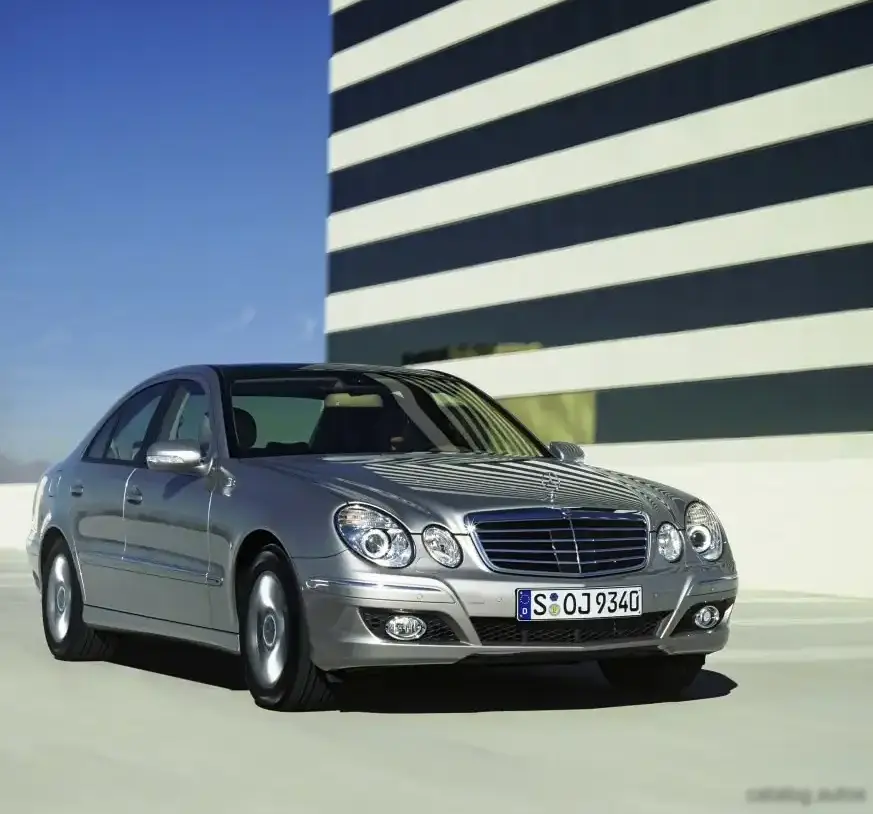
The Mercedes-Benz E 420 CDI, produced from 2006 to 2009 as part of the W211 facelift generation, represented the pinnacle of diesel performance within the E-Class lineup. This variant, equipped with a potent 4.0-liter V8 turbodiesel engine and the 7G-TRONIC seven-speed automatic transmission, offered a unique blend of luxury, power, and efficiency. Positioned as the flagship diesel model, it catered to buyers seeking a high-performance executive sedan without sacrificing the fuel economy benefits of a diesel powertrain. The W211 facelift, introduced in late 2002, brought significant aesthetic and technological updates to the E-Class, and the E 420 CDI capitalized on these improvements.
Technical Specifications
| Brand | Mercedes-Benz |
| Model | E-class |
| Generation | E-class (W211, facelift 2006) |
| Type (Engine) | E 420 CDI V8 (314 Hp) 7G-TRONIC |
| Start of production | 2006 |
| End of production | 2009 |
| Powertrain Architecture | Internal Combustion engine |
| Body type | Sedan |
| Seats | 5 |
| Doors | 4 |
| Fuel consumption (economy) – urban (NEDC) | 13.2 l/100 km (17.8 US mpg, 21.4 UK mpg, 7.6 km/l) |
| Fuel consumption (economy) – extra urban (NEDC) | 7 l/100 km (33.6 US mpg, 40.4 UK mpg, 14.3 km/l) |
| Fuel consumption (economy) – combined (NEDC) | 9.3 l/100 km (25.3 US mpg, 30.4 UK mpg, 10.8 km/l) |
| CO2 emissions (NEDC) | 246 g/km |
| Fuel Type | Diesel |
| Acceleration 0 – 100 km/h | 6.1 sec |
| Acceleration 0 – 62 mph | 6.1 sec |
| Acceleration 0 – 60 mph | 5.8 sec |
| Maximum speed | 250 km/h (155.34 mph), Electronically limited |
| Emission standard | Euro 4 |
| Weight-to-power ratio | 5.8 kg/Hp, 171.1 Hp/tonne |
| Weight-to-torque ratio | 2.5 kg/Nm, 397.8 Nm/tonne |
| Power | 314 Hp @ 3600 rpm |
| Power per litre | 78.6 Hp/l |
| Torque | 730 Nm @ 2200 rpm (538.42 lb.-ft. @ 2200 rpm) |
| Engine layout | Front, Longitudinal |
| Engine Model/Code | OM 629.910 |
| Engine displacement | 3996 cm3 (243.85 cu. in.) |
| Number of cylinders | 8 |
| Engine configuration | V-engine |
| Cylinder Bore | 86 mm (3.39 in.) |
| Piston Stroke | 86 mm (3.39 in.) |
| Compression ratio | 17.5:1 |
| Number of valves per cylinder | 4 |
| Fuel injection system | Diesel Commonrail |
| Engine aspiration | BiTurbo, Intercooler |
| Valvetrain | DOHC |
| Engine oil capacity | 10.5 l (11.1 US qt, 9.24 UK qt) |
| Coolant | 15.3 l (16.17 US qt, 13.46 UK qt) |
| Kerb Weight | 1835 kg (4045.48 lbs.) |
| Max. weight | 2435 kg (5368.26 lbs.) |
| Max load | 600 kg (1322.77 lbs.) |
| Trunk (boot) space – minimum | 530 l (18.72 cu. ft.) |
| Fuel tank capacity | 80 l (21.13 US gal, 17.6 UK gal) |
| Permitted trailer load with brakes (12%) | 1900 kg (4188.78 lbs.) |
| Permitted trailer load without brakes | 750 kg (1653.47 lbs.) |
| Length | 4856 mm (191.18 in.) |
| Width | 1822 mm (71.73 in.) |
| Width including mirrors | 2063 mm (81.22 in.) |
| Height | 1465 mm (57.68 in.) |
| Wheelbase | 2854 mm (112.36 in.) |
| Front track | 1559 mm (61.38 in.) |
| Rear (Back) track | 1552 mm (61.1 in.) |
| Front overhang | 869 mm (34.21 in.) |
| Rear overhang | 1133 mm (44.61 in.) |
| Minimum turning circle (turning diameter) | 11.4 m (37.4 ft.) |
| Drivetrain Architecture | The Internal combustion engine (ICE) drives the rear wheels of the vehicle. |
| Drive wheel | Rear wheel drive |
| Number of gears and type of gearbox | 7 gears, automatic transmission G-TRONIC |
| Front suspension | Independent multi-link suspension, Transverse stabilizer, Air suspension |
| Rear suspension | Independent multi-link suspension, Air suspension, Transverse stabilizer |
| Front brakes | Ventilated discs |
| Rear brakes | Ventilated discs |
| Assisting systems | ABS (Anti-lock braking system) |
| Steering type | Steering rack and pinion |
| Power steering | Hydraulic Steering |
| Tires size | 245/45 R17 |
| Wheel rims size | 8J x 17 |
Powertrain & Engine Architecture
The heart of the E 420 CDI is the OM 629.910 4.0-liter V8 diesel engine. This engine utilizes a common rail direct injection system, delivering fuel at extremely high pressures for optimized combustion. Two turbochargers, sequentially activated, provide a broad torque curve and minimize turbo lag. The first, smaller turbocharger operates at lower engine speeds, providing immediate response, while the second, larger turbocharger kicks in at higher speeds for increased power. An intercooler further enhances performance by cooling the compressed intake air. The engine features a double overhead camshaft (DOHC) valvetrain with four valves per cylinder, contributing to its high power output and efficiency. The 7G-TRONIC seven-speed automatic transmission, a hallmark of Mercedes-Benz technology, provides smooth and precise gear changes. Its wide gear ratio spread allows for both relaxed cruising and responsive acceleration.
Driving Characteristics
The E 420 CDI delivered a remarkably refined driving experience. The substantial 730 Nm (538 lb-ft) of torque, available from just 2200 rpm, provided effortless acceleration in virtually any gear. The 0-60 mph sprint was dispatched in around 5.8 seconds, making it genuinely quick for a large luxury sedan. While not as overtly sporty as some of its gasoline-powered counterparts, the E 420 CDI offered a confident and composed ride, thanks to its sophisticated suspension system, which often included air suspension on higher trim levels. The 7G-TRONIC transmission contributed to a seamless driving experience, with well-chosen gear ratios that maximized both performance and fuel economy. Compared to the E 320 CDI (with its inline-six engine), the E 420 CDI offered significantly more power and a smoother, more refined feel. It lacked the agility of the smaller, lighter E-Class models, but compensated with its sheer presence and effortless cruising ability.
Equipment & Trim Levels
The E 420 CDI typically came well-equipped, reflecting its position as a premium model. Standard features often included leather upholstery, automatic climate control, a premium audio system, and power-adjustable front seats. Optional extras included a sunroof, navigation system, upgraded leather, and various driver assistance systems. The interior design was typical of Mercedes-Benz at the time, emphasizing luxury and comfort with high-quality materials and a sophisticated layout. Trim levels varied depending on the market, but generally offered a range of customization options, allowing buyers to tailor the car to their preferences.
Chassis & Braking
The W211 E-Class chassis featured a multi-link independent suspension at both the front and rear, providing a comfortable and controlled ride. Many E 420 CDI models were equipped with air suspension, which further enhanced ride quality and allowed for adjustable ride height. Braking duties were handled by ventilated disc brakes on all four wheels, providing ample stopping power. Anti-lock braking system (ABS) and electronic stability control (ESP) were standard features, enhancing safety and stability. Stabilizer bars were fitted front and rear to reduce body roll during cornering.
Market Reception & Comparison
The E 420 CDI was generally well-received by automotive critics, who praised its powerful engine, smooth transmission, and luxurious interior. However, some reviewers noted its relatively high price and complex technology. Compared to other diesel-powered E-Class models, such as the E 320 CDI, the E 420 CDI offered a significant performance advantage but came at a higher cost. Fuel economy was respectable for a V8 engine, but not dramatically better than some of the smaller diesel options. Reliability was generally good, but the complex engine and transmission systems could be expensive to repair.
Legacy
The Mercedes-Benz E 420 CDI represents a high point in diesel engine technology. The OM 629 V8 engine is known for its durability and potential for high mileage. Today, well-maintained examples are sought after by enthusiasts who appreciate their unique combination of power, luxury, and efficiency. However, potential buyers should be aware of the potential for costly repairs due to the engine’s complexity and age. The E 420 CDI remains a testament to Mercedes-Benz’s engineering prowess and a distinctive offering within the W211 E-Class generation.