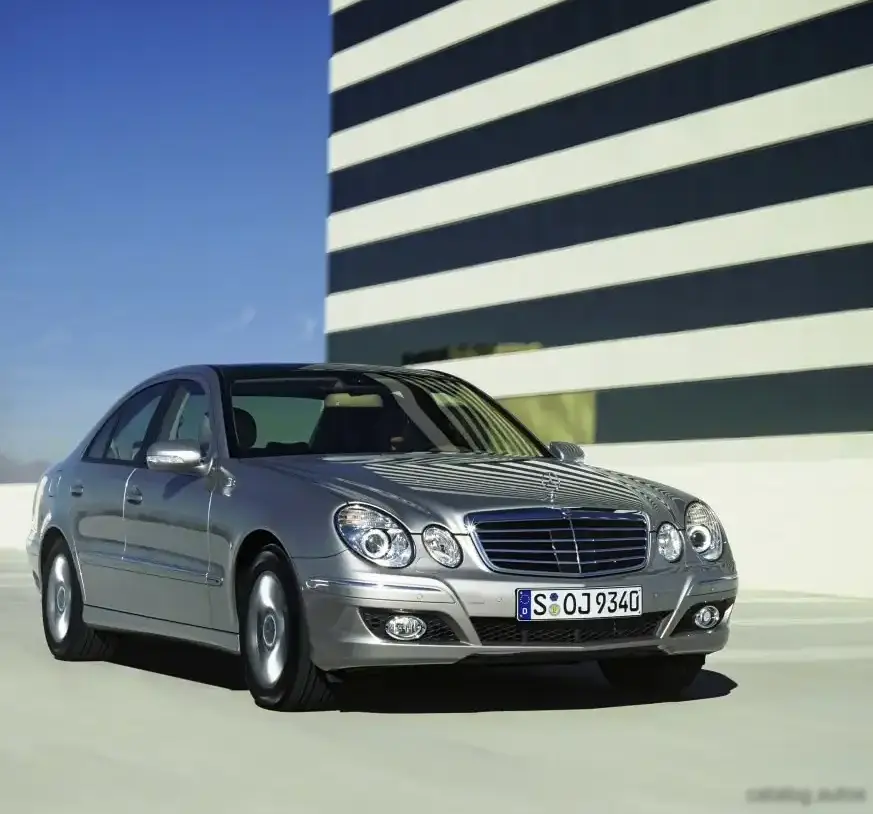
The Mercedes-Benz E 500, part of the W211 E-Class facelift introduced in 2006, represented the performance pinnacle of the range prior to the arrival of the AMG models. Produced through 2009, this variant combined a naturally aspirated 5.5-liter V8 engine with the sophisticated 7G-TRONIC seven-speed automatic transmission, offering a blend of luxury, power, and refinement. Positioned as the top-tier non-AMG E-Class, it catered to buyers seeking substantial performance without the overtly sporty character of the AMG variants. It was primarily sold in Europe, North America, and select Asian markets where larger displacement engines were favored.
Technical Specifications
| Brand | Mercedes-Benz |
| Model | E-class |
| Generation | E-class (W211, facelift 2006) |
| Type (Engine) | E 500 V8 (388 Hp) 7G-TRONIC |
| Start of production | 2006 |
| End of production | 2009 |
| Powertrain Architecture | Internal Combustion engine |
| Body type | Sedan |
| Seats | 5 |
| Doors | 4 |
| Fuel consumption (economy) – urban (NEDC) | 16.9 l/100 km (13.9 US mpg, 16.7 UK mpg, 5.9 km/l) |
| Fuel consumption (economy) – extra urban (NEDC) | 8.2 l/100 km (28.7 US mpg, 34.4 UK mpg, 12.2 km/l) |
| Fuel consumption (economy) – combined (NEDC) | 11.5 l/100 km (20.5 US mpg, 24.6 UK mpg, 8.7 km/l) |
| CO2 emissions (NEDC) | 273 g/km |
| Fuel Type | Petrol (Gasoline) |
| Acceleration 0 – 100 km/h | 5.3 sec |
| Acceleration 0 – 62 mph | 5.3 sec |
| Acceleration 0 – 60 mph | 5 sec |
| Maximum speed | 250 km/h (155.34 mph), Electronically limited |
| Emission standard | Euro 4 |
| Weight-to-power ratio | 4.4 kg/Hp, 226.9 Hp/tonne |
| Weight-to-torque ratio | 3.2 kg/Nm, 309.9 Nm/tonne |
| Power | 388 Hp @ 6000 rpm |
| Power per litre | 71 Hp/l |
| Torque | 530 Nm @ 2800-4800 rpm (390.91 lb.-ft. @ 2800-4800 rpm) |
| Engine layout | Front, Longitudinal |
| Engine Model/Code | M 273.960 |
| Engine displacement | 5461 cm3 (333.25 cu. in.) |
| Number of cylinders | 8 |
| Engine configuration | V-engine |
| Cylinder Bore | 98 mm (3.86 in.) |
| Piston Stroke | 90.5 mm (3.56 in.) |
| Compression ratio | 10.7:1 |
| Number of valves per cylinder | 4 |
| Fuel injection system | Multi-port manifold injection |
| Engine aspiration | Naturally aspirated engine |
| Valvetrain | DOHC |
| Engine oil capacity | 8.5 l (8.98 US qt | 7.48 UK qt) |
| Coolant | 11.3 l (11.94 US qt | 9.94 UK qt) |
| Kerb Weight | 1710 kg (3769.9 lbs.) |
| Max. weight | 2310 kg (5092.68 lbs.) |
| Max load | 600 kg (1322.77 lbs.) |
| Trunk (boot) space – minimum | 530 l (18.72 cu. ft.) |
| Fuel tank capacity | 80 l (21.13 US gal | 17.6 UK gal) |
| Permitted trailer load with brakes (12%) | 1900 kg (4188.78 lbs.) |
| Permitted trailer load without brakes | 750 kg (1653.47 lbs.) |
| Length | 4856 mm (191.18 in.) |
| Width | 1822 mm (71.73 in.) |
| Width including mirrors | 2063 mm (81.22 in.) |
| Height | 1483 mm (58.39 in.) |
| Wheelbase | 2854 mm (112.36 in.) |
| Front track | 1559 mm (61.38 in.) |
| Rear (Back) track | 1552 mm (61.1 in.) |
| Front overhang | 869 mm (34.21 in.) |
| Rear overhang | 1133 mm (44.61 in.) |
| Minimum turning circle (turning diameter) | 11.4 m (37.4 ft.) |
| Drivetrain Architecture | The Internal combustion engine (ICE) drives the rear wheels of the vehicle. |
| Drive wheel | Rear wheel drive |
| Number of gears and type of gearbox | 7 gears, automatic transmission G-TRONIC |
| Front suspension | Independent multi-link suspension, Transverse stabilizer, Air suspension |
| Rear suspension | Independent multi-link suspension, Air suspension, Transverse stabilizer |
| Front brakes | Ventilated discs |
| Rear brakes | Ventilated discs |
| Assisting systems | ABS (Anti-lock braking system) |
| Steering type | Steering rack and pinion |
| Power steering | Hydraulic Steering |
| Tires size | 245/45 R17 |
| Wheel rims size | 8J x 17 |
Powertrain & Engine Architecture
The heart of the E 500 is the M273.960 5.5-liter V8 engine. This engine is a naturally aspirated, three-valve-per-cylinder design featuring a 90-degree V-angle. It utilizes a multi-port fuel injection system and a relatively high 10.7:1 compression ratio. The engine’s construction incorporates an aluminum alloy block and cylinder heads, contributing to weight reduction. The 7G-TRONIC transmission is a seven-speed automatic gearbox known for its smooth shifting and efficiency. It features a torque converter lock-up clutch that engages in most gears, improving fuel economy and responsiveness. The transmission offers both fully automatic and manual shift modes, allowing the driver to control gear selection.
Driving Characteristics
The E 500 delivered a noticeably different driving experience compared to the four-cylinder or six-cylinder E-Class models. The V8 engine provided ample torque throughout the rev range, resulting in strong acceleration. The 0-60 mph sprint was consistently achieved in around 5 seconds. The 7G-TRONIC transmission contributed to smooth and seamless gear changes, enhancing the overall driving comfort. While not as overtly sporty as the AMG variants, the E 500 offered a refined and powerful driving experience suitable for long-distance cruising and spirited driving. The gear ratios were tuned for a balance between acceleration and fuel efficiency, with a relatively tall seventh gear for highway cruising.
Equipment & Trim Levels
The E 500 typically came standard with a high level of equipment, reflecting its position as the flagship non-AMG model. Standard features included leather upholstery, wood trim, automatic climate control, a premium sound system, and power-adjustable front seats with memory function. Optional extras included a sunroof, navigation system, upgraded sound system, and various driver assistance systems such as Distronic adaptive cruise control and Parktronic parking assist. The interior design was characterized by its luxurious materials and attention to detail, offering a comfortable and refined cabin environment.
Chassis & Braking
The E 500 featured a fully independent suspension system with multi-link setups at both the front and rear. Air suspension was often included, providing a comfortable ride and the ability to adjust the ride height. The braking system consisted of ventilated discs on all four wheels, providing ample stopping power. Anti-lock brakes (ABS) and electronic stability control (ESP) were standard safety features. The chassis was designed to provide a balance between comfort and handling, offering a stable and predictable driving experience.
Market Reception & Comparison
The E 500 was generally well-received by automotive critics, who praised its powerful engine, smooth transmission, and luxurious interior. However, some critics noted that its fuel economy was relatively poor compared to the smaller-engined E-Class models. Compared to the E 350, the E 500 offered significantly more power and performance, but at a higher price point and with increased running costs. The E 500 also differed from the diesel-powered E 320 CDI in terms of its engine characteristics and fuel type. The V8 offered a more refined and responsive driving experience, while the diesel provided superior fuel economy.
Legacy
The M273 engine, while robust, is known to be susceptible to certain issues with age, including oil leaks and potential problems with the balance shaft. The 7G-TRONIC transmission is generally reliable, but requires regular fluid changes to maintain optimal performance. Today, the W211 E 500 represents a relatively affordable entry point into the world of Mercedes-Benz V8 ownership. Well-maintained examples are sought after by enthusiasts who appreciate their combination of luxury, performance, and classic Mercedes-Benz styling. The car’s relative rarity compared to other E-Class models has also contributed to its growing collectibility.