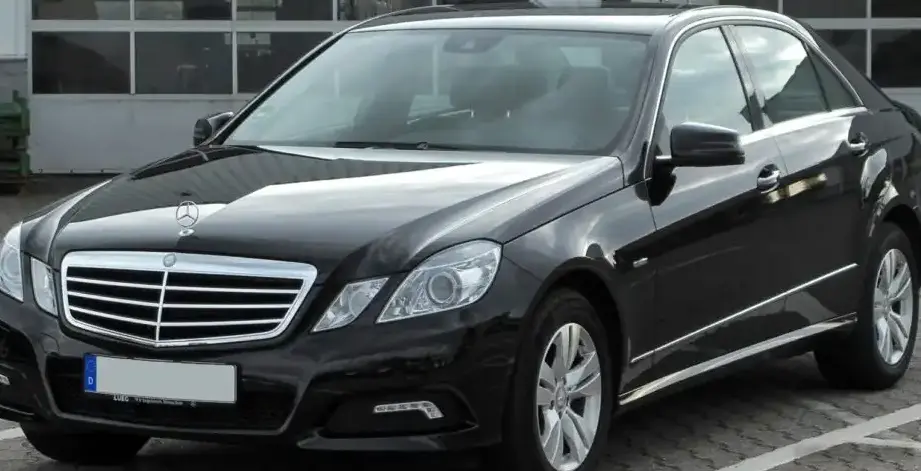
The Mercedes-Benz E 200 CGI BlueEFFICIENCY, produced between 2009 and 2011, was a key variant within the W212 E-Class range. Positioned as a mid-range offering, it aimed to balance performance and fuel economy, appealing to buyers seeking a comfortable and refined executive sedan without the higher costs associated with the more powerful E 250 or E 350 models. This variant was primarily marketed in Europe and other regions where smaller displacement, turbocharged engines were favored for their efficiency and tax benefits. The W212 generation, launched in 2009, represented a significant evolution of the E-Class, incorporating advanced technology and a more contemporary design language.
Technical Specifications
| Brand | Mercedes-Benz |
| Model | E-class |
| Generation | E-class (W212) |
| Type | E 200 CGI BlueEFFICIENCY (184 Hp) 5G-TRONIC |
| Start of production | 2009 |
| End of production | 2011 |
| Powertrain Architecture | Internal Combustion engine |
| Body type | Sedan |
| Seats | 5 |
| Doors | 4 |
| Fuel consumption (urban) | 10.2-10.5 l/100 km (23.1 – 22.4 US mpg) |
| Fuel consumption (extra urban) | 6-6.3 l/100 km (39.2 – 37.3 US mpg) |
| Fuel consumption (combined) | 7.5-7.9 l/100 km (31.4 – 29.8 US mpg) |
| CO2 emissions | 177-184 g/km |
| Fuel Type | Petrol (Gasoline) |
| Acceleration 0 – 100 km/h | 8.2 sec |
| Acceleration 0 – 62 mph | 8.2 sec |
| Acceleration 0 – 60 mph | 7.8 sec |
| Maximum speed | 230 km/h (142.92 mph) |
| Emission standard | Euro 5 |
| Weight-to-power ratio | 8.4 kg/Hp |
| Weight-to-torque ratio | 5.7 kg/Nm |
| Power | 184 Hp @ 5250 rpm |
| Torque | 270 Nm @ 1800-4600 rpm (199.14 lb.-ft.) |
| Engine layout | Front, Longitudinal |
| Engine Model/Code | M 271.860 |
| Engine displacement | 1796 cm3 (109.6 cu. in.) |
| Number of cylinders | 4 |
| Engine configuration | Inline |
| Cylinder Bore | 82 mm (3.23 in.) |
| Piston Stroke | 85 mm (3.35 in.) |
| Compression ratio | 9.8:1 |
| Number of valves per cylinder | 4 |
| Fuel injection system | Direct injection |
| Engine aspiration | Turbocharger, Intercooler |
| Valvetrain | DOHC |
| Engine oil capacity | 5.5 l (5.81 US qt | 4.84 UK qt) |
| Kerb Weight | 1540 kg (3395.12 lbs.) |
| Max. weight | 2150 kg (4739.94 lbs.) |
| Max load | 610 kg (1344.82 lbs.) |
| Trunk (boot) space | 540 l (19.07 cu. ft.) |
| Fuel tank capacity | 59 l (15.59 US gal | 12.98 UK gal) |
| Permitted trailer load (8%) | 1900 kg (4188.78 lbs.) |
| Permitted trailer load (12%) | 1700 kg (3747.86 lbs.) |
| Length | 4868 mm (191.65 in.) |
| Width | 1854 mm (72.99 in.) |
| Width including mirrors | 2071 mm (81.54 in.) |
| Height | 1470 mm (57.87 in.) |
| Wheelbase | 2874 mm (113.15 in.) |
| Front track | 1600 mm (62.99 in.) |
| Rear track | 1619 mm (63.74 in.) |
| Front overhang | 841 mm (33.11 in.) |
| Rear overhang | 1153 mm (45.39 in.) |
| Minimum turning circle | 11.25 m (36.91 ft.) |
| Drivetrain | Rear wheel drive |
| Number of gears | 5 |
| Gearbox type | Automatic transmission G-TRONIC |
| Front suspension | Independent multi-link suspension |
| Rear suspension | Independent multi-link suspension |
| Front brakes | Ventilated discs |
| Rear brakes | Disc |
| Assisting systems | ABS (Anti-lock braking system) |
| Steering type | Steering rack and pinion |
| Power steering | Hydraulic Steering |
| Tires size | 225/55 R16; 245/45 R17 |
| Wheel rims size | 7.5J x 16; 8J x 17 |
Powertrain & Engine Architecture
The E 200 CGI BlueEFFICIENCY was powered by the M271.860 1.8-liter inline-four cylinder engine. This engine was a significant departure from earlier Mercedes-Benz engines, utilizing direct fuel injection and a turbocharger with an intercooler to deliver a respectable 184 horsepower and 199 lb-ft of torque. The “CGI” designation stood for “Compressed Gasoline Ignition,” referring to the stratified charge direct injection system. This system aimed to improve fuel efficiency by creating a leaner air-fuel mixture during partial load operation. The engine featured a double overhead camshaft (DOHC) valvetrain with four valves per cylinder. The 5G-TRONIC automatic transmission, a five-speed unit, was the sole transmission option for this variant. It was known for its smooth shifts and relatively quick response, though it lacked the efficiency of more modern transmissions with a greater number of gears.
Driving Characteristics
The E 200 CGI with the 5G-TRONIC transmission offered a comfortable and refined driving experience. Acceleration from 0-60 mph took around 7.8 seconds, which was adequate for everyday driving but noticeably slower than the E 250 or E 350 models. The turbocharger provided a good amount of low-end torque, making it easy to navigate city traffic. However, the five-speed automatic transmission sometimes felt a bit dated, lacking the responsiveness and fuel efficiency of newer transmissions. Gear ratios were optimized for comfort and fuel economy rather than outright performance. Compared to the manual transmission options available on other E-Class models, the automatic prioritized ease of use over driver engagement.
Equipment & Trim Levels
The E 200 CGI BlueEFFICIENCY typically came standard with features such as automatic climate control, power windows and mirrors, a multi-function steering wheel, and a basic audio system. Upholstery was usually cloth, though leather options were available. Common optional extras included a sunroof, upgraded audio systems (often from Harman Kardon), navigation system, parking sensors, and heated seats. The “BlueEFFICIENCY” designation indicated the inclusion of fuel-saving technologies like start-stop functionality, which automatically shut off the engine when the vehicle was stationary to reduce emissions and fuel consumption.
Chassis & Braking
The W212 E-Class featured an independent multi-link suspension on both the front and rear axles, providing a comfortable ride and good handling characteristics. The E 200 CGI typically came equipped with ventilated disc brakes on the front and solid disc brakes on the rear. Anti-lock braking system (ABS) was standard. The suspension was tuned for comfort, prioritizing a smooth ride over sporty handling. Stabilizer bars were fitted to both axles to reduce body roll during cornering.
Market Reception & Comparison
The E 200 CGI BlueEFFICIENCY was generally well-received by critics as a sensible and efficient option within the E-Class range. It offered a good balance of comfort, features, and fuel economy. However, some reviewers noted that the engine lacked the punch of the larger displacement engines, and the five-speed automatic transmission felt somewhat outdated compared to competitors. Compared to the E 250, the E 200 offered lower running costs but sacrificed performance. The E 200 CGI was often seen as a more practical choice for drivers who prioritized fuel efficiency and comfort over outright speed.
Legacy
The M271 engine, while generally reliable, is known to require regular maintenance, particularly regarding the timing chain. Oil changes should be performed according to the manufacturer’s recommendations to prevent premature wear. The 5G-TRONIC transmission is also relatively durable but can experience issues with the valve body or conductor plate over time. In the used car market, the E 200 CGI BlueEFFICIENCY represents a relatively affordable entry point into Mercedes-Benz ownership. Its fuel efficiency and comfortable ride continue to appeal to buyers seeking a refined and practical executive sedan. However, potential buyers should be aware of the potential maintenance costs associated with the engine and transmission.