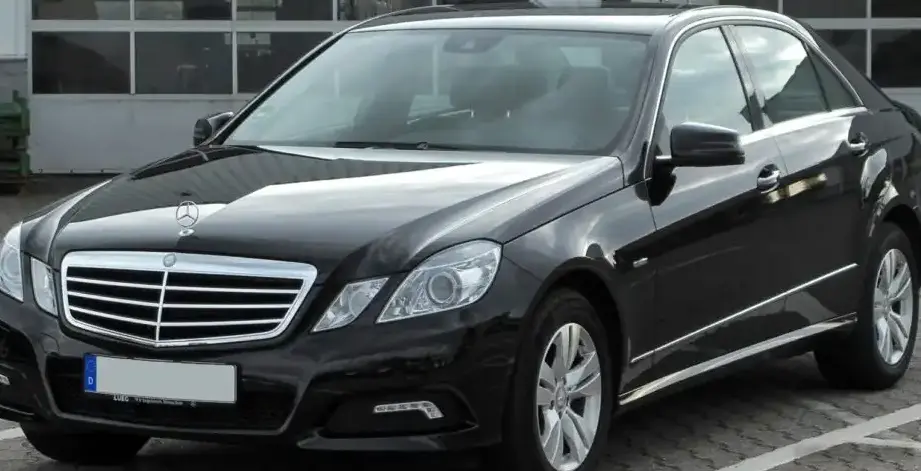
The Mercedes-Benz E-Class W212 E 250 CGI BlueEFFICIENCY, produced from September 2009 to February 2011, represented a key offering in the mid-size luxury sedan segment. Positioned as a balance between performance and efficiency within the W212 range, this variant featured a 1.8-liter turbocharged four-cylinder engine paired with a 5G-TRONIC automatic transmission. It served as a more accessible entry point into the E-Class lineup compared to the higher-performance E 350 or the diesel-powered E 250 CDI, appealing to buyers prioritizing fuel economy and a comfortable driving experience. The W212 generation itself was a significant evolution for the E-Class, introducing a more modern design language and a suite of advanced technologies.
Technical Specifications
| Brand | Mercedes-Benz |
| Model | E-class |
| Generation | E-class (W212) |
| Type | E 250 CGI BlueEFFICIENCY (204 Hp) 5G-TRONIC |
| Start of production | September, 2009 |
| End of production | February, 2011 |
| Powertrain Architecture | Internal Combustion engine |
| Body type | Sedan |
| Seats | 5 |
| Doors | 4 |
| Fuel consumption (urban) | 10.3-10.6 l/100 km (22.8 – 22.2 US mpg) |
| Fuel consumption (extra urban) | 6.1-6.4 l/100 km (38.6 – 36.8 US mpg) |
| Fuel consumption (combined) | 7.6-8 l/100 km (30.9 – 29.4 US mpg) |
| CO2 emissions | 179-187 g/km |
| Fuel Type | Petrol (Gasoline) |
| Acceleration 0 – 100 km/h | 7.8 sec |
| Acceleration 0 – 62 mph | 7.8 sec |
| Acceleration 0 – 60 mph | 7.4 sec |
| Maximum speed | 238 km/h (147.89 mph) |
| Emission standard | Euro 5 |
| Weight-to-power ratio | 7.5 kg/Hp |
| Weight-to-torque ratio | 5 kg/Nm |
| Power | 204 Hp @ 5500 rpm |
| Torque | 310 Nm @ 2000-4300 rpm (228.64 lb.-ft. @ 2000-4300 rpm) |
| Engine layout | Front, Longitudinal |
| Engine Model/Code | M 271.860 |
| Engine displacement | 1796 cm3 (109.6 cu. in.) |
| Number of cylinders | 4 |
| Engine configuration | Inline |
| Cylinder Bore | 82 mm (3.23 in.) |
| Piston Stroke | 85 mm (3.35 in.) |
| Compression ratio | 9.3:1 |
| Number of valves per cylinder | 4 |
| Fuel injection system | Direct injection |
| Engine aspiration | Turbocharger, Intercooler |
| Valvetrain | DOHC |
| Engine oil capacity | 5.5 l (5.81 US qt | 4.84 UK qt) |
| Coolant capacity | 7.8 l (8.24 US qt | 6.86 UK qt) |
| Kerb Weight | 1540 kg (3395.12 lbs.) |
| Max. weight | 2150 kg (4739.94 lbs.) |
| Max load | 610 kg (1344.82 lbs.) |
| Trunk (boot) space | 540 l (19.07 cu. ft.) |
| Fuel tank capacity | 59 l (15.59 US gal | 12.98 UK gal) |
| Max. roof load | 100 kg (220.46 lbs.) |
| Permitted trailer load (braked) | 1900 kg (4188.78 lbs.) |
| Permitted trailer load (unbraked) | 750 kg (1653.47 lbs.) |
| Permitted towbar download | 84 kg (185.19 lbs.) |
| Length | 4868 mm (191.65 in.) |
| Width | 1854 mm (72.99 in.) |
| Width including mirrors | 2071 mm (81.54 in.) |
| Height | 1470 mm (57.87 in.) |
| Wheelbase | 2874 mm (113.15 in.) |
| Front track | 1600 mm (62.99 in.) |
| Rear track | 1619 mm (63.74 in.) |
| Front overhang | 841 mm (33.11 in.) |
| Rear overhang | 1153 mm (45.39 in.) |
| Drag coefficient (Cd) | 0.26 |
| Minimum turning circle | 11.25 m (36.91 ft.) |
| Drivetrain | Rear wheel drive |
| Gearbox | 5 gears, automatic transmission G-TRONIC |
| Front suspension | Coil spring, Independent multi-link suspension, Transverse stabilizer |
| Rear suspension | Independent multi-link spring suspension with stabilizer |
| Front brakes | Ventilated discs, 322 mm |
| Rear brakes | Disc, 300 mm |
| Steering type | Steering rack and pinion |
| Power steering | Hydraulic |
| Tires size | 225/55 R16; 245/45 R17 |
| Wheel rims size | 7.5J x 16; 8J x 17 |
Powertrain & Engine Architecture
The heart of the E 250 CGI BlueEFFICIENCY is the M 271.860 1.8-liter inline-four cylinder engine. This engine is a key member of Mercedes-Benz’s CGI (Compressed Ignition Gasoline) family, utilizing direct fuel injection and a turbocharger with an intercooler to deliver a balance of power and efficiency. The engine’s direct injection system, developed in partnership with Bosch, allows for precise fuel metering and improved combustion efficiency. The turbocharger provides increased power output without significantly increasing engine displacement. The engine produces 204 horsepower at 5500 rpm and 310 Nm (228.64 lb-ft) of torque between 2000 and 4300 rpm. The 5G-TRONIC automatic transmission, a five-speed unit, was specifically tuned to complement the engine’s characteristics, offering smooth shifts and optimized gear ratios for both city and highway driving. This transmission was known for its responsiveness and contribution to the overall refined driving experience.
Driving Characteristics
The E 250 CGI BlueEFFICIENCY offered a comfortable and refined driving experience, prioritizing smoothness and fuel efficiency over outright performance. While the 0-60 mph acceleration time of around 7.4 seconds was respectable, it wasn’t as quick as the E 350 models. The 5G-TRONIC transmission provided seamless gear changes, but some drivers found it less engaging than a manual transmission. The engine delivered adequate power for everyday driving situations, with the turbocharger providing a noticeable boost in acceleration when needed. The rear-wheel-drive configuration contributed to balanced handling, although it wasn’t particularly sporty. The suspension was tuned for comfort, absorbing bumps and imperfections in the road effectively.
Equipment & Trim Levels
The E 250 CGI BlueEFFICIENCY typically came standard with a generous array of features, reflecting its position as a luxury sedan. Standard equipment included automatic climate control, power-adjustable front seats, a multi-function steering wheel, and an audio system with CD player. Upholstery was typically a high-quality cloth, with leather options available as an upgrade. Optional extras included a sunroof, navigation system, premium sound system, and various driver-assistance features like parking sensors and adaptive cruise control. Trim levels were relatively simple, with most customization options available through individual selections rather than distinct packages.
Chassis & Braking
The W212 E-Class featured a robust chassis with a multi-link independent suspension at all four corners. The front suspension utilized coil springs and a transverse stabilizer bar, while the rear suspension employed a similar setup. This configuration provided a comfortable ride and good handling characteristics. Braking duties were handled by ventilated discs at the front and solid discs at the rear. Anti-lock braking system (ABS) was standard, enhancing safety and control during emergency braking situations. The E 250, being a lighter variant, generally had slightly smaller brake rotors compared to the higher-powered models.
Market Reception & Comparison
The E 250 CGI BlueEFFICIENCY was generally well-received by automotive critics as a sensible and efficient option within the E-Class range. It was praised for its comfortable ride, refined interior, and fuel economy. However, some reviewers noted that its performance wasn’t as exhilarating as the more powerful E 350 models. Compared to the E 250 CDI diesel variant, the E 250 CGI offered slightly less torque but a more responsive engine character. The gasoline version also avoided the potential maintenance concerns associated with diesel particulate filters. Fuel economy was competitive for its class, making it an attractive option for buyers prioritizing running costs.
Legacy
The M 271.860 engine, while generally reliable, is known to require regular maintenance, particularly regarding the timing chain. Early examples of the 5G-TRONIC transmission can sometimes exhibit issues with smooth shifting as they age, but these are often addressable with fluid changes and software updates. Today, the W212 E 250 CGI BlueEFFICIENCY represents a relatively affordable entry point into Mercedes-Benz ownership. Its combination of luxury, comfort, and reasonable running costs makes it a popular choice in the used car market, particularly for buyers seeking a well-equipped and reliable mid-size sedan.