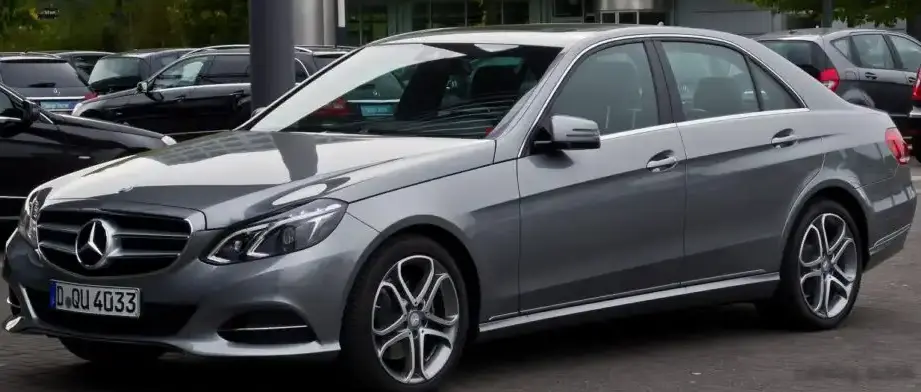
The Mercedes-Benz E 200 (W212 facelift, produced from April 2013 to January 2016) represented the entry point into the W212 E-Class range following the model’s mid-cycle refresh. Positioned as a more accessible alternative to the higher-powered E 250 and E 350 models, the E 200 offered a balance of efficiency, comfort, and the prestige associated with the three-pointed star. This variant primarily targeted buyers seeking a refined executive sedan experience without the higher price tag of its more potent siblings. It was sold primarily in European and Asian markets, where smaller displacement engines were favored due to tax regulations and fuel costs.
| Brand | Mercedes-Benz |
| Model | E-Class |
| Generation | E-Class (W212, facelift 2013) |
| Type (Engine) | E 200 (184 Hp) |
| Start of production | April, 2013 |
| End of production | January, 2016 |
| Powertrain Architecture | Internal Combustion engine |
| Body type | Sedan |
| Seats | 5 |
| Doors | 4 |
| Fuel consumption (urban) | 8-8.4 l/100 km (29.4 – 28 US mpg) |
| Fuel consumption (extra urban) | 5-5.3 l/100 km (47 – 44.4 US mpg) |
| Fuel consumption (combined) | 6.1-6.5 l/100 km (38.6 – 36.2 US mpg) |
| CO2 emissions | 142-151 g/km |
| Fuel Type | Petrol (Gasoline) |
| Acceleration 0 – 100 km/h | 8.2 sec |
| Acceleration 0 – 62 mph | 8.2 sec |
| Acceleration 0 – 60 mph | 7.8 sec |
| Maximum speed | 233 km/h (144.78 mph) |
| Emission standard | Euro 6 |
| Weight-to-power ratio | 8.4 kg/Hp |
| Weight-to-torque ratio | 5.7 kg/Nm |
| Power | 184 Hp @ 5500 rpm |
| Torque | 270 Nm @ 1200-4600 rpm (199.14 lb.-ft. @ 1200-4600 rpm) |
| Engine layout | Front, Longitudinal |
| Engine Model/Code | M 274.920 |
| Engine displacement | 1991 cm3 (121.5 cu. in.) |
| Number of cylinders | 4 |
| Engine configuration | Inline |
| Cylinder Bore | 83 mm (3.27 in.) |
| Piston Stroke | 92 mm (3.62 in.) |
| Compression ratio | 9.8:1 |
| Number of valves per cylinder | 4 |
| Fuel injection system | Direct injection |
| Engine aspiration | Turbocharger, Intercooler |
| Valvetrain | DOHC |
| Engine oil capacity | 6.3 l (6.66 US qt | 5.54 UK qt) |
| Coolant capacity | 8.5 l (8.98 US qt | 7.48 UK qt) |
| Kerb Weight | 1540 kg (3395.12 lbs.) |
| Max. weight | 2180 kg (4806.08 lbs.) |
| Max load | 640 kg (1410.96 lbs.) |
| Trunk (boot) space (minimum) | 540 l (19.07 cu. ft.) |
| Fuel tank capacity | 59 l (15.59 US gal | 12.98 UK gal) |
| Max. roof load | 100 kg (220.46 lbs.) |
| Permitted trailer load (with brakes) | 1700 kg (3747.86 lbs.) |
| Permitted trailer load (without brakes) | 750 kg (1653.47 lbs.) |
| Permitted towbar download | 84 kg (185.19 lbs.) |
| Length | 4879 mm (192.09 in.) |
| Width | 1854 mm (72.99 in.) |
| Width including mirrors | 2071 mm (81.54 in.) |
| Height | 1474 mm (58.03 in.) |
| Wheelbase | 2874 mm (113.15 in.) |
| Front track | 1598 mm (62.91 in.) |
| Rear track | 1614 mm (63.54 in.) |
| Front overhang | 849 mm (33.43 in.) |
| Rear overhang | 1156 mm (45.51 in.) |
| Drag coefficient (Cd) | 0.26 |
| Minimum turning circle | 11.28 m (37.01 ft.) |
| Drivetrain | Rear wheel drive |
| Number of gears | 6 |
| Gearbox type | Manual transmission |
Powertrain & Engine Architecture
The E 200 utilized the M274.920 2.0-liter inline-four cylinder engine, a member of Mercedes-Benz’s modular engine family. This engine featured direct fuel injection and a single twin-scroll turbocharger with an intercooler. The engine produced 184 horsepower at 5,500 rpm and 270 Nm (199 lb-ft) of torque available from a low 1,200 rpm to 4,600 rpm. This broad torque curve was a key characteristic, providing good responsiveness in everyday driving situations. The engine incorporated a timing chain for durability and featured variable valve timing on both the intake and exhaust sides (DOHC) to optimize performance and efficiency. The standard transmission was a 6-speed manual gearbox, although a 5-speed automatic transmission (5G-TRONIC) was also available as an option. The automatic transmission was known for its smooth shifts but lacked the efficiency of more modern multi-gear automatics.
Driving Characteristics
The E 200, particularly with the manual transmission, offered a reasonably engaging driving experience. While not a sports sedan, the engine’s torque delivery made it feel more powerful than its horsepower figure suggested. Acceleration from 0-100 km/h (0-62 mph) took approximately 8.2 seconds. The automatic transmission, while comfortable, did slightly diminish performance due to its fewer gears and less aggressive shift programming. Compared to the E 250 (which featured a more powerful version of the same engine), the E 200 felt less urgent in acceleration. However, it provided a more relaxed and fuel-efficient driving experience, making it well-suited for long-distance cruising. The rear-wheel-drive configuration contributed to balanced handling, although it wasn’t as nimble as some of its front-wheel-drive competitors.
Equipment & Trim Levels
The E 200 typically came standard with features such as automatic climate control, a multi-function steering wheel, power windows and mirrors, and an audio system with Bluetooth connectivity. Upholstery was generally cloth, with leather options available as upgrades. Common optional extras included a sunroof, navigation system, parking sensors, heated seats, and upgraded audio systems. Trim levels varied slightly depending on the market, but generally followed a progression from base ‘SE’ to more luxurious ‘Sport’ or ‘AMG Line’ packages. The ‘Sport’ trim added features like sport suspension, alloy wheels, and interior trim upgrades, while the ‘AMG Line’ offered more aggressive styling cues and performance-oriented enhancements.
Chassis & Braking
The W212 E-Class utilized a multi-link independent suspension system at both the front and rear, providing a comfortable and controlled ride. The E 200 typically featured ventilated disc brakes at the front and solid disc brakes at the rear. Anti-lock Braking System (ABS) and Electronic Stability Program (ESP) were standard safety features. The suspension was tuned for comfort, prioritizing ride quality over outright handling sharpness. Optional air suspension was available, offering adjustable ride height and damping for an even more refined experience. Stabilizer bars were fitted front and rear to reduce body roll during cornering.
Market Reception & Comparison
The E 200 was generally well-received by automotive critics as a sensible and refined entry-level option within the E-Class range. It was praised for its fuel efficiency, comfortable ride, and the prestige of the Mercedes-Benz brand. However, some reviewers noted that the engine lacked the outright performance of its more powerful siblings. Compared to the E 250, the E 200 offered a lower purchase price but sacrificed some performance. Against competitors like the BMW 3 Series and Audi A4, the E 200 offered a more luxurious interior and a more comfortable ride, but potentially less engaging handling. Fuel economy figures were competitive for its class, averaging around 6.1-6.5 l/100 km (38.6-36.2 US mpg).
Legacy
The M274 engine family, including the version used in the E 200, has proven to be relatively reliable, although some owners have reported issues with the timing chain and oil leaks over the long term. The 5G-TRONIC automatic transmission, while generally durable, is known to require more frequent servicing than newer automatic transmissions. Today, the W212 E 200 represents a relatively affordable entry point into Mercedes-Benz ownership. Well-maintained examples are still common on the used car market and offer a good balance of comfort, reliability, and prestige. Its fuel efficiency and relatively low running costs make it an attractive option for buyers seeking a refined executive sedan without breaking the bank.