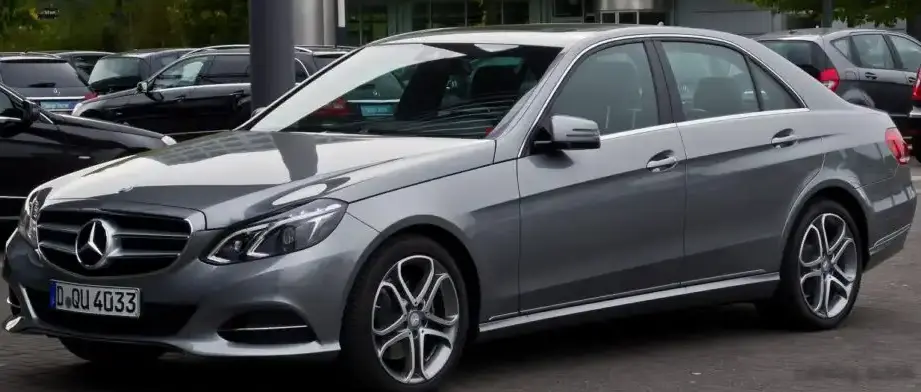
The Mercedes-Benz E 200 BlueTEC, produced from July 2014 to January 2016, was a key variant within the W212 E-Class facelift range. Positioned as an efficient and refined option, it catered to buyers seeking a balance between performance, economy, and the prestige associated with the E-Class nameplate. This model represented a significant step towards cleaner diesel technology, incorporating advanced emissions control systems to meet stringent Euro 6 standards. It primarily served the European market, where diesel engines held a substantial share of the executive car segment.
| Brand | Mercedes-Benz |
| Model | E-class |
| Generation | E-class (W212, facelift 2013) |
| Type (Engine) | E 200 BlueTEC (136 Hp) |
| Start of production | July, 2014 |
| End of production | January, 2016 |
| Powertrain Architecture | Internal Combustion engine |
| Body type | Sedan |
| Seats | 5 |
| Doors | 4 |
| Fuel consumption (urban) | 5.6-5.9 l/100 km (42 – 39.9 US mpg) |
| Fuel consumption (extra urban) | 4-4.2 l/100 km (58.8 – 56 US mpg) |
| Fuel consumption (combined) | 4.6-4.8 l/100 km (51.1 – 49 US mpg) |
| CO2 emissions | 119-125 g/km |
| Fuel Type | Diesel |
| Acceleration 0 – 100 km/h | 10.2 sec |
| Acceleration 0 – 62 mph | 10.2 sec |
| Acceleration 0 – 60 mph | 9.7 sec |
| Maximum speed | 210 km/h (130.49 mph) |
| Emission standard | Euro 6 |
| Weight-to-power ratio | 12.2 kg/Hp |
| Weight-to-torque ratio | 4.6 kg/Nm |
| Power | 136 Hp @ 2800-4600 rpm |
| Torque | 360 Nm @ 1400-2600 rpm (265.52 lb.-ft.) |
| Engine layout | Front, Longitudinal |
| Engine Model/Code | OM 651.925 |
| Engine displacement | 2143 cm3 (130.77 cu. in.) |
| Number of cylinders | 4 |
| Engine configuration | Inline |
| Cylinder Bore | 83 mm (3.27 in.) |
| Piston Stroke | 99 mm (3.9 in.) |
| Compression ratio | 16.2:1 |
| Number of valves per cylinder | 4 |
| Fuel injection system | Diesel Commonrail |
| Engine aspiration | Turbocharger, Intercooler |
| Valvetrain | DOHC |
| Engine oil capacity | 6.5 l (6.87 US qt | 5.72 UK qt) |
| Coolant capacity | 10 l (10.57 US qt | 8.8 UK qt) |
| Kerb Weight | 1660 kg (3659.67 lbs.) |
| Max. weight | 2320 kg (5114.72 lbs.) |
| Max load | 660 kg (1455.05 lbs.) |
| Trunk (boot) space | 490 l (17.3 cu. ft.) |
| Fuel tank capacity | 59 l (15.59 US gal | 12.98 UK gal) |
| AdBlue tank | 25.5 l (6.74 US gal | 5.61 UK gal) |
| Max. roof load | 100 kg (220.46 lbs.) |
| Permitted trailer load (braked) | 1900 kg (4188.78 lbs.) |
| Permitted trailer load (unbraked) | 750 kg (1653.47 lbs.) |
| Permitted towbar download | 84 kg (185.19 lbs.) |
| Length | 4879 mm (192.09 in.) |
| Width | 1854 mm (72.99 in.) |
| Width including mirrors | 2071 mm (81.54 in.) |
| Height | 1474 mm (58.03 in.) |
| Wheelbase | 2874 mm (113.15 in.) |
| Front track | 1598 mm (62.91 in.) |
| Rear track | 1614 mm (63.54 in.) |
| Drag coefficient (Cd) | 0.25 |
| Minimum turning circle | 11.28 m (37.01 ft.) |
| Drivetrain | Rear wheel drive |
| Number of gears | 6 |
| Gearbox type | Manual transmission |
Powertrain & Engine Architecture
The E 200 BlueTEC utilized the OM 651.925, a 2.1-liter inline-four diesel engine. This engine was a mainstay of the Mercedes-Benz lineup, known for its durability and efficiency. It featured a common rail direct injection system, delivering fuel at extremely high pressures for optimized combustion. The engine also incorporated a turbocharger with an intercooler, boosting power output and improving throttle response. The valvetrain employed a double overhead camshaft (DOHC) design with four valves per cylinder, enhancing volumetric efficiency. The six-speed manual transmission was the standard offering, providing precise gear changes and contributing to the car’s fuel efficiency. A 7G-TRONIC PLUS automatic transmission was available as an option, offering smoother shifts and enhanced convenience.
Driving Characteristics
The 136 horsepower and 360 Nm (265 lb-ft) of torque provided by the E 200 BlueTEC resulted in a comfortable and relaxed driving experience. Acceleration from 0 to 100 km/h (0-62 mph) took approximately 10.2 seconds, which was adequate for everyday driving but not particularly sporty. The engine’s torque curve was relatively flat, providing good pulling power from low engine speeds. Compared to the more powerful E 250 CDI or E 350 CDI models, the E 200 BlueTEC offered less outright performance, but it excelled in fuel economy. The manual transmission allowed for greater driver control, while the optional automatic provided a more effortless experience, particularly in urban traffic. The rear-wheel-drive configuration contributed to balanced handling, although it wasn’t as engaging as the all-wheel-drive 4MATIC variants.
Equipment & Trim Levels
The E 200 BlueTEC typically came equipped with a generous array of standard features, including automatic climate control, a multi-function steering wheel, and an audio system with Bluetooth connectivity. Interior upholstery was typically Artico leather, a high-quality synthetic leather. Optional extras included a sunroof, navigation system, premium sound system, and various driver assistance systems such as lane keeping assist and blind spot monitoring. Trim levels varied depending on the market, but generally offered options for upgraded interior materials, exterior styling enhancements, and additional comfort features. The Avantgarde and AMG Line packages were popular choices, offering a sportier aesthetic and enhanced equipment levels.
Chassis & Braking
The W212 E-Class featured a sophisticated chassis design, incorporating a multi-link independent suspension at both the front and rear. This setup provided a comfortable ride and good handling characteristics. The E 200 BlueTEC typically came with ventilated disc brakes at the front and solid disc brakes at the rear. Anti-lock braking system (ABS) and electronic stability control (ESP) were standard safety features. Optional air suspension was available, offering adjustable ride height and improved comfort. Stabilizer bars were fitted to both axles to reduce body roll during cornering.
Market Reception & Comparison
The E 200 BlueTEC was generally well-received by automotive critics, who praised its fuel efficiency, refined ride, and comfortable interior. It was seen as a sensible choice for buyers prioritizing economy and practicality over outright performance. Compared to the higher-output diesel variants, the E 200 BlueTEC offered lower running costs but sacrificed some performance. Its fuel economy figures were competitive with other executive cars in its class, and its emissions were relatively low, thanks to the advanced BlueTEC technology. Reliability was generally good, although some owners reported issues with the diesel particulate filter (DPF) system, particularly on vehicles used primarily for short journeys.
Legacy
The Mercedes-Benz E 200 BlueTEC (W212) remains a popular choice in the used car market, particularly for those seeking a comfortable, reliable, and fuel-efficient executive car. The OM 651 engine is known for its longevity, and with proper maintenance, it can provide many years of trouble-free service. However, potential buyers should be aware of the potential for DPF issues and ensure that the vehicle has been regularly serviced. The W212 E-Class, as a whole, is considered a well-built and refined vehicle, and the E 200 BlueTEC represents a compelling value proposition for those seeking a premium driving experience without the high running costs of more powerful models.