
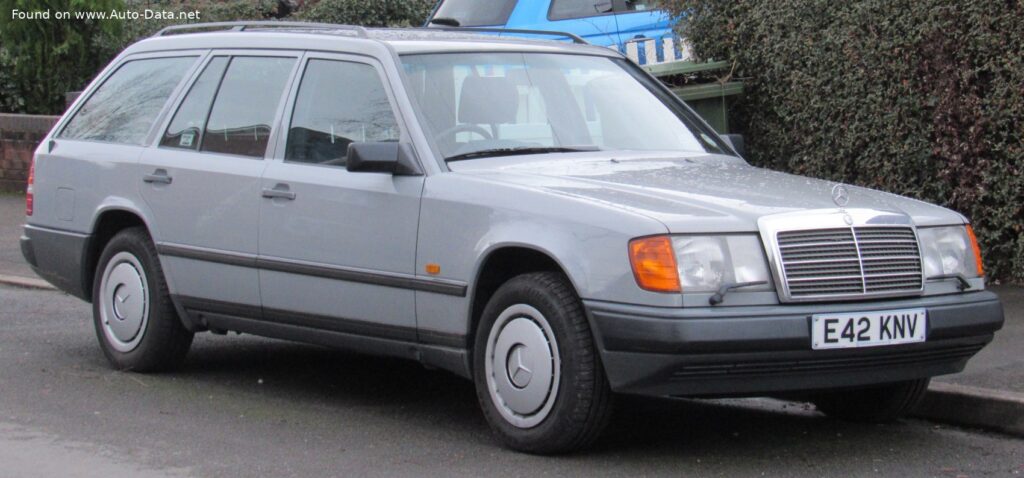
Mercedes-Benz S124 300 TD Turbo (147 Hp) Automatic
The Mercedes-Benz W124 series, produced from 1984 to 1996, stands as a testament to German engineering and a high-water mark for Mercedes-Benz’s reputation for durability, quality, and understated luxury. Among its various body styles, the S124 station wagon (or “estate” as it’s known in Europe) offered unparalleled practicality without compromising the W124’s core attributes. The Mercedes-Benz S124 300 TD Turbo, specifically the 147 horsepower automatic variant produced between September 1988 and August 1989, represented the pinnacle of diesel-powered luxury wagons for its era. It combined the W124’s robust chassis and refined ride with a powerful, efficient, and famously durable turbocharged diesel engine, making it a highly sought-after vehicle for families and professionals alike who demanded reliability, comfort, and ample cargo space.
Positioned in the executive car segment, the S124 300 TD Turbo was a sophisticated offering designed to excel on long journeys, provide comfortable daily commuting, and handle substantial loads. Its meticulous construction and advanced features for the time cemented its place as a benchmark for premium automobiles, influencing subsequent generations of luxury vehicles and solidifying Mercedes-Benz’s image as a manufacturer of “over-engineered” machines.
Engine and Performance of the Mercedes-Benz S124 300 TD Turbo
At the heart of the 1988-1989 Mercedes-Benz S124 300 TD Turbo was the revered OM 603 D 30 A / 603.960 engine, a 3.0-liter (2996 cm³ or 182.83 cu. in.) inline six-cylinder diesel powerplant. This SOHC (Single Overhead Camshaft) engine utilized a precombustion chamber injection system, a common and robust design for diesel engines of its time, known for its ability to handle various fuel qualities and contribute to the engine’s legendary longevity. The addition of a turbocharger significantly boosted its output compared to naturally aspirated diesel variants, delivering a respectable 147 horsepower at 4600 rpm. This power output, especially for a diesel engine in the late 1980s, was quite impressive, providing ample motivation for the substantial S124 wagon.
More crucial than peak horsepower for a vehicle designed for hauling and cruising was its torque figure. The 300 TD Turbo generated a formidable 273 Nm (201.35 lb.-ft.) of torque at a low 2400 rpm. This broad and accessible torque band was instrumental in the vehicle’s smooth acceleration and effortless highway cruising, allowing it to pull away from a standstill or overtake with confidence, even when fully loaded. The engine’s robust design, featuring a compression ratio of 22:1 and two valves per cylinder, underscored its focus on durability and efficiency.
Power was transmitted to the rear wheels via a smooth-shifting 4-speed automatic transmission, a common and reliable choice for luxury vehicles of the era. This drivetrain architecture, combined with the engine’s characteristics, allowed the S124 300 TD Turbo to accelerate from 0 to 60 mph in a respectable 10.4 seconds, with a top speed of 121.17 mph (195 km/h). While not sports car territory, these figures were more than adequate for a family-oriented wagon and competitive among its peers.
Fuel economy was another strong suit for this diesel powerhouse. Mercedes-Benz quoted an urban fuel consumption of 9.4 l/100 km (25 US mpg) and an extra-urban figure of 6.9 l/100 km (34.1 US mpg). These efficiency numbers were excellent for a vehicle of its size and performance, making it an economical choice for long-distance travel, especially in markets where diesel fuel was more prevalent and cost-effective.
Chassis and Drivetrain
The W124 platform was celebrated for its sophisticated chassis design, and the S124 wagon benefited immensely from this. It featured a front wishbone suspension and a groundbreaking independent multi-link rear suspension. This advanced rear setup, a Mercedes-Benz innovation, provided exceptional ride comfort, precise handling, and superior stability, even when the vehicle was carrying heavy loads. The hydraulic power steering, utilizing a cone worm with recirculation balls system, offered a balanced feel, providing both ease of maneuverability at low speeds and reassuring stability on the highway.
Braking performance was handled by ventilated discs at the front and solid discs at the rear, complemented by an Anti-lock Braking System (ABS), which was a significant safety feature for the time. The standard tire size was 195/65 R15 on 6.5J x 15 wheel rims, providing a good balance of grip, comfort, and durability.
Design and Features
The Mercedes-Benz S124 station wagon embodied a timeless, elegant, and functional design language that has aged remarkably well. Its exterior styling was characterized by clean lines, a relatively low beltline for excellent visibility, and a purposeful stance. The S124 wagon shared the W124 sedan’s front-end styling, including the iconic Mercedes-Benz grille and integrated headlights, projecting an image of solidity and prestige.
With a length of 187.6 inches, a width of 68.5 inches, and a height of 58.66 inches, the S124 offered substantial interior volume. The wheelbase of 110.24 inches contributed to its stable ride and generous passenger legroom. As a 5-door, 5-seat station wagon, its primary appeal lay in its exceptional versatility. The spacious cargo area was easily accessible through a large rear hatch, and the rear seats could typically be folded down to create a cavernous load bay, transforming it into a highly capable utility vehicle. While this specific data only lists 5 seats, many S124 wagons in the era were optionally available with a rear-facing third-row jump seat, further enhancing its family-hauling capabilities.
Inside, the S124 maintained Mercedes-Benz’s reputation for high-quality materials and ergonomic design. The cabin was built to last, with durable fabrics or leather, precisely fitted trim, and intuitive controls. Features common to W124 models included automatic climate control, power windows, central locking, and a premium audio system, all designed to enhance passenger comfort and convenience. Safety was a paramount concern for Mercedes-Benz, and the W124 featured a rigid passenger cell, crumple zones, and the aforementioned ABS, setting high standards for occupant protection in its class.
Technical Specifications
| Category | Specification |
|---|---|
| Brand | Mercedes-Benz |
| Model | W124 |
| Generation | S124 |
| Engine Type | 300 TD Turbo (147 Hp) Automatic |
| Production Start | September, 1988 |
| Production End | August, 1989 |
| Powertrain Architecture | Internal Combustion engine |
| Body Type | Station wagon (estate) |
| Seats | 5 |
| Doors | 5 |
| Performance Specs | |
| Fuel Consumption (Urban) | 9.4 l/100 km (25 US mpg) |
| Fuel Consumption (Extra Urban) | 6.9 l/100 km (34.1 US mpg) |
| Fuel Type | Diesel |
| Acceleration 0-60 mph | 10.4 sec |
| Maximum Speed | 121.17 mph (195 km/h) |
| Weight-to-Power Ratio | 10.7 kg/Hp (93 Hp/tonne) |
| Weight-to-Torque Ratio | 5.8 kg/Nm (172.8 Nm/tonne) |
| Engine Specs | |
| Power | 147 Hp @ 4600 rpm |
| Power per Liter | 49.1 Hp/l |
| Torque | 273 Nm (201.35 lb.-ft.) @ 2400 rpm |
| Engine Layout | Front, Longitudinal |
| Engine Model/Code | OM 603 D 30 A / 603.960 |
| Engine Displacement | 2996 cm³ (3.0 l / 182.83 cu. in.) |
| Number of Cylinders | 6 |
| Engine Configuration | Inline |
| Cylinder Bore | 87 mm (3.43 in.) |
| Piston Stroke | 84 mm (3.31 in.) |
| Compression Ratio | 22:1 |
| Valves per Cylinder | 2 |
| Fuel Injection System | Precombustion chamber injection |
| Engine Aspiration | Turbocharger |
| Valvetrain | SOHC |
| Engine Oil Capacity | 7.5 l (7.93 US qt) |
| Coolant Capacity | 9.5 l (10.04 US qt) |
| Space, Volume and Weights | |
| Kerb Weight | 1580 kg (3483.3 lbs.) |
| Max. Weight | 2200 kg (4850.17 lbs.) |
| Max Load | 620 kg (1366.87 lbs.) |
| Fuel Tank Capacity | 72 l (19.02 US gal) |
| Dimensions | |
| Length | 4765 mm (187.6 in.) |
| Width | 1740 mm (68.5 in.) |
| Height | 1490 mm (58.66 in.) |
| Wheelbase | 2800 mm (110.24 in.) |
| Front Track | 1497 mm (58.94 in.) |
| Rear Track | 1488 mm (58.58 in.) |
| Drivetrain, Brakes and Suspension Specs | |
| Drivetrain Architecture | Internal combustion engine drives the rear wheels. |
| Drive Wheel | Rear wheel drive |
| Gearbox Type | 4 gears, automatic transmission |
| Front Suspension | Wishbone |
| Rear Suspension | Independent multi-link suspension |
| Front Brakes | Ventilated discs |
| Rear Brakes | Disc |
| Assisting Systems | ABS (Anti-lock braking system) |
| Steering Type | Cone worm with recirculation balls |
| Power Steering | Hydraulic Steering |
| Front Wheel Tires | 195/65 R15 |
| Rear Wheel Tires | 195/65 R15 |
| Front Wheel Rims | 6.5J x 15 |
| Rear Wheel Rims | 6.5J x 15 |
Legacy and Market Impact
The Mercedes-Benz W124, and particularly its S124 wagon variant, has carved out an enduring legacy as one of the most well-engineered and durable automobiles ever produced. The Mercedes-Benz S124 300 TD Turbo stands as a prime example of this reputation, embodying the “over-engineered” philosophy that Mercedes-Benz was famous for during this era. Its build quality was legendary, with many examples still reliably serving owners decades after rolling off the production line. This longevity, coupled with its robust mechanicals and timeless design, has earned it a cult following among enthusiasts and a strong demand in the classic car market.
In its primary markets, particularly Europe and to some extent in the United States, the S124 300 TD Turbo competed against other premium executive wagons such as the BMW 5 Series Touring (E34 generation), the Audi 100 Avant (C3/C4 generations), and to a lesser extent, the Volvo 740/940 series. While rivals offered compelling packages, the Mercedes-Benz often distinguished itself with a perceived higher level of engineering sophistication, a more compliant ride, and an unmatched reputation for diesel engine reliability and durability. Its effortless torque and impressive fuel economy made it a favorite for long-distance travel and as a capable workhorse for professionals who needed to carry equipment or transport families in comfort.
The historical significance of the S124 300 TD Turbo lies in its contribution to establishing the diesel engine’s viability as a refined, powerful, and efficient option in the luxury segment. It demonstrated that a diesel vehicle could offer a premium driving experience without sacrificing performance or comfort. Today, these vehicles are celebrated for their mechanical integrity, ease of maintenance (relative to modern complex cars), and their distinctive driving character. Many S124 owners cherish them as daily drivers or weekend classics, a testament to their enduring appeal and the foresight of their original design and engineering. The S124 300 TD Turbo continues to represent a golden age for Mercedes-Benz, a period when meticulous engineering and uncompromising quality were the hallmarks of the brand.
