
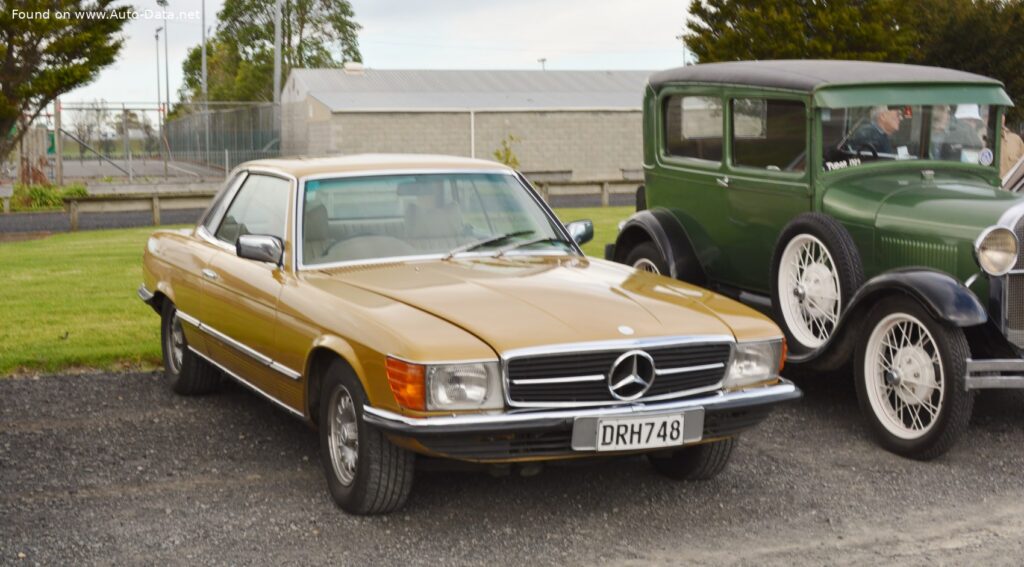
Mercedes-Benz SLC (C107) 280 SLC (185 Hp)
The Mercedes-Benz SLC (C107) 280 SLC (185 Hp) represents a distinctive chapter in the German automaker’s illustrious history, serving as the fixed-roof coupe variant of the popular R107 SL roadster. Produced from May 1974 to February 1976, this specific iteration of the C107 chassis offered a compelling blend of luxury, grand touring capability, and robust engineering. While the R107/C107 platform enjoyed global appeal, the 280 SLC, with its inline-six engine, was particularly well-suited for European markets where fuel efficiency and displacement-based taxation often favored smaller, yet still potent, powertrains over the larger V8s offered in other SLC models. It carved out a niche for itself as a sophisticated, comfortable, and stylish five-seater coupe, designed for long-distance travel with a touch more practicality than its convertible sibling.
Engine & Performance: The Heart of the Mercedes-Benz SLC (C107) 280 SLC
At the core of the Mercedes-Benz SLC (C107) 280 SLC (185 Hp) lay the venerable M 110 E 28 engine, an inline-six unit renowned for its smoothness and durability. This powerplant, identified by the code M 110 E 28 / 110.982, featured a displacement of 2746 cubic centimeters, or approximately 2.7 liters (167.57 cu. in.). It was a sophisticated design for its era, boasting a Double Overhead Camshaft (DOHC) valvetrain with two valves per cylinder, ensuring efficient gas flow and contributing to its refined character. Fuel delivery was handled by a multi-port manifold injection system, a significant technological advancement that provided more precise fueling compared to carburetors, leading to improved performance and efficiency. As a naturally aspirated engine, it delivered its power linearly and predictably.
The M 110 engine in this configuration produced a healthy 185 horsepower at 6000 revolutions per minute, a respectable figure for a luxury coupe in the mid-1970s. Torque output stood at 238 Newton-meters, which translates to approximately 175.54 lb.-ft. at 4500 rpm, providing ample pulling power across the rev range. This power was channeled to the rear wheels through a standard 4-speed manual transmission, offering a direct and engaging driving experience.
In terms of acceleration, the 280 SLC was capable of reaching 60 miles per hour from a standstill in an estimated 9.6 seconds, with the 0-100 km/h sprint taking 10.1 seconds. Its maximum speed was rated at 205 km/h, or 127.38 mph, making it a capable cruiser on the Autobahn or American interstate highways. Despite its performance credentials, Mercedes-Benz also engineered the vehicle for reasonable fuel economy for its class and era, with a combined consumption rating of 12.5 liters per 100 kilometers, or approximately 18.8 US miles per gallon. With a substantial 90-liter (23.78 US gallon) fuel tank, the 280 SLC offered an impressive cruising range, reinforcing its grand touring credentials. The vehicle’s weight-to-power ratio was 8.4 kg/Hp, or 119.4 Hp/tonne, indicating a balanced approach to performance and luxury.
Design & Features of the Mercedes-Benz SLC (C107)
The Mercedes-Benz C107 chassis, sharing its underpinnings with the R107 SL roadster, was a paragon of Mercedes-Benz design from the 1970s. The SLC variant distinguished itself with a fixed roof and a longer wheelbase (111.02 inches compared to the SL’s 96.9 inches), allowing for the inclusion of a usable rear seat, making it a true 2-door, 5-seater coupe. Its elegant lines, characterized by a long hood, prominent grille, and a subtly sloping roofline, exuded a timeless sophistication. The overall length measured 187.01 inches, with a width of 70.47 inches and a height of 52.36 inches, giving it a substantial and imposing road presence.
Inside, the SLC offered a blend of luxury and ergonomic design. High-quality materials, comfortable seating, and a well-appointed dashboard were hallmarks of Mercedes-Benz interiors of the period. While specific feature lists are not provided, one can infer the presence of amenities expected in a luxury vehicle of its time, such as power windows, air conditioning (optional), and a sophisticated audio system. Safety, a perennial Mercedes-Benz priority, was addressed through robust construction and features like disc brakes on all four wheels.
The suspension system was designed to provide a comfortable yet controlled ride, essential for a grand tourer. The front featured a double wishbone setup with a transverse stabilizer, while the rear utilized trailing arms also with a transverse stabilizer. This independent suspension architecture ensured excellent road holding and passenger comfort. Braking power was supplied by ventilated discs at the front and solid discs at the rear, a capable system for the vehicle’s weight and performance. Steering was handled by a hydraulic power-assisted cone worm with recirculation balls system, offering precise control and ease of maneuverability. The car rode on 195/70 R14 tires mounted on 6.5J x 14-inch wheel rims, a common specification for luxury cars of its era, balancing grip with ride comfort.
Technical Specifications: Mercedes-Benz SLC (C107) 280 SLC (185 Hp)
| Category | Specification |
|---|---|
| General Information | |
| Brand | Mercedes-Benz |
| Model | SLC |
| Generation | SLC (C107) |
| Type (Engine) | 280 SLC (185 Hp) |
| Start of Production | May, 1974 |
| End of Production | February, 1976 |
| Powertrain Architecture | Internal Combustion engine |
| Body type | Coupe |
| Seats | 5 |
| Doors | 2 |
| Performance Specs | |
| Fuel Consumption (combined) | 12.5 l/100 km (18.8 US mpg) |
| Fuel Type | Petrol (Gasoline) |
| Acceleration 0-60 mph | 9.6 sec |
| Acceleration 0-100 km/h | 10.1 sec |
| Maximum Speed | 205 km/h (127.38 mph) |
| Weight-to-power ratio | 8.4 kg/Hp (119.4 Hp/tonne) |
| Weight-to-torque ratio | 6.5 kg/Nm (153.5 Nm/tonne) |
| Engine Specs | |
| Power | 185 Hp @ 6000 rpm |
| Power per liter | 67.4 Hp/l |
| Torque | 238 Nm @ 4500 rpm (175.54 lb.-ft. @ 4500 rpm) |
| Engine Layout | Front, Longitudinal |
| Engine Model/Code | M 110 E 28 / 110.982 |
| Engine Displacement | 2746 cm3 (2.7 liters / 167.57 cu. in.) |
| Number of Cylinders | 6 |
| Engine Configuration | Inline |
| Cylinder Bore | 86 mm (3.39 in.) |
| Piston Stroke | 78.8 mm (3.1 in.) |
| Compression Ratio | 9:1 |
| Number of Valves per Cylinder | 2 |
| Fuel Injection System | Multi-port manifold injection |
| Engine Aspiration | Naturally aspirated engine |
| Valvetrain | DOHC |
| Engine Oil Capacity | 6 liters (6.34 US qt) |
| Coolant Capacity | 12 liters (12.68 US qt) |
| Space, Volume and Weights | |
| Kerb Weight | 1550 kg (3417.17 lbs.) |
| Max. Weight | 2040 kg (4497.43 lbs.) |
| Max Load | 490 kg (1080.27 lbs.) |
| Fuel Tank Capacity | 90 liters (23.78 US gal) |
| Dimensions | |
| Length | 4750 mm (187.01 in.) |
| Width | 1790 mm (70.47 in.) |
| Height | 1330 mm (52.36 in.) |
| Wheelbase | 2820 mm (111.02 in.) |
| Front Track | 1452 mm (57.17 in.) |
| Rear (Back) Track | 1440 mm (56.69 in.) |
| Drivetrain, Brakes and Suspension Specs | |
| Drivetrain Architecture | Internal combustion engine drives the rear wheels |
| Drive Wheel | Rear-wheel drive |
| Number of Gears and Type of Gearbox | 4 gears, manual transmission |
| Front Suspension | Double wishbone, Transverse stabilizer |
| Rear Suspension | Transverse stabilizer, Trailing arm |
| Front Brakes | Ventilated discs |
| Rear Brakes | Disc |
| Steering Type | Cone worm with recirculation balls |
| Power Steering | Hydraulic Steering |
| Tires Size | 195/70 R14 |
| Wheel Rims Size | 6.5J x 14 |
Legacy & Market Impact of the Mercedes-Benz SLC (C107)
The Mercedes-Benz C107 series, including the Mercedes-Benz SLC (C107) 280 SLC (185 Hp), holds a significant place in the brand’s history, often overshadowed by its more famous roadster sibling, the R107 SL. However, the SLC carved out its own identity as a sophisticated, long-distance grand touring coupe. While the R107 SL was primarily a two-seater convertible designed for leisure and open-air driving, the SLC offered a more practical and year-round proposition with its fixed roof and crucial rear seating, making it a viable choice for families or those requiring occasional rear passenger capacity.
In the mid-1970s European luxury market, the 280 SLC faced competition from rivals such as the Jaguar XJ-S and the BMW 6 Series (E24), both offering their own interpretations of the luxury grand tourer. The Mercedes-Benz distinguished itself with its renowned build quality, engineering integrity, and a reputation for unparalleled longevity and reliability. The M 110 inline-six engine, in particular, was celebrated for its smooth operation and robust design, contributing to the car’s enduring appeal.
The C107 SLC models, including the 280 SLC, were often utilized in motorsport, particularly in rallying and endurance racing, which further cemented their reputation for durability and performance. While the 280 SLC might not have been the most powerful variant, its balance and efficiency made it a strong contender in specific events and a popular choice for discerning buyers in its primary markets.
Today, the Mercedes-Benz SLC (C107) 280 SLC is regarded as a classic car, appreciating for its elegant styling, solid engineering, and the unmistakable cachet of a vintage Mercedes-Benz. It represents an era when Mercedes-Benz vehicles were engineered with an almost obsessive attention to detail and designed to last for decades. Its robust construction and relative ease of maintenance, coupled with the growing appreciation for classic German luxury cars, ensure its continued relevance among collectors and enthusiasts worldwide. The 280 SLC stands as a testament to Mercedes-Benz’s commitment to delivering a luxurious, capable, and enduring grand tourer, even in its six-cylinder guise, offering a refined driving experience that remains compelling even half a century later.
