
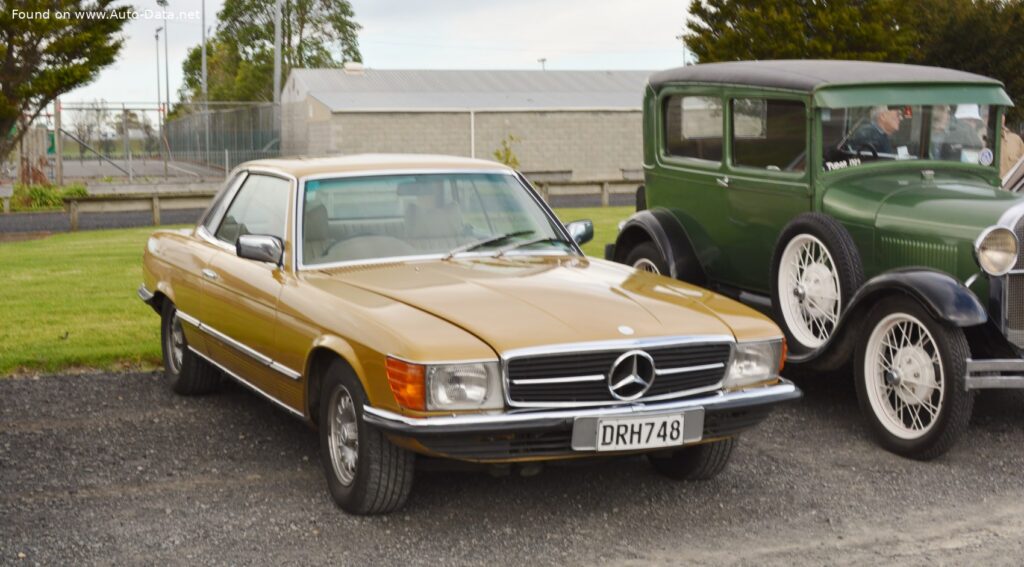
The Mercedes-Benz SLC (C107): A Grand Touring Icon
The Mercedes-Benz SLC (C107) represents a distinctive chapter in the Stuttgart automaker’s illustrious history, serving as the fixed-roof, long-wheelbase coupe variant of the popular R107 SL roadster. Introduced in June 1971, the Mercedes-Benz SLC (C107) was designed to offer a more practical, four-to-five-seat grand touring experience than its two-seat convertible sibling. While the R107 SL was conceived primarily as a sporty roadster for two, the C107 SLC aimed at a broader luxury market, providing enhanced comfort and space for longer journeys. The 350 SLC V8, produced from 1971 to 1976, was one of the initial V8-powered offerings in this series, embodying Mercedes-Benz’s commitment to robust engineering, sophisticated design, and refined performance in the early 1970s luxury segment.
Positioned as a premium personal luxury coupe, the SLC competed with other high-end European and American models, offering a unique blend of German engineering precision and comfortable cruising capabilities. Its production run spanned nearly five years before being succeeded by more modern designs, but its legacy as a stylish and capable grand tourer remains firmly established. This article delves into the specifics of the 350 SLC V8, exploring its powertrain, design philosophy, technical specifications, and its lasting impact on the automotive landscape.
Engine & Performance of the Mercedes-Benz SLC (C107) 350 SLC V8
At the heart of the Mercedes-Benz SLC (C107) 350 SLC V8 lies the M 116 E 35 engine, a naturally aspirated V8 unit revered for its smooth operation and dependable power delivery. This powerplant, designated M 116.982, featured a displacement of 3,499 cubic centimeters (3.5 liters or 213.52 cubic inches). With an overhead camshaft (SOHC) valvetrain and two valves per cylinder, the engine was designed for a balance of performance and durability. Fuel was supplied via a multi-port manifold injection system, a sophisticated technology for its era, ensuring precise fuel delivery and efficiency.
The 3.5-liter V8 generated a respectable 200 horsepower at 5800 revolutions per minute (rpm), translating to a power output of 57.2 horsepower per liter. Torque figures were equally impressive for the period, peaking at 286 Newton-meters (210.94 pound-feet) at 4000 rpm. This robust torque curve provided ample pulling power, making the SLC a relaxed cruiser on highways while still capable of brisk acceleration. The engine’s compression ratio of 9.5:1 was fairly high, contributing to its efficiency and power.
Power was sent to the rear wheels through a 4-speed manual transmission, offering an engaging driving experience for those who preferred direct control over gear changes. This drivetrain architecture, combined with the front, longitudinal engine layout, contributed to the car’s balanced weight distribution and classic rear-wheel-drive dynamics. Performance metrics included an acceleration from 0 to 60 miles per hour in a swift 8.6 seconds, and a top speed of 130.49 miles per hour (210 km/h). While not a pure sports car, these figures placed the 350 SLC firmly in the realm of high-performance luxury vehicles of its time. Fuel economy, rated at approximately 18.1 US miles per gallon (13 liters per 100 km) combined, was typical for a V8-powered luxury coupe of the early 1970s.
Design & Features of the Mercedes-Benz SLC (C107)
The design of the Mercedes-Benz SLC (C107) is instantly recognizable, sharing its fundamental styling cues with the R107 SL roadster but distinguished by its unique coupe body. The C107’s most notable visual differences include its longer wheelbase (111.02 inches or 2820 mm), which accommodated the rear seats, and its distinctive fixed roofline. The rear quarter windows featured characteristic louvers, a design element that not only added to its aesthetic appeal but also provided some sun protection for rear occupants, especially in warmer climates. The overall length of the vehicle measured 187.01 inches (4750 mm), with a width of 70.47 inches (1790 mm) and a height of 52.36 inches (1330 mm), giving it a commanding yet elegant presence on the road.
Inside, the SLC offered a luxurious and well-appointed cabin, consistent with Mercedes-Benz’s reputation for quality and comfort. Designed for five occupants, though the rear seats were more suited for children or short trips for adults, the interior featured high-quality materials, ergonomic controls, and excellent fit and finish. For its era, the SLC boasted advanced safety features, including a rigid passenger cell, crumple zones, and a padded dashboard, reflecting Mercedes-Benz’s pioneering approach to automotive safety.
The suspension system comprised a double wishbone setup with a transverse stabilizer at the front and a trailing arm design with a transverse stabilizer at the rear, providing a comfortable ride characteristic of a grand tourer while maintaining competent handling. Braking duties were handled by ventilated discs at the front and solid discs at the rear, offering reliable stopping power. The hydraulic power steering system, a cone worm with recirculation balls type, provided precise and effortless control. The car rode on 205/70 R14 tires mounted on 6.5J x 14 wheel rims, a common specification for luxury vehicles of the period.
Technical Specifications
| Category | Specification |
|---|---|
| General Information | |
| Brand | Mercedes-Benz |
| Model | SLC |
| Generation | SLC (C107) |
| Type (Engine) | 350 SLC V8 (200 Hp) |
| Start of Production | June, 1971 |
| End of Production | February, 1976 |
| Powertrain Architecture | Internal Combustion Engine |
| Body type | Coupe |
| Seats | 5 |
| Doors | 2 |
| Performance Specs | |
| Fuel Consumption (combined) | 13 l/100 km (18.1 US mpg) |
| Fuel Type | Petrol (Gasoline) |
| Acceleration 0 – 60 mph | 8.6 seconds |
| Maximum speed | 130.49 mph (210 km/h) |
| Weight-to-power ratio | 8 kg/Hp (125.8 Hp/tonne) |
| Weight-to-torque ratio | 5.6 kg/Nm (179.9 Nm/tonne) |
| Engine Specs | |
| Power | 200 Hp @ 5800 rpm |
| Power per liter | 57.2 Hp/l |
| Torque | 286 Nm (210.94 lb.-ft.) @ 4000 rpm |
| Engine layout | Front, Longitudinal |
| Engine Model/Code | M 116 E 35 / 116.982 |
| Engine displacement | 3499 cm3 (3.5 l / 213.52 cu. in.) |
| Number of cylinders | 8 |
| Engine configuration | V-engine |
| Cylinder Bore | 92 mm (3.62 in.) |
| Piston Stroke | 65.8 mm (2.59 in.) |
| Compression ratio | 9.5:1 |
| Number of valves per cylinder | 2 |
| Fuel injection system | Multi-port manifold injection |
| Engine aspiration | Naturally aspirated engine |
| Valvetrain | SOHC (Single Overhead Camshaft) |
| Engine oil capacity | 8 l (8.45 US qt) |
| Coolant capacity | 14.3 l (15.11 US qt) |
| Space, Volume and Weights | |
| Kerb Weight | 1590 kg (3505.35 lbs.) |
| Max. weight | 2080 kg (4585.62 lbs.) |
| Max load | 490 kg (1080.27 lbs.) |
| Fuel tank capacity | 90 l (23.78 US gal) |
| Dimensions | |
| Length | 4750 mm (187.01 in.) |
| Width | 1790 mm (70.47 in.) |
| Height | 1330 mm (52.36 in.) |
| Wheelbase | 2820 mm (111.02 in.) |
| Front track | 1452 mm (57.17 in.) |
| Rear (Back) track | 1440 mm (56.69 in.) |
| Drivetrain, Brakes and Suspension Specs | |
| Drivetrain Architecture | Rear wheel drive |
| Drive wheel | Rear wheel drive |
| Number of gears and type of gearbox | 4 gears, manual transmission |
| Front suspension | Double wishbone, Transverse stabilizer |
| Rear suspension | Transverse stabilizer, Trailing arm |
| Front brakes | Ventilated discs |
| Rear brakes | Disc |
| Steering type | Cone worm with recirculation balls |
| Power steering | Hydraulic Steering |
| Tires size | 205/70 R14 |
| Wheel rims size | 6.5J x 14 |
Legacy & Market Impact of the Mercedes-Benz SLC (C107)
The Mercedes-Benz SLC (C107) carved out a distinct niche in the luxury grand touring market of the 1970s. While often overshadowed by its more flamboyant roadster sibling, the R107 SL, the SLC offered a more practical and refined experience for those desiring a fixed-roof, V8-powered Mercedes-Benz. Its longer wheelbase and rear seating made it a compelling option for comfortable long-distance travel, a characteristic highly valued by its target demographic. The C107’s reputation for exceptional build quality, robust mechanicals, and timeless styling contributed significantly to Mercedes-Benz’s image as a premier luxury automaker.
One of the most notable aspects of the SLC’s legacy is its unexpected success in rallying. Despite its size and luxury orientation, the C107, particularly later, more powerful variants, achieved significant victories in endurance rallies such as the Bandama Rally in Ivory Coast and the Safari Rally in Kenya. This demonstrated the car’s inherent strength and reliability, reinforcing Mercedes-Benz’s engineering prowess in extreme conditions and adding a surprising layer of sporting credibility to its luxury image.
In its primary markets, which included North America and Europe, the SLC faced competition from a variety of luxury coupes. Key rivals included the Jaguar XJ-S, which offered a different interpretation of British luxury and performance, and the BMW 6 Series (E24), which emphasized a sportier driving dynamic. Domestically in the U.S., models like the Cadillac Eldorado also vied for the attention of luxury coupe buyers, albeit with a distinctly American approach to comfort and styling. However, the Mercedes-Benz SLC stood apart with its blend of understated elegance, vault-like construction, and sophisticated German engineering.
Today, the Mercedes-Benz SLC (C107) is recognized as a classic, appreciated by collectors and enthusiasts for its distinctive design, comfortable ride, and enduring mechanical integrity. The 350 SLC V8, as one of the early V8 models, represents a foundational piece of this legacy, offering a glimpse into the luxury and performance standards of Mercedes-Benz during the 1970s. Its robust M116 engine is known for its longevity, and well-maintained examples continue to provide a refined driving experience, underscoring the car’s lasting impact as a true grand touring icon.
