
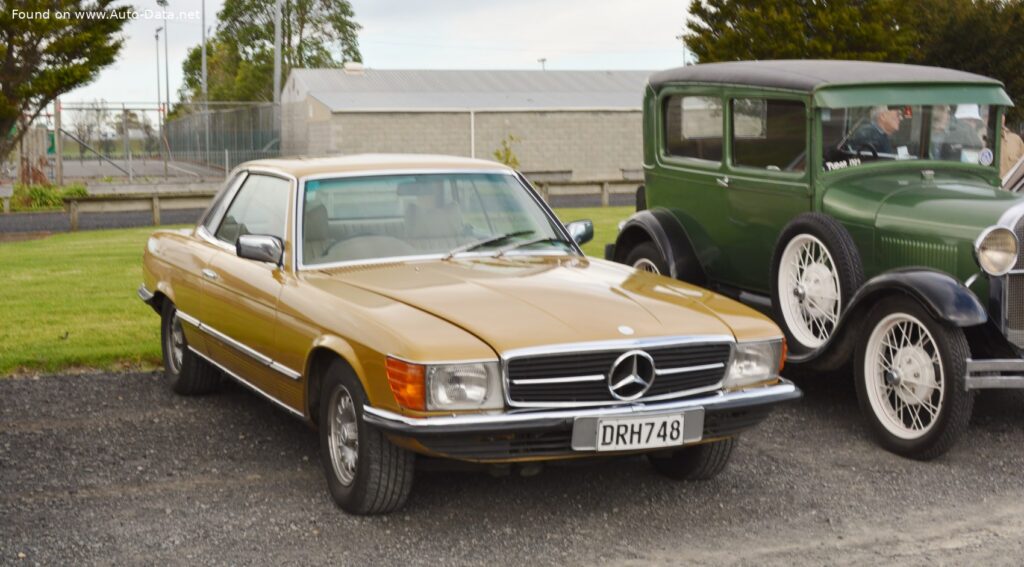
The Mercedes-Benz SLC (C107) 350 SLC V8 (200 Hp) Automatic: A Classic Grand Tourer
The Mercedes-Benz SLC, specifically the C107 generation, represents a significant chapter in the German automaker’s history of luxury coupes. Introduced in June 1971, the SLC (Sport Leicht Coupé or Sport Light Coupé) was derived from the iconic R107 SL roadster, sharing its platform but featuring a longer wheelbase and a fixed roof, creating a true 2+2 grand touring coupe. This article focuses on the Mercedes-Benz SLC (C107) 350 SLC V8 (200 Hp) Automatic variant, a sophisticated and powerful offering that captivated the luxury market during its production run from 1971 to February 1976. Designed for comfort, style, and effortless long-distance cruising, the C107 SLC carved out its own niche, offering a more practical and enclosed alternative to its roadster sibling while retaining Mercedes-Benz’s hallmark engineering and build quality.
Engine and Performance: The Heart of the Mercedes-Benz SLC (C107)
At the core of the Mercedes-Benz SLC (C107) 350 SLC V8 (200 Hp) Automatic lies a robust 3.5-liter (3499 cm³ or 213.52 cu. in.) M116 E 35 V8 gasoline engine. This naturally aspirated, front-longitudinal powerplant was a testament to Mercedes-Benz’s commitment to smooth, reliable power delivery. Featuring a Single Overhead Camshaft (SOHC) valvetrain and multi-port manifold injection, the engine produced a respectable 200 horsepower at 5800 rpm. Its power-per-liter figure of 57.2 Hp/l was competitive for its era, highlighting efficient design.
Equally impressive was the torque output, reaching 286 Nm (210.94 lb.-ft.) at a relatively accessible 4000 rpm. This ample torque, combined with the smooth operation of a 3-speed automatic transmission, ensured a relaxed yet confident driving experience. The Mercedes-Benz SLC (C107) was not designed to be a lightweight sports car, but rather a refined cruiser. Despite its curb weight of 3505.35 lbs. (1590 kg), the 350 SLC V8 could accelerate from 0 to 60 mph in a brisk 9 seconds (0-100 km/h in 9.5 seconds), with a top speed of 127.38 mph (205 km/h). These figures underscored its capability as a swift grand tourer, capable of effortlessly covering vast distances on autobahns or American interstates. The powertrain architecture, driving the rear wheels, provided classic handling dynamics, balancing comfort with predictable road manners.
Fuel economy, while not a primary concern for luxury car buyers of the early 1970s, was rated at approximately 18.1 US mpg (13 l/100 km) combined. This was a reasonable figure for a V8-powered luxury coupe of its size and weight. The generous 23.78 US gallon (90 liter) fuel tank capacity further emphasized its long-distance touring credentials, allowing for extended journeys between fill-ups.
Design and Features: Elegance and Practicality in the Mercedes-Benz SLC (C107)
The C107 Mercedes-Benz SLC (C107) distinguished itself from its R107 SL roadster sibling primarily through its distinctive fixed roof and a longer wheelbase, which measured 111.02 inches (2820 mm) compared to the SL’s 96.9 inches. This extended wheelbase was crucial for accommodating genuine rear seating, transforming the SL’s occasional rear bench into a more usable 2+2 configuration, making it a five-seater coupe. The body type remained a sleek 2-door coupe, exuding a sense of understated luxury characteristic of Mercedes-Benz design from that era.
Measuring 187.01 inches (4750 mm) in length, 70.47 inches (1790 mm) in width, and 52.36 inches (1330 mm) in height, the SLC possessed a graceful, elongated profile. Its design featured the iconic Mercedes-Benz grille, horizontal headlights, and a clean, uncluttered aesthetic that has aged remarkably well. The longer rear overhang and distinctive rear window treatment, which included small louvers on some models, further differentiated it from the shorter SL.
In terms of features, the 350 SLC V8 offered a blend of luxury and advanced engineering for its time. Standard equipment often included power steering, utilizing a cone worm with recirculation balls system for precise control. The suspension system was designed for comfort and stability, featuring a double wishbone setup with a transverse stabilizer at the front and a trailing arm with a transverse stabilizer at the rear. Braking performance was handled by ventilated discs at the front and solid discs at the rear, providing confident stopping power for a vehicle of its mass and speed. The car rode on 205/70 R14 tires mounted on 6.5J x 14 wheel rims, a common specification for luxury vehicles of the period, balancing ride comfort with adequate grip. Safety was a paramount concern for Mercedes-Benz, and the C107 featured a robust body structure, designed to protect occupants, alongside features like collapsible steering columns and padded interiors, which were advanced for the early 1970s.
Technical Specifications: Mercedes-Benz SLC (C107) 350 SLC V8 (200 Hp) Automatic
| General Information | |
| Brand | Mercedes-Benz |
| Model | SLC |
| Generation | SLC (C107) |
| Type (Engine) | 350 SLC V8 (200 Hp) Automatic |
| Start of Production | June, 1971 year |
| End of Production | February, 1976 year |
| Powertrain Architecture | Internal Combustion engine |
| Body type | Coupe |
| Seats | 5 |
| Doors | 2 |
| Performance Specs | |
| Fuel Consumption (economy) – combined | 13 l/100 km (18.1 US mpg, 21.7 UK mpg, 7.7 km/l) |
| Fuel Type | Petrol (Gasoline) |
| Acceleration 0 – 60 mph | 9 sec |
| Acceleration 0 – 100 km/h | 9.5 sec |
| Maximum Speed | 205 km/h (127.38 mph) |
| Weight-to-power ratio | 8 kg/Hp, 125.8 Hp/tonne |
| Weight-to-torque ratio | 5.6 kg/Nm, 179.9 Nm/tonne |
| Engine Specs | |
| Power | 200 Hp @ 5800 rpm |
| Power per liter | 57.2 Hp/l |
| Torque | 286 Nm @ 4000 rpm (210.94 lb.-ft. @ 4000 rpm) |
| Engine layout | Front, Longitudinal |
| Engine Model/Code | M 116 E 35 / 116.982 |
| Engine displacement | 3499 cm³ (3.5 l, 213.52 cu. in.) |
| Number of cylinders | 8 |
| Engine configuration | V-engine |
| Cylinder Bore | 92 mm (3.62 in.) |
| Piston Stroke | 65.8 mm (2.59 in.) |
| Compression ratio | 9.5:1 |
| Number of valves per cylinder | 2 |
| Fuel injection system | Multi-port manifold injection |
| Engine aspiration | Naturally aspirated engine |
| Valvetrain | SOHC |
| Engine oil capacity | 8 l (8.45 US qt | 7.04 UK qt) |
| Coolant | 14.3 l (15.11 US qt | 12.58 UK qt) |
| Space, Volume and Weights | |
| Kerb Weight (Curb Weight) | 1590 kg (3505.35 lbs.) |
| Max. weight (Gross Weight) | 2080 kg (4585.62 lbs.) |
| Max load | 490 kg (1080.27 lbs.) |
| Fuel tank capacity | 90 l (23.78 US gal | 19.8 UK gal) |
| Dimensions | |
| Length | 4750 mm (187.01 in.) |
| Width | 1790 mm (70.47 in.) |
| Height | 1330 mm (52.36 in.) |
| Wheelbase | 2820 mm (111.02 in.) |
| Front track | 1452 mm (57.17 in.) |
| Rear (Back) track | 1440 mm (56.69 in.) |
| Drivetrain, Brakes and Suspension Specs | |
| Drivetrain Architecture | The Internal combustion engine (ICE) drives the rear wheels of the vehicle. |
| Drive wheel | Rear wheel drive |
| Number of gears and type of gearbox | 3 gears, automatic transmission |
| Front suspension | Double wishbone, Transverse stabilizer |
| Rear suspension | Transverse stabilizer, Trailing arm |
| Front brakes | Ventilated discs |
| Rear brakes | Disc |
| Steering type | Cone worm with recirculation balls |
| Power steering | Hydraulic Steering |
| Tires size | 205/70 R14 |
| Wheel rims size | 6.5J x 14 |
Legacy and Market Impact of the Mercedes-Benz SLC (C107)
The Mercedes-Benz SLC (C107) holds a distinct place in automotive history, often overshadowed by its more famous roadster counterpart, the R107 SL. However, the SLC was a significant model in its own right, carving out a niche as a sophisticated and comfortable grand touring coupe. In its primary markets, particularly Europe and North America, the SLC appealed to buyers seeking the prestige and engineering excellence of Mercedes-Benz, combined with the practicality of a fixed roof and usable rear seats. It was a car for discerning individuals who valued long-distance comfort and understated luxury over outright sporting pretense.
Competitors in the luxury coupe segment during the 1970s included vehicles like the BMW E9 coupes (such as the 3.0 CS and CSL), the Jaguar XJ-S, and various luxury offerings from Cadillac or Lincoln in the American market. The SLC stood out with its robust, almost indestructible build quality, refined V8 engines, and a reputation for reliability that few rivals could match. While the BMWs offered a sportier driving experience and the Jaguars were known for their distinctive styling, the SLC delivered a unique blend of solidity, comfort, and timeless elegance.
Beyond its role as a luxury cruiser, the C107 SLC also gained an unexpected reputation in motorsports. Despite its size and weight, Mercedes-Benz campaigned the SLC in demanding long-distance rallies, particularly in Africa and South America. These rally successes, including victories in the grueling Bandama Rally, showcased the car’s incredible durability and engineering prowess under extreme conditions, further cementing its bulletproof image.
Today, the Mercedes-Benz SLC (C107) is recognized as a classic, appreciating in value as enthusiasts rediscover its unique charm and historical significance. It represents an era when Mercedes-Benz built cars with an unparalleled sense of solidity and luxury, designed to last for decades. Its legacy endures as a testament to German engineering and design, offering a comfortable, stylish, and powerful grand touring experience that remains compelling even half a century after its introduction. The 350 SLC V8, with its quintessential V8 engine and automatic transmission, remains a highly desirable example of this iconic generation.
