The Mercedes-Benz SLC (R172 facelift 2016): A Compact Roadster’s Evolution
The Mercedes-Benz SLC, internally designated R172, represents the final iteration of a lineage of compact luxury roadsters from the German automaker, succeeding the iconic SLK-Class. The facelifted version, introduced in April 2016, marked a significant rebranding, aligning the roadster with Mercedes-Benz’s contemporary naming convention (C for its C-Class platform roots). The SLC 180, specifically, was a key entry-level variant, primarily tailored for European and other international markets where its blend of efficiency, accessible performance, and premium appeal found a strong audience. This model, produced from April 2016 until May 2019, continued the tradition of a two-door, two-seat coupe-cabriolet, offering the versatility of a retractable hardtop in a stylish, compact package.
The SLC 180 aimed to combine the prestige and design language of the Mercedes-Benz brand with a more economical and agile driving experience. While North American markets typically received higher-output versions, the SLC 180 played a crucial role in expanding the SLC’s market reach, appealing to buyers seeking luxury roadster aesthetics without the full-throttle performance or higher running costs of its more powerful siblings. It maintained the R172 generation’s core engineering, including its sophisticated suspension and driver-focused cockpit, ensuring a refined and engaging drive characteristic of the Mercedes-Benz marque.
Engine and Performance of the Mercedes-Benz SLC (R172 facelift 2016) SLC 180
At the heart of the SLC 180 lies a compact yet capable M 274.910 engine, a 1.6-liter (1595 cm³ or 97.33 cu. in.) inline four-cylinder gasoline unit. This powertrain architecture features a front, longitudinal layout, driving the rear wheels, a classic setup for a sporty roadster. The engine benefits from a turbocharger and intercooler, enhancing its output and efficiency, particularly at lower RPMs. It generates a respectable 156 horsepower at 5300 rpm, translating to a power-per-liter figure of 97.8 Hp/l, showcasing its modern engineering.
More notably for daily driving, the SLC 180 delivers a robust 250 Nm (184.39 lb.-ft.) of torque, available across a broad and accessible rev range from 1200 to 4000 rpm. This wide torque band ensures responsive acceleration and flexible performance, making it well-suited for both city driving and spirited touring. Mated to a 6-speed manual transmission, the SLC 180 offers a direct and engaging driving experience, allowing the driver to fully exploit the engine’s characteristics. Performance figures include an acceleration from 0 to 60 mph in a swift 7.5 seconds (calculated), with 0 to 100 km/h achieved in 7.9 seconds. The top speed is rated at 226 km/h (140.43 mph), making it a competent performer within its segment.
Fuel efficiency was a key selling point for the SLC 180 in its target markets. The combined fuel consumption is an impressive 5.8-5.6 liters per 100 km, which translates to an excellent 40.6 – 42 US mpg. CO2 emissions are also kept in check at 134-127 g/km, adhering to the Euro 6 emission standard. This balance of performance and economy made the SLC 180 an attractive option for consumers prioritizing lower running costs without sacrificing the premium Mercedes-Benz experience.
Design and Features
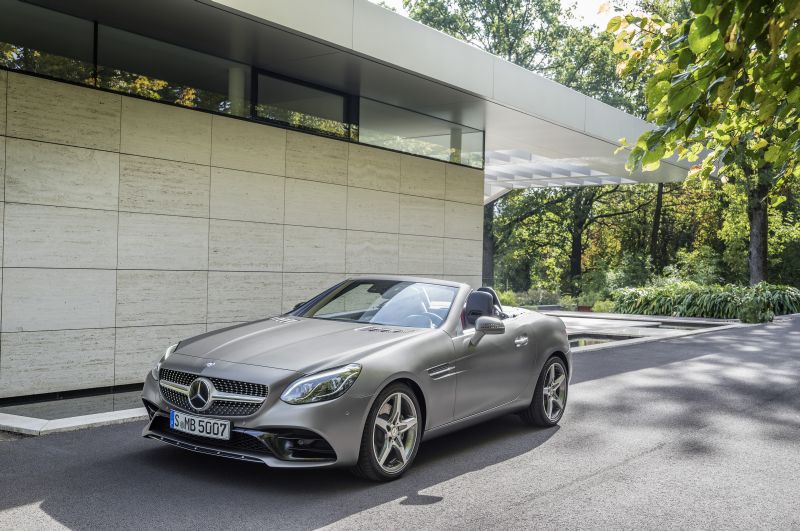
The Mercedes-Benz SLC (R172 facelift 2016) retained the sleek, athletic proportions that defined its SLK predecessors, but with updated styling cues that brought it in line with Mercedes-Benz’s contemporary design language. As a coupe-cabriolet roadster, its defining feature is the innovative vario-roof – a retractable hardtop that transforms the car from a secure coupe to an open-air roadster in a matter of seconds. This design provided the best of both worlds: the security and refinement of a fixed-roof coupe, and the exhilarating experience of a convertible.
Visually, the facelift introduced a revised front fascia with a diamond grille (standard or optional depending on trim), new LED Intelligent Light System headlamps, and updated bumper designs, giving the SLC a sharper and more aggressive stance. The rear also received subtle updates, including new LED tail lamps and a redesigned bumper. With a length of 162.72 inches, a width of 71.26 inches (78.98 inches including mirrors), and a height of 51.22 inches, the SLC 180 maintained its compact and agile footprint, ideal for navigating crowded European cityscapes and winding country roads.
Inside, the two-seat cockpit offered a blend of luxury and sportiness. Mercedes-Benz emphasized high-quality materials and craftsmanship. While the SLC 180 would feature standard Mercedes-Benz infotainment, it might not have the most advanced options available on higher trims. However, essential features like automatic climate control, a multi-function steering wheel, and a premium audio system would be expected. Safety was paramount, with standard features including ABS (Anti-lock Braking System), a comprehensive airbag system, and Mercedes-Benz’s suite of electronic stability control systems. The power steering was an electric rack and pinion system, providing precise feedback and ease of maneuverability, complemented by an impressive minimum turning circle of 34.51 feet.
Technical Specifications: Mercedes-Benz SLC (R172 facelift 2016) SLC 180
| Category | Specification |
|---|---|
| General Information | |
| Brand | Mercedes-Benz |
| Model | SLC |
| Generation | SLC (R172 facelift 2016) |
| Engine Type | SLC 180 (156 Hp) |
| Production Start | April, 2016 |
| Production End | May, 2019 |
| Powertrain Architecture | Internal Combustion Engine |
| Body Type | Coupe – Cabriolet, Roadster |
| Seats | 2 |
| Doors | 2 |
| Performance Specifications | |
| Fuel Consumption (Urban) | 7.7-7.4 l/100 km (30.5 – 31.8 US mpg) |
| Fuel Consumption (Extra Urban) | 4.9-4.5 l/100 km (48 – 52.3 US mpg) |
| Fuel Consumption (Combined) | 5.8-5.6 l/100 km (40.6 – 42 US mpg) |
| CO2 Emissions | 134-127 g/km |
| Fuel Type | Petrol (Gasoline) |
| Acceleration 0 – 60 mph | 7.5 sec |
| Acceleration 0 – 100 km/h | 7.9 sec |
| Maximum Speed | 226 km/h (140.43 mph) |
| Emission Standard | Euro 6 |
| Weight-to-Power Ratio | 8.7 kg/Hp (114.7 Hp/tonne) |
| Weight-to-Torque Ratio | 5.4 kg/Nm (183.8 Nm/tonne) |
| Engine Specifications | |
| Power | 156 Hp @ 5300 rpm |
| Power per Liter | 97.8 Hp/l |
| Torque | 250 Nm (184.39 lb.-ft.) @ 1200-4000 rpm |
| Engine Layout | Front, Longitudinal |
| Engine Model/Code | M 274.910 |
| Engine Displacement | 1595 cm³ (1.6 l / 97.33 cu. in.) |
| Number of Cylinders | 4 |
| Engine Configuration | Inline |
| Compression Ratio | 10.3:1 |
| Fuel Injection System | Direct injection |
| Engine Aspiration | Turbocharger, Intercooler |
| Engine Oil Capacity | 6.1 l (6.45 US qt) |
| Dimensions, Volume & Weights | |
| Kerb Weight | 1360 kg (2998.29 lbs) |
| Maximum Weight | 1750 kg (3858.09 lbs) |
| Maximum Load | 390 kg (859.8 lbs) |
| Trunk (Boot) Space (Min) | 225 l (7.95 cu. ft.) |
| Trunk (Boot) Space (Max) | 335 l (11.83 cu. ft.) |
| Fuel Tank Capacity | 60 l (15.85 US gal) |
| Length | 4133 mm (162.72 in) |
| Width | 1810 mm (71.26 in) |
| Width including mirrors | 2006 mm (78.98 in) |
| Height | 1301 mm (51.22 in) |
| Wheelbase | 2430 mm (95.67 in) |
| Front Track | 1559 mm (61.38 in) |
| Rear Track | 1565 mm (61.61 in) |
| Drag Coefficient (Cd) | 0.31 |
| Minimum Turning Circle | 10.52 m (34.51 ft) |
| Drivetrain, Brakes & Suspension | |
| Drivetrain Architecture | Internal Combustion Engine drives the rear wheels. |
| Drive Wheel | Rear wheel drive |
| Gearbox Type | 6 gears, manual transmission |
| Front Suspension | Independent multi-link suspension |
| Rear Suspension | Independent multi-link suspension |
| Front Brakes | Ventilated discs |
| Rear Brakes | Disc |
| Assisting Systems | ABS (Anti-lock Braking System) |
| Steering Type | Steering rack and pinion |
| Power Steering | Electric Steering |
| Tires Size | 205/55 R16 |
| Wheel Rims Size | 16 inches |
Legacy and Market Impact
The Mercedes-Benz SLC (R172 facelift 2016), particularly in its SLC 180 guise, carved out a specific niche in the European luxury roadster market. While the larger-engined variants like the SLC 300 and the AMG SLC 43 were aimed at performance enthusiasts, the SLC 180 provided a more accessible entry point into the premium convertible segment. Its primary market was undoubtedly Europe, where its smaller, turbocharged engine was favored for its fuel economy, lower emissions, and favorable tax implications compared to larger displacement engines. In contrast, the SLC 180 was generally not offered in the United States, where market preferences skewed towards higher horsepower figures and larger engines for luxury vehicles.
The SLC 180’s reputation was built on its ability to deliver the quintessential Mercedes-Benz experience – quality, comfort, and sophisticated design – wrapped in a compact, stylish package. It was an ideal choice for buyers who appreciated the brand’s prestige and the open-air driving experience but didn’t require blistering acceleration. Competitors in its primary market included the Audi TT Roadster, BMW Z4, and to some extent, the Porsche Boxster (though the Boxster often competed at a higher performance and price point). The SLC distinguished itself with its unique retractable hardtop, offering greater refinement and security than soft-top rivals, especially important in diverse climates.
Historically, the SLC (and its SLK predecessor) played a significant role in democratizing the luxury roadster segment. It made the dream of owning a Mercedes-Benz convertible more attainable for a wider audience. The R172 generation, and particularly its facelifted SLC branding, marked the end of an era for Mercedes-Benz’s compact roadsters with internal combustion engines, as the automotive industry shifted towards electrification. The SLC 180 stands as a testament to Mercedes-Benz’s commitment to offering a broad range of options, showcasing that luxury and driving enjoyment could be delivered even with a more modest powertrain, perfectly suited to its intended audience and market conditions.