The Mercedes-Benz SLC (R172 facelift 2016) SLC 180 (156 Hp) 9G-TRONIC: A Compact Luxury Roadster
The Mercedes-Benz SLC (R172 facelift 2016) represents a significant refresh and rebranding of the third-generation SLK-Class roadster. Introduced in April 2016 and produced until May 2019, the SLC nameplate marked a new chapter for Mercedes-Benz’s compact luxury convertible, aligning it with the brand’s updated nomenclature strategy where “C” indicated its close relation to the C-Class sedan. The SLC 180 variant, specifically equipped with the 156 horsepower engine and advanced 9G-TRONIC automatic transmission, served as the entry point into the SLC lineup, primarily targeting European and international markets where its blend of efficiency, luxury, and engaging driving dynamics appealed to a broad audience seeking a premium open-top experience.
This iteration of the R172 chassis retained the essence of its SLK predecessor – a two-seat, front-engine, rear-wheel-drive roadster featuring a signature retractable hardtop that transformed it from a sleek coupe into an exhilarating convertible in mere seconds. The facelift brought updated styling cues, enhanced technology, and refined powertrains, ensuring the SLC remained competitive in the evolving luxury roadster segment. While the SLC 180 was not typically offered in the United States market, its technical sophistication and adherence to modern automotive standards exemplify Mercedes-Benz’s engineering prowess, delivering a compelling package for discerning drivers in its intended regions.
Engine and Performance of the Mercedes-Benz SLC (R172 facelift 2016)
At the heart of the Mercedes-Benz SLC 180 (156 Hp) 9G-TRONIC lies a sophisticated M 274.910 engine, an inline four-cylinder gasoline (petrol) unit. This 1.6-liter (1595 cm³ or 97.33 cu. in.) powerplant is engineered for both spirited performance and remarkable efficiency, a hallmark of modern Mercedes-Benz design. Utilizing direct fuel injection and a turbocharger with an intercooler, the engine delivers a respectable 156 horsepower at 5300 rpm. More impressively for a compact engine, it generates a robust 184.39 lb.-ft. (250 Nm) of torque, available across a broad rev range from a low 1200 rpm up to 4000 rpm. This wide torque band ensures responsive acceleration and flexible driving characteristics, whether navigating urban environments or cruising on the open highway.
Power is seamlessly transferred to the rear wheels via Mercedes-Benz’s advanced 9G-TRONIC nine-speed automatic transmission. This sophisticated gearbox is a key contributor to the SLC 180’s balanced performance profile. Its nine ratios allow the engine to consistently operate within its optimal efficiency and power bands, resulting in smooth shifts, improved fuel economy, and refined cruising. The SLC 180 accelerates from 0 to 60 mph in a brisk 7.7 seconds, with a top speed reaching 138.57 mph (223 km/h). These figures underscore its capability as a nimble and enjoyable sports car, despite its role as the entry-level model.
Fuel efficiency is another strong suit, with combined fuel consumption rated between 38.6 and 42 US mpg (6.1-5.6 l/100 km). Urban driving yields 30.5 to 32.2 US mpg, while extra-urban cruising can achieve an impressive 45.2 to 50 US mpg. These figures, coupled with CO2 emissions ranging from 128-139 g/km, highlight the vehicle’s compliance with strict Euro 6 emission standards, showcasing Mercedes-Benz’s commitment to environmental responsibility even in its performance-oriented models. The engine’s front, longitudinal layout contributes to the car’s balanced weight distribution and classic rear-wheel-drive dynamics, enhancing the driving experience.
Design and Features
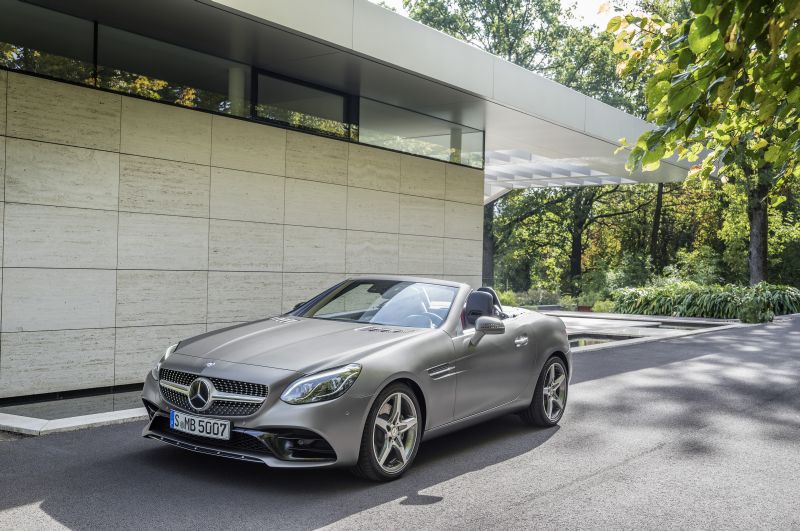
The Mercedes-Benz SLC (R172 facelift 2016) retained the beloved “Coupe – Cabriolet, Roadster” body type that had defined its SLK predecessors. This design philosophy centered around a two-door, two-seat configuration with a sophisticated retractable hardtop, offering the best of both worlds: the security and refinement of a coupe and the exhilarating open-air experience of a roadster. The facelift introduced refreshed styling elements that gave the SLC a more modern and assertive presence. Key visual updates included a redesigned front bumper, a standard diamond grille, and updated LED Intelligent Light System headlamps and taillamps, which provided both improved visibility and a distinctive light signature.
Dimensionally, the SLC 180 measured 162.72 inches (4133 mm) in length, 71.26 inches (1810 mm) in width (78.98 inches including mirrors), and 51.22 inches (1301 mm) in height, with a wheelbase of 95.67 inches (2430 mm). These compact dimensions contributed to its agile handling and ease of maneuverability, with a minimum turning circle of just 34.51 feet (10.52 m). The car’s aerodynamic efficiency was commendable, boasting a drag coefficient (Cd) of 0.31, which aided both performance and fuel economy.
Inside, the SLC offered a cabin synonymous with Mercedes-Benz luxury and craftsmanship. While the SLC 180 served as the entry model, it still featured high-quality materials, comfortable sport seats, and an intuitive layout. Standard features typically included a multifunction steering wheel, automatic climate control, and a modern infotainment system with a central display. Safety was paramount, with standard equipment including ABS (Anti-lock Braking System), a comprehensive airbag system, and stability control. The electric power steering provided precise feedback, while the independent multi-link suspension at both front and rear ensured a blend of sporty handling and comfortable ride quality. The trunk space varied from 7.95 cu. ft. (225 liters) with the roof down to 11.83 cu. ft. (335 liters) with the roof up, offering practical storage for a compact roadster.
Technical Specifications
| Category | Specification | US/Imperial Equivalent |
|---|---|---|
| General Information | ||
| Brand | Mercedes-Benz | |
| Model | SLC | |
| Generation | SLC (R172 facelift 2016) | |
| Engine Type | SLC 180 (156 Hp) 9G-TRONIC | |
| Production Start | April, 2016 | |
| Production End | May, 2019 | |
| Powertrain Architecture | Internal Combustion Engine | |
| Body Type | Coupe – Cabriolet, Roadster | |
| Seats | 2 | |
| Doors | 2 | |
| Performance Specs | ||
| Fuel Consumption (Urban) | 7.7-7.3 l/100 km | 30.5 – 32.2 US mpg |
| Fuel Consumption (Extra Urban) | 5.2-4.7 l/100 km | 45.2 – 50 US mpg |
| Fuel Consumption (Combined) | 6.1-5.6 l/100 km | 38.6 – 42 US mpg |
| CO2 Emissions | 139-128 g/km | |
| Fuel Type | Petrol (Gasoline) | |
| Acceleration 0 – 60 mph | 7.7 sec | |
| Maximum Speed | 223 km/h | 138.57 mph |
| Emission Standard | Euro 6 | |
| Weight-to-Power Ratio | 8.9 kg/Hp | 112.6 Hp/tonne |
| Engine Specs | ||
| Power | 156 Hp @ 5300 rpm | |
| Power per liter | 97.8 Hp/l | |
| Torque | 250 Nm @ 1200-4000 rpm | 184.39 lb.-ft. @ 1200-4000 rpm |
| Engine Layout | Front, Longitudinal | |
| Engine Model/Code | M 274.910 | |
| Engine Displacement | 1595 cm³ | 1.6 Liters / 97.33 cu. in. |
| Number of Cylinders | 4 | |
| Engine Configuration | Inline | |
| Compression Ratio | 10.3:1 | |
| Fuel Injection System | Direct injection | |
| Engine Aspiration | Turbocharger, Intercooler | |
| Engine Oil Capacity | 6.1 l | 6.45 US qt |
| Space, Volume and Weights | ||
| Kerb Weight | 1385 kg | 3053.4 lbs. |
| Max. Weight | 1775 kg | 3913.21 lbs. |
| Max Load | 390 kg | 859.8 lbs. |
| Trunk (boot) space – minimum | 225 l | 7.95 cu. ft. |
| Trunk (boot) space – maximum | 335 l | 11.83 cu. ft. |
| Fuel Tank Capacity | 60 l | 15.85 US gal |
| Dimensions | ||
| Length | 4133 mm | 162.72 in. |
| Width | 1810 mm | 71.26 in. |
| Width including mirrors | 2006 mm | 78.98 in. |
| Height | 1301 mm | 51.22 in. |
| Wheelbase | 2430 mm | 95.67 in. |
| Front Track | 1559 mm | 61.38 in. |
| Rear Track | 1565 mm | 61.61 in. |
| Drag Coefficient (Cd) | 0.31 | |
| Minimum Turning Circle | 10.52 m | 34.51 ft. |
| Drivetrain, Brakes and Suspension | ||
| Drivetrain Architecture | ICE drives rear wheels | |
| Drive Wheel | Rear wheel drive | |
| Gearbox | 9-speed automatic, 9G-TRONIC | |
| Front Suspension | Independent multi-link suspension | |
| Rear Suspension | Independent multi-link suspension | |
| Front Brakes | Ventilated discs | |
| Rear Brakes | Disc | |
| Assisting Systems | ABS (Anti-lock braking system) | |
| Steering Type | Steering rack and pinion | |
| Power Steering | Electric Steering | |
| Tires Size | 205/55 R16 | |
| Wheel Rims Size | 16 inch |
Legacy and Market Impact
The Mercedes-Benz SLC (R172 facelift 2016) SLC 180 (156 Hp) 9G-TRONIC held a unique position within the Mercedes-Benz portfolio and the broader luxury roadster market. As the entry-level variant, it was strategically important for Mercedes-Benz, particularly in European markets where smaller displacement engines are often favored due to tax structures and fuel efficiency considerations. It offered the allure of a premium Mercedes-Benz convertible experience at a more accessible price point than its more powerful siblings, such as the SLC 300 or the AMG SLC 43.
The SLC 180 competed in a segment that, while niche, was fiercely contested by rivals like the Audi TT Roadster and the BMW Z4. While the SLC 180 might not have matched the outright performance of some higher-tier variants from its competitors, it distinguished itself with its classic Mercedes-Benz refinement, the sophisticated retractable hardtop, and the brand’s reputation for comfort and build quality. Its efficient 1.6-liter turbocharged engine and the advanced 9G-TRONIC transmission provided a compelling blend of everyday usability and open-top driving pleasure, making it a practical choice for those seeking a stylish two-seater without excessive running costs.
The SLC nameplate, though short-lived from 2016 to 2019, served as a bridge between the SLK’s legacy and Mercedes-Benz’s contemporary naming conventions. It continued the tradition of compact, elegant roadsters that Mercedes-Benz had pioneered with the original SLK in the mid-1990s. The R172 generation, and its SLC facelift, marked the end of an era for Mercedes-Benz’s dedicated retractable hardtop roadsters, as the market began to shift towards SUVs and larger, softer-top convertibles. The SLC’s discontinuation reflected broader industry trends, yet its impact as a well-engineered, luxurious, and efficient open-top vehicle remains significant. It continued to uphold Mercedes-Benz’s heritage of producing desirable, aspirational vehicles, offering a taste of the brand’s sporting luxury to a wider audience.