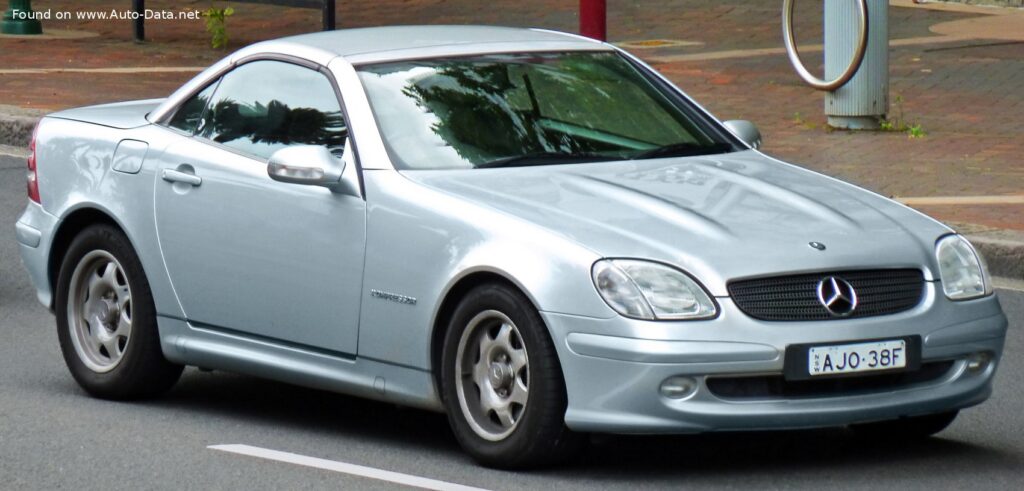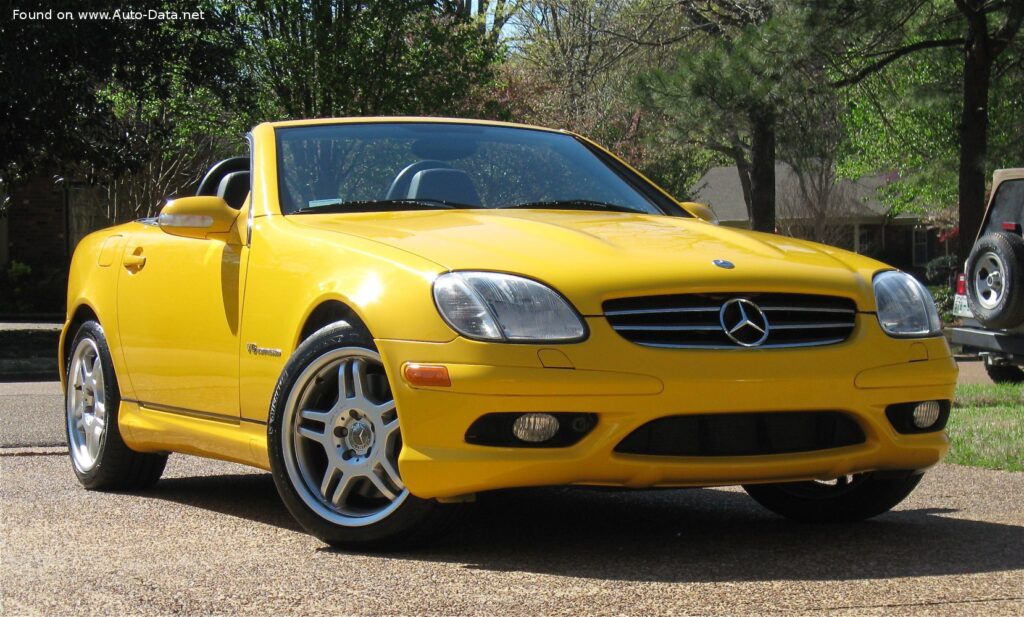
Introduction to the Mercedes-Benz SLK (R170, facelift 2000)
The Mercedes-Benz SLK (R170, facelift 2000) represents a pivotal moment in the history of compact luxury roadsters, solidifying Mercedes-Benz’s commitment to the segment. Launched originally in 1996, the R170 generation quickly garnered attention for its innovative retractable hardtop, dubbed the “Vario-Roof,” a feature that seamlessly transformed the vehicle from a secure coupe to an exhilarating open-top roadster at the push of a button. The facelifted model, introduced in February 2000 and produced until April 2004, brought a series of enhancements in styling, powertrain, and interior refinement, ensuring its competitive edge in the burgeoning two-seater market.
While the SLK lineup offered various engine options globally, the SLK 200 Kompressor (163 Hp) Automatic variant, specifically, played a crucial role in markets outside of North America, such as Europe and parts of Asia. Here, its blend of supercharged four-cylinder performance, respectable fuel economy, and Mercedes-Benz prestige made it an attractive entry point into the luxury roadster segment. It offered a compelling balance for buyers seeking the style and innovation of the SLK without necessarily requiring the larger displacement engines found in higher-tier models. This particular model, with its 5-speed automatic transmission, emphasized ease of use and comfortable cruising, aligning with the sophisticated image of the Mercedes-Benz brand.
Powertrain and Performance of the Mercedes-Benz SLK (R170, facelift 2000) SLK 200 Kompressor
Engine Architecture and Dynamics
At the heart of the SLK 200 Kompressor (163 Hp) Automatic lies Mercedes-Benz’s M 111.958 engine, a 2.0-liter (1998 cm3 or 121.93 cubic inches) inline-four unit. This powerplant is distinguished by its “Kompressor” designation, indicating the use of a supercharger with an intercooler. This forced induction system was instrumental in extracting impressive power and torque from a relatively small displacement engine, a common strategy by Mercedes-Benz during this era to enhance performance while maintaining efficiency.
The engine is configured longitudinally at the front, driving the rear wheels, a classic sports car layout that contributes to balanced handling characteristics. With a compression ratio of 9.5:1 and a DOHC valvetrain featuring four valves per cylinder, the engine delivered 163 horsepower at 5300 rpm. More importantly for real-world driving, it produced a robust 230 Nm (169.64 lb.-ft.) of torque, available across a broad range from 2500 to 4800 rpm. This wide torque band ensured responsive acceleration and flexible cruising, making the car feel energetic despite its modest horsepower figure by modern standards.
Mated to a 5-speed automatic transmission, the SLK 200 Kompressor offered a smooth and refined driving experience. The automatic gearbox was well-suited to the car’s character, providing effortless shifts for both relaxed open-top cruising and more spirited driving. Performance figures for this setup included an acceleration from 0 to 60 mph in a respectable 8.1 seconds, with a maximum speed of 136.7 mph (220 km/h).
Fuel efficiency, while not the primary focus of a sports roadster, was commendable for its time, especially given the supercharged engine. The combined NEDC cycle rating stood at 9.2 liters per 100 km, translating to approximately 25.6 US mpg. Emissions met the Euro 4 standard, reflecting Mercedes-Benz’s commitment to environmental considerations even in the early 2000s. The car’s weight-to-power ratio of 7.9 kg/Hp further underscored its agile nature.
Design, Features, and Innovation
Exterior and Interior Aesthetics
The R170 generation of the SLK, particularly the facelifted model, maintained its distinctive and appealing design language. Its compact dimensions – 157.87 inches in length, 67.52 inches in width, and 50.16 inches in height – contributed to its agile stance and sporty proportions. The facelift brought subtle but effective updates, including revised bumpers, side skirts, and clear-lens taillights, giving it a more modern and cohesive appearance. The drag coefficient of 0.33 Cd was respectable for a convertible, contributing to both fuel efficiency and reduced wind noise with the top up.
The most celebrated feature of the SLK R170 was undoubtedly its electro-hydraulic “Vario-Roof.” This ingenious retractable hardtop, a pioneering technology for its segment, allowed owners to transform the car from a sleek coupe into an open-air roadster in just 25 seconds. This innovation offered the best of both worlds: the security, refinement, and weather protection of a fixed-roof coupe, combined with the exhilarating experience of a convertible. This feature set the SLK apart from many of its soft-top rivals and significantly influenced future convertible designs across the industry.
Safety and Convenience in the R170
Inside, the Mercedes-Benz SLK (R170, facelift 2000) offered a driver-focused cockpit with Mercedes-Benz’s signature blend of luxury and ergonomic design. High-quality materials, refined trim options, and a logical control layout characterized the cabin. Despite being a two-seater roadster, the trunk space was surprisingly versatile, offering 5.12 cubic feet (145 liters) with the roof down and expanding to a more practical 12.29 cubic feet (348 liters) with the roof up, making it suitable for weekend getaways.
From a safety perspective, the R170 was equipped with standard features for its time, including ABS (Anti-lock Braking System) and a robust chassis designed to protect occupants. The car featured ventilated disc brakes at the front and disc brakes at the rear, providing confident stopping power. The suspension system, comprising a coil spring, double wishbone setup with a transverse stabilizer at the front and an independent multi-link suspension with coil springs and a transverse stabilizer at the rear, offered a sophisticated balance of ride comfort and sporty handling. Hydraulic power steering, utilizing a cone worm with recirculation balls, provided direct feedback and ease of maneuverability, with a minimum turning circle of 34.78 feet.
Technical Specifications: Mercedes-Benz SLK (R170, facelift 2000) SLK 200 Kompressor (163 Hp) Automatic
| Category | Specification |
|---|---|
General Information |
|
| Brand | Mercedes-Benz |
| Model | SLK |
| Generation | SLK (R170, facelift 2000) |
| Type (Engine) | SLK 200 Kompressor (163 Hp) Automatic |
| Start of Production | February, 2000 |
| End of Production | April, 2004 |
| Powertrain Architecture | Internal Combustion Engine |
| Body type | Roadster |
| Seats | 2 |
| Doors | 2 |
Performance Specs |
|
| Fuel consumption (economy) – urban (NEDC) | 13.3 l/100 km (17.7 US mpg) |
| Fuel consumption (economy) – extra urban (NEDC) | 6.9 l/100 km (34.1 US mpg) |
| Fuel consumption (economy) – combined (NEDC) | 9.2 l/100 km (25.6 US mpg) |
| CO2 emissions (NEDC) | 221 g/km |
| Fuel Type | Petrol (Gasoline) |
| Acceleration 0 – 60 mph | 8.1 sec |
| Acceleration 0 – 62 mph (0 – 100 km/h) | 8.5 sec |
| Maximum speed | 220 km/h (136.7 mph) |
| Emission standard | Euro 4 |
| Weight-to-power ratio | 7.9 kg/Hp (126.4 Hp/tonne) |
| Weight-to-torque ratio | 5.6 kg/Nm (178.3 Nm/tonne) |
Engine Specs |
|
| Power | 163 Hp @ 5300 rpm |
| Power per liter | 81.6 Hp/l |
| Torque | 230 Nm (169.64 lb.-ft.) @ 2500-4800 rpm |
| Engine layout | Front, Longitudinal |
| Engine Model/Code | M 111.958 |
| Engine displacement | 1998 cm3 (121.93 cu. in.) |
| Number of cylinders | 4 |
| Engine configuration | Inline |
| Cylinder Bore | 89.9 mm (3.54 in.) |
| Piston Stroke | 78.7 mm (3.1 in.) |
| Compression ratio | 9.5:1 |
| Number of valves per cylinder | 4 |
| Fuel injection system | Multi-port manifold injection |
| Engine aspiration | Supercharger, Intercooler |
| Valvetrain | DOHC |
| Engine oil capacity | 5.5 l (5.81 US qt) |
| Coolant capacity | 8 l (8.45 US qt) |
Space, Volume and Weights |
|
| Kerb Weight | 1290 kg (2843.96 lbs.) |
| Max. weight | 1625 kg (3582.51 lbs.) |
| Max load | 335 kg (738.55 lbs.) |
| Trunk (boot) space – minimum | 145 l (5.12 cu. ft.) |
| Trunk (boot) space – maximum | 348 l (12.29 cu. ft.) |
| Fuel tank capacity | 60 l (15.85 US gal) |
| Max. roof load | 30 kg (66.14 lbs.) |
Dimensions |
|
| Length | 4010 mm (157.87 in.) |
| Width | 1715 mm (67.52 in.) |
| Height | 1274 mm (50.16 in.) |
| Wheelbase | 2400 mm (94.49 in.) |
| Front track | 1488 mm (58.58 in.) |
| Rear (Back) track | 1471 mm (57.91 in.) |
| Drag coefficient (Cd) | 0.33 |
| Minimum turning circle (turning diameter) | 10.6 m (34.78 ft.) |
Drivetrain, Brakes and Suspension Specs |
|
| Drivetrain Architecture | The Internal combustion engine (ICE) drives the rear wheels of the vehicle. |
| Drive wheel | Rear wheel drive |
| Number of gears and type of gearbox | 5 gears, automatic transmission |
| Front suspension | Coil spring, Double wishbone, Transverse stabilizer |
| Rear suspension | Independent multi-link suspension, Transverse stabilizer, Coil spring |
| Front brakes | Ventilated discs |
| Rear brakes | Disc |
| Assisting systems | ABS (Anti-lock braking system) |
| Steering type | Cone worm with recirculation balls |
| Power steering | Hydraulic Steering |
| Tires size | 205/60 R 15 91 V |
| Wheel rims size | 7 J x 15 H 2 |
Legacy and Market Impact of the SLK R170
The Mercedes-Benz SLK R170, and specifically its facelifted iteration, left an indelible mark on the automotive landscape. It was often affectionately referred to as the “Baby SL,” drawing a connection to Mercedes-Benz’s larger, more luxurious SL-Class roadsters, but offering a more accessible and youthful interpretation. Its primary market impact was the popularization of the retractable hardtop, a feature that was once exclusive to high-end vehicles or concept cars. The Vario-Roof’s success on the SLK inspired numerous competitors to adopt similar designs, fundamentally changing the convertible market for the better by offering enhanced practicality, security, and year-round usability.
In its competitive set, the SLK R170 faced rivals such as the BMW Z3, the Audi TT Roadster, and in some performance guises, even the Porsche Boxster. The SLK 200 Kompressor (163 Hp) Automatic, while not directly competing with the higher-performance variants of these rivals, carved out its niche by offering a compelling blend of Mercedes-Benz luxury, innovative technology, and sufficient performance for daily driving and spirited weekend excursions. In markets like Europe, where fuel costs and vehicle taxation often favored smaller displacement engines, the 200 Kompressor was a particularly strong seller, representing a significant volume for the SLK lineup. It allowed a broader demographic to experience the prestige and engineering of a Mercedes-Benz roadster.
The car’s reputation was built on its distinctive styling, the ingenious Vario-Roof, and the perceived quality and engineering excellence associated with Mercedes-Benz. It was seen as a stylish, sophisticated, and somewhat avant-garde choice for those seeking a compact two-seater. Over time, the R170 has gained a following among enthusiasts who appreciate its blend of classic Mercedes-Benz aesthetics with groundbreaking technology from its era. Its enduring appeal lies in its ability to offer an engaging driving experience, combined with the versatility of its retractable hardtop, making it a compelling modern classic that continues to represent accessible luxury and innovative design. The SLK R170 laid the groundwork for subsequent generations of Mercedes-Benz compact roadsters, cementing its place as an important model in the brand’s history.