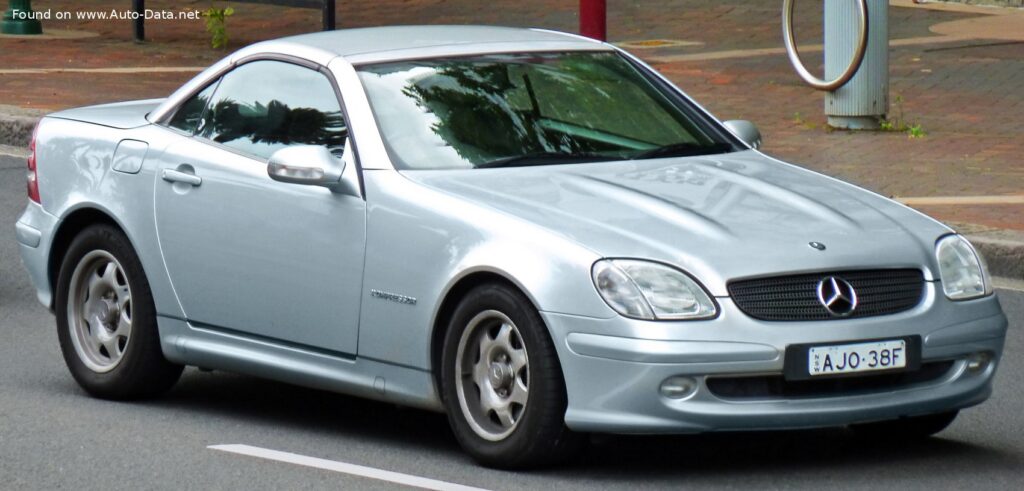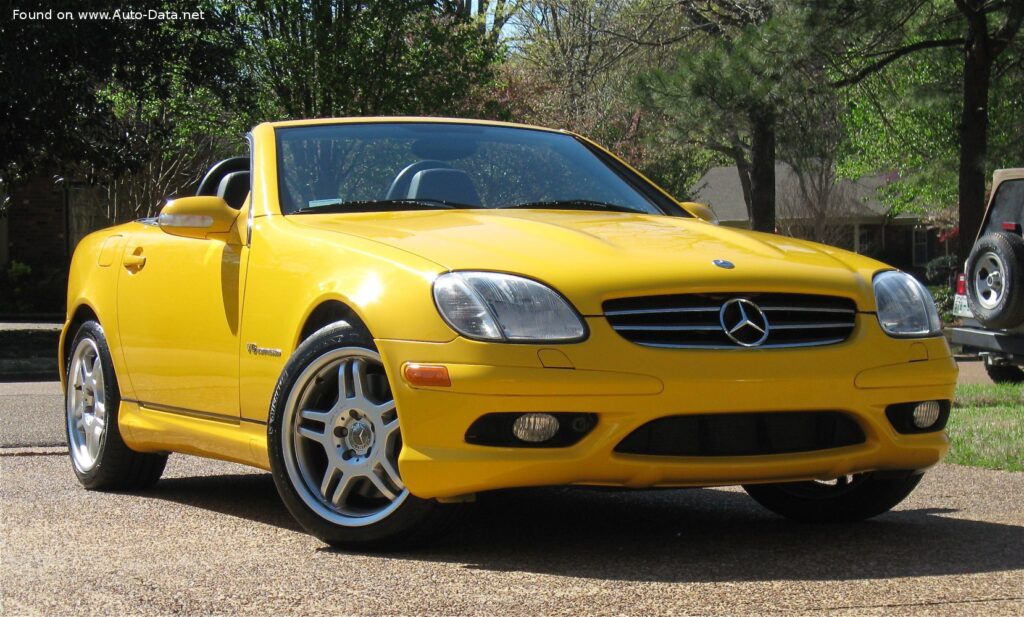
Introduction to the Mercedes-Benz SLK (R170, facelift 2000) SLK 320 V6 (218 Hp)
The Mercedes-Benz SLK (R170, facelift 2000) SLK 320 V6 (218 Hp) represents a significant iteration of Mercedes-Benz’s groundbreaking compact luxury roadster. Launched in February 2000 as a refreshed version of the original R170 generation, this model solidified the SLK’s position in the global automotive market, particularly appealing to enthusiasts in North America and Europe seeking a blend of open-air driving pleasure, luxury, and performance. The R170 SLK, first introduced in 1996, was a pioneer in its segment, primarily due to its innovative Vario-Roof – a retractable hardtop that offered the security and comfort of a coupe with the exhilaration of a convertible at the touch of a button. The 2000 facelift brought subtle but meaningful updates, including revised styling, enhanced interior features, and, crucially, a more potent engine lineup, with the SLK 320 V6 standing out as a performance leader before the AMG variant. This specific model, produced until April 2004, perfectly encapsulated Mercedes-Benz’s commitment to engineering prowess and luxurious motoring in a compact, sporty package.
Engine and Performance: The Heart of the Mercedes-Benz SLK (R170, facelift 2000)
At the core of the Mercedes-Benz SLK (R170, facelift 2000) SLK 320 V6 lies a robust 3.2-liter (3199 cm3 or 195.21 cu. in.) naturally aspirated V6 engine, designated M 112.947. This powerplant was engineered to deliver a compelling balance of smooth power delivery and responsive acceleration. It produced a healthy 218 horsepower at 5700 rpm, which for its time and segment, was a commendable output. Torque figures were equally impressive, peaking at 227.17 lb.-ft. (308 Nm) across a broad range from 3000 to 4800 rpm, ensuring strong pulling power throughout the rev band.
The engine featured a V-engine configuration with six cylinders, each benefiting from a three-valve-per-cylinder SOHC (Single Overhead Camshaft) valvetrain, a design choice by Mercedes-Benz to optimize both power and efficiency. Fuel delivery was managed by a multi-port manifold injection system, ensuring precise fuel metering. With a compression ratio of 10:1, the engine ran efficiently on premium gasoline.
Performance figures for the SLK 320 V6 were genuinely sporty. It could accelerate from 0 to 60 mph in a swift 6.6 seconds (0-100 km/h in 6.9 seconds), making it a formidable contender against its rivals. The top speed was electronically limited, or naturally capped, at an impressive 152.24 mph (245 km/h). Power was sent to the rear wheels via a precise 6-speed manual transmission, offering an engaging driving experience for purists. The vehicle’s weight-to-power ratio stood at 6.1 kg/Hp (163.9 Hp/tonne), highlighting its effective power delivery relative to its curb weight of 2932.15 lbs (1330 kg).
Despite its performance focus, Mercedes-Benz also considered efficiency. The combined fuel economy for the SLK 320 V6 was rated at 21.2 US mpg (11.1 l/100 km). Urban driving yielded approximately 14.3 US mpg (16.4 l/100 km), while extra-urban cruising could achieve up to 29.4 US mpg (8 l/100 km). CO2 emissions were rated at 259 g/km, meeting the Euro 4 emission standard, which was progressive for its time.
Design and Features: A Blend of Style and Innovation
Body and Exterior
The Mercedes-Benz SLK (R170, facelift 2000) retained the compact, athletic proportions that defined the original SLK, but with subtle enhancements. As a two-door, two-seat roadster, its primary design objective was to convey sportiness and elegance. The facelift introduced minor styling tweaks, including updated bumpers, side skirts, and clear-lens taillights, giving it a more modern and refined appearance. The vehicle’s dimensions were compact, with a length of 157.87 inches (4010 mm), a width of 67.52 inches (1715 mm), and a height of 50.35 inches (1279 mm), all contributing to its agile stance. The wheelbase measured 94.49 inches (2400 mm), providing a stable platform for dynamic driving.
The most distinctive feature of the R170 SLK, carried over and refined in the facelift model, was its innovative Vario-Roof. This electro-hydraulic retractable hardtop could transform the car from a secure coupe to an open-air roadster in just 25 seconds, a revolutionary feature that offered the best of both worlds without the compromises often associated with traditional soft-top convertibles. Its drag coefficient (Cd) was 0.33, indicative of a relatively aerodynamic design for a roadster.
Interior and Technology
Inside, the SLK 320 V6 offered a driver-focused cockpit with a blend of luxury and functionality. The facelift introduced minor interior updates, including new trim options and revised instrument cluster graphics, enhancing the overall cabin ambiance. Despite its compact nature, the interior was well-appointed, featuring high-quality materials and ergonomic controls typical of Mercedes-Benz. Standard features for the era included air conditioning, power windows, and a premium audio system.
Safety was also a priority. The SLK 320 V6 came equipped with a range of assisting systems, notably ABS (Anti-lock Braking System), which was crucial for maintaining control during hard braking. The car also featured front and side airbags, offering enhanced occupant protection. The steering system was a hydraulic power-assisted cone worm with recirculation balls, providing direct feedback and ease of maneuverability, with a minimum turning circle of 34.78 feet (10.6 meters).
The suspension setup was designed for a sporty yet comfortable ride, featuring a double wishbone with coil springs and a transverse stabilizer at the front, and an independent multi-link suspension with coil springs and a transverse stabilizer at the rear. Braking power was supplied by ventilated discs at the front and solid discs at the rear. The car rode on 16-inch alloy wheels, with front tires sized 205/55 R 16 and wider rear tires at 225/50 R 16, optimizing grip and handling dynamics.
Technical Specifications
| General Information | |
|---|---|
| Brand | Mercedes-Benz |
| Model | SLK (R170, facelift 2000) |
| Type (Engine) | SLK 320 V6 (218 Hp) |
| Start of Production | February, 2000 |
| End of Production | April, 2004 |
| Powertrain Architecture | Internal Combustion engine |
| Body Type | Roadster |
| Seats | 2 |
| Doors | 2 |
| Performance Specifications | |
| Fuel Consumption (Urban) | 16.4 l/100 km (14.3 US mpg) |
| Fuel Consumption (Extra Urban) | 8 l/100 km (29.4 US mpg) |
| Fuel Consumption (Combined) | 11.1 l/100 km (21.2 US mpg) |
| CO2 Emissions (NEDC) | 259 g/km |
| Fuel Type | Petrol (Gasoline) |
| Acceleration 0-60 mph | 6.6 sec |
| Acceleration 0-100 km/h | 6.9 sec |
| Maximum Speed | 245 km/h (152.24 mph) |
| Emission Standard | Euro 4 |
| Weight-to-Power Ratio | 6.1 kg/Hp (163.9 Hp/tonne) |
| Weight-to-Torque Ratio | 4.3 kg/Nm (231.6 Nm/tonne) |
| Engine Specifications | |
| Power | 218 Hp @ 5700 rpm |
| Power per liter | 68.1 Hp/l |
| Torque | 308 Nm @ 3000-4800 rpm (227.17 lb.-ft.) |
| Engine Layout | Front, Longitudinal |
| Engine Model/Code | M 112.947 |
| Engine Displacement | 3199 cm3 (3.2 liters / 195.21 cu. in.) |
| Number of Cylinders | 6 |
| Engine Configuration | V-engine |
| Cylinder Bore | 89.9 mm (3.54 in.) |
| Piston Stroke | 84 mm (3.31 in.) |
| Compression Ratio | 10:1 |
| Number of Valves per Cylinder | 3 |
| Fuel Injection System | Multi-port manifold injection |
| Engine Aspiration | Naturally aspirated engine |
| Valvetrain | SOHC |
| Engine Oil Capacity | 8 liters (8.45 US qt) |
| Coolant Capacity | 9.5 liters (10.04 US qt) |
| Space, Volume and Weights | |
| Kerb Weight | 1330 kg (2932.15 lbs) |
| Max. Weight | 1665 kg (3670.7 lbs) |
| Max Load | 335 kg (738.55 lbs) |
| Trunk Space (Minimum) | 145 liters (5.12 cu. ft.) |
| Trunk Space (Maximum) | 348 liters (12.29 cu. ft.) |
| Fuel Tank Capacity | 60 liters (15.85 US gal) |
| Max. Roof Load | 30 kg (66.14 lbs) |
| Dimensions | |
| Length | 4010 mm (157.87 in.) |
| Width | 1715 mm (67.52 in.) |
| Height | 1279 mm (50.35 in.) |
| Wheelbase | 2400 mm (94.49 in.) |
| Front Track | 1488 mm (58.58 in.) |
| Rear Track | 1485 mm (58.46 in.) |
| Drag Coefficient (Cd) | 0.33 |
| Minimum Turning Circle | 10.6 m (34.78 ft) |
| Drivetrain, Brakes and Suspension | |
| Drivetrain Architecture | Rear wheel drive |
| Drive Wheel | Rear wheel drive |
| Number of Gears and Type | 6 gears, manual transmission |
| Front Suspension | Coil spring, Double wishbone, Transverse stabilizer |
| Rear Suspension | Independent multi-link suspension, Transverse stabilizer, Coil spring |
| Front Brakes | Ventilated discs |
| Rear Brakes | Disc |
| Assisting Systems | ABS (Anti-lock braking system) |
| Steering Type | Cone worm with recirculation balls |
| Power Steering | Hydraulic Steering |
| Front Wheel Tires | 205/55 R 16 91 V |
| Rear Wheel Tires | 225/50 R 16 92 V |
| Front Wheel Rims | 7 J x 16 H 2 |
| Rear Wheel Rims | 8 J x 16 H 2 |
Legacy and Market Impact of the Mercedes-Benz SLK (R170, facelift 2000)
The Mercedes-Benz SLK (R170, facelift 2000) SLK 320 V6 left an indelible mark on the luxury compact roadster segment. Its initial introduction in 1996, and subsequent facelift in 2000, cemented its reputation as a stylish and innovative vehicle. The R170 generation, often affectionately dubbed the “baby SL” due to its design cues reminiscent of the larger Mercedes-Benz SL-Class, democratized the retractable hardtop concept, making it accessible to a broader market and forcing competitors to innovate.
In the North American market, the SLK 320 V6 was particularly well-received. It offered a compelling blend of Mercedes-Benz luxury, open-top driving excitement, and respectable performance that resonated with buyers looking for a premium two-seater without the higher price tag of a Porsche 911 convertible. Its main competitors included the BMW Z3 (and later Z4), the Porsche Boxster, and the Audi TT Roadster. While the Boxster often offered a more focused sports car experience, and the Z3/Z4 provided a more raw roadster feel, the SLK 320 V6 carved out its niche by offering a uniquely refined and comfortable convertible experience, underscored by the practicality of its Vario-Roof.
The SLK’s historical significance lies in its pioneering spirit. It effectively popularized the retractable hardtop, a feature that many other manufacturers adopted in subsequent years. This innovation transformed the convertible landscape, offering enhanced security, better climate control, and reduced noise levels compared to traditional soft tops. The R170 SLK, especially in its more powerful 320 V6 guise, demonstrated that a compact roadster could still embody the luxury, engineering, and performance expected from the Mercedes-Benz brand.
Today, the Mercedes-Benz SLK (R170, facelift 2000) is regarded by many as a modern classic. Its timeless design, coupled with the enduring appeal of its Vario-Roof, ensures its continued presence on enthusiast radars. The SLK 320 V6, with its potent engine and engaging manual transmission option, stands out as a particularly desirable variant, offering a balance of everyday usability and weekend driving thrills. Its legacy is one of innovation, style, and accessible luxury in the compact roadster segment.