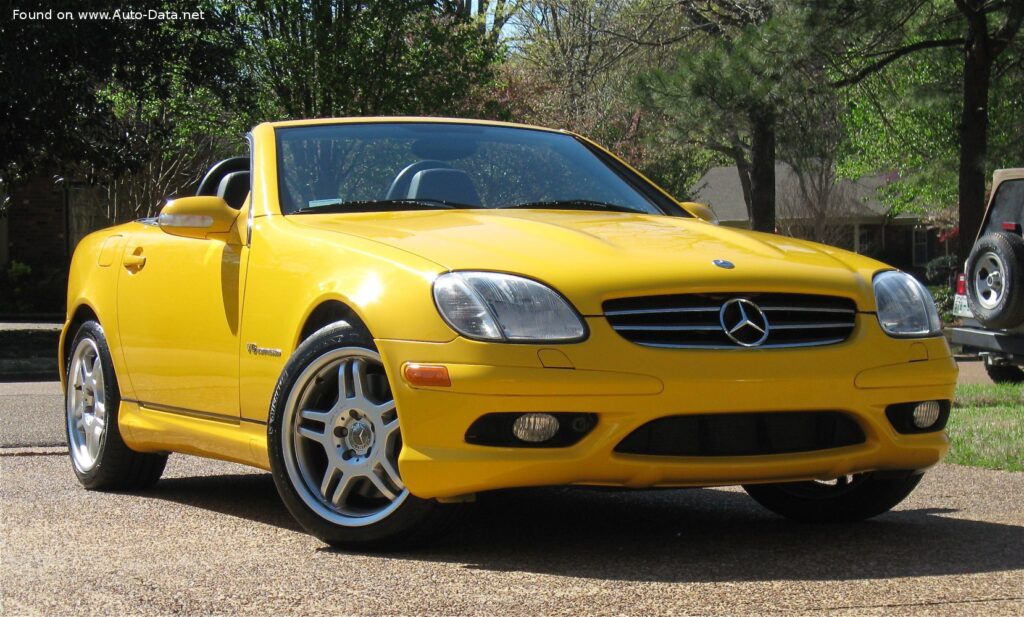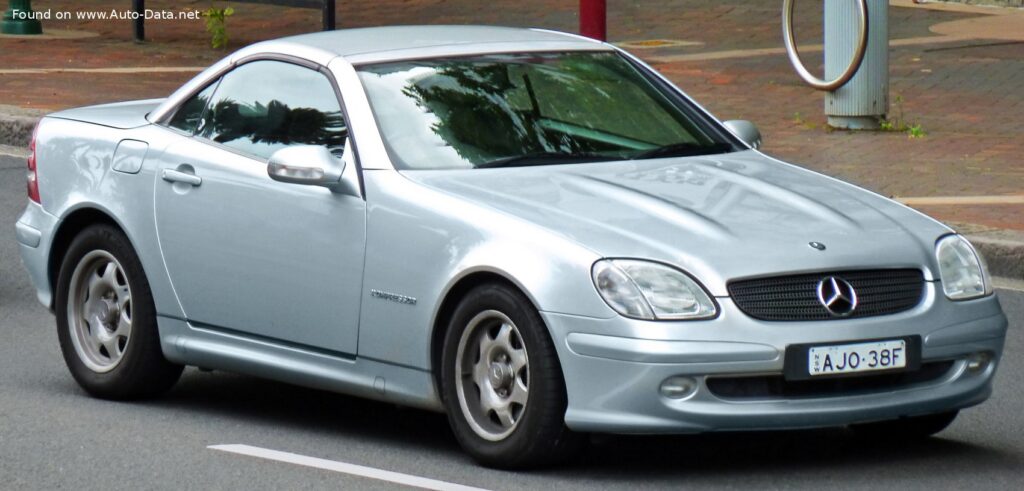
The Mercedes-Benz SLK (R170) SLK 230 Kompressor (193 Hp) Automatic represents a pivotal moment in the history of the compact luxury roadster segment. Unveiled to critical acclaim, the R170 generation, produced from July 1996 to February 2000 for this specific variant, redefined expectations for open-top driving by introducing the innovative Vario-roof – a retractable hardtop that seamlessly transformed the vehicle from a sleek coupe to an exhilarating roadster with the touch of a button. This model, with its potent supercharged engine and refined automatic transmission, quickly established itself as a formidable contender in a burgeoning market, offering a blend of sporty performance, everyday usability, and Mercedes-Benz’s hallmark luxury.
The “SLK” designation itself, derived from the German “Sportlich, Leicht, Kurz” (Sporty, Light, Short), perfectly encapsulated the car’s design philosophy. It was conceived to be a dynamic, accessible, and stylish two-seater that could appeal to a broader audience than traditional, often more uncompromising, roadsters. The SLK 230 Kompressor variant, in particular, was the range-topping model at its launch, showcasing advanced powertrain technology for its time and setting a high bar for its competitors in terms of both innovation and driving pleasure. Its arrival marked a significant shift in Mercedes-Benz’s product strategy, targeting a younger, more lifestyle-oriented demographic while maintaining the brand’s reputation for engineering excellence.
The Mercedes-Benz SLK (R170) Generation: Innovation and Aspiration
The R170 generation of the Mercedes-Benz SLK was an entirely new venture for the German automaker, aiming to create a compact, two-seat roadster that combined the exhilaration of open-air motoring with the security and refinement of a coupe. It was effectively a spiritual successor to earlier Mercedes-Benz roadsters but reimagined for the modern era, leveraging contemporary technology and design principles. The car’s concept was first previewed at the Turin Motor Show in 1994, generating immense excitement, primarily due to its groundbreaking Vario-roof technology. This feature, which allowed the car to switch between a hardtop coupe and an open-top roadster in just 25 seconds, was a game-changer, offering unmatched versatility and comfort compared to traditional soft-top convertibles.
The SLK was designed from the ground up to be a global product, though its primary market appeal was strong in Europe and North America. Its compact dimensions made it agile and easy to maneuver in urban environments, while its sophisticated engineering promised a rewarding driving experience on the open road. The R170 chassis was a derivative of the C-Class (W202) platform but heavily modified for its specific application, featuring a shorter wheelbase and a more performance-oriented suspension setup. The SLK 230 Kompressor, as the initial flagship, was tasked with demonstrating the performance capabilities and technological prowess of this new roadster line.
Engine and Performance of the SLK 230 Kompressor
At the heart of the Mercedes-Benz SLK (R170) SLK 230 Kompressor (193 Hp) Automatic was a meticulously engineered 2.3-liter (2295 cm3) inline-four engine, designated M 111.973. This powerplant was noteworthy for its use of a supercharger, a mechanical compressor that forces more air into the engine, thereby significantly boosting power output without the lag often associated with early turbochargers. Coupled with an intercooler to reduce the intake air temperature, the supercharger ensured a consistent and robust power delivery across the rev range.
The engine produced a healthy 193 horsepower at 5300 rpm, a substantial figure for a four-cylinder engine of its time. More impressively, its torque output was 206.52 lb.-ft. (280 Nm), available across a broad band from 2500 to 4800 rpm. This wide torque curve was a key characteristic of the supercharged engine, providing excellent responsiveness and effortless acceleration from low speeds, making it well-suited for both spirited driving and comfortable cruising. Power was routed to the rear wheels via a smooth 5-speed automatic transmission, which complemented the car’s luxury-sport ethos by offering convenient and refined gear changes.
Performance figures for the SLK 230 Kompressor were impressive for its class. It could accelerate from 0 to 60 mph in a brisk 6.9 seconds, with a top speed reaching 141.05 mph (227 km/h). The car’s weight-to-power ratio of 6.5 kg/Hp (154.4 Hp/tonne) highlighted its efficiency in converting engine output into tangible performance. Despite its focus on performance, the SLK 230 Kompressor also offered reasonable fuel economy for a supercharged vehicle of its era. The combined fuel consumption was rated at 24.8 US mpg (9.5 l/100 km), with extra-urban driving potentially yielding up to 33.6 US mpg (7 l/100 km). CO2 emissions were 225 g/km, reflecting the technology available in the late 1990s.
Design and Features
The design of the Mercedes-Benz SLK (R170) was a harmonious blend of classic roadster proportions and contemporary Mercedes-Benz styling cues. Its compact dimensions—157.28 inches in length, 67.52 inches in width, and 50.55 inches in height—gave it a nimble and athletic stance. The wheelbase measured 94.49 inches, contributing to its agile handling characteristics. A drag coefficient (Cd) of 0.33 was respectable for an open-top vehicle, aiding in both performance and fuel efficiency.
The most defining feature of the SLK (R170) was undoubtedly its retractable hardtop, or “Vario-roof.” This ingenious mechanism allowed the car to transform from a secure, weather-tight coupe to an open-air roadster in under half a minute, offering the best of both worlds. Unlike traditional soft-top convertibles, the Vario-roof provided enhanced security, better sound insulation, and improved climate control, making the SLK a viable year-round daily driver. When the roof was stowed, trunk space was reduced to 5.12 cu. ft. (145 liters), but with the roof up, it expanded to a more accommodating 12.29 cu. ft. (348 liters).
Inside, the SLK 230 Kompressor offered a driver-focused cockpit with premium materials and ergonomic controls. The two-seat cabin was designed for comfort and sportiness, featuring supportive seats and a clear instrument cluster. Standard features for the era included air conditioning, power windows, and a sophisticated audio system. Safety was also a consideration, with the R170 featuring dual front airbags and an Anti-lock Braking System (ABS) as standard. The chassis incorporated a double-wishbone front suspension and an independent multi-link rear suspension, both with coil springs and transverse stabilizers, providing a refined ride quality while maintaining responsive handling. Braking power was supplied by ventilated discs at the front and solid discs at the rear, ensuring confident stopping capability.
The car was equipped with a hydraulic power steering system, utilizing a cone worm with recirculation balls, providing direct feedback and a comfortable steering effort. It rode on 16-inch alloy wheels, with front tires sized 205/55 R 16 and wider rear tires at 225/50 R 16, optimizing grip and stability for its rear-wheel-drive architecture.
Technical Specifications
| Category | Specification | Value |
|---|---|---|
| General Information | ||
| Brand | Mercedes-Benz | |
| Model | SLK | |
| Generation | SLK (R170) | |
| Type (Engine) | SLK 230 Kompressor (193 Hp) Automatic | |
| Production Start | July, 1996 | |
| Production End | February, 2000 | |
| Powertrain Architecture | Internal Combustion engine | |
| Body Type | Roadster | |
| Seats | 2 | |
| Doors | 2 | |
| Performance Specs | ||
| Fuel Consumption (Urban, NEDC) | 17.3 US mpg (13.6 l/100 km) | |
| Fuel Consumption (Extra Urban, NEDC) | 33.6 US mpg (7 l/100 km) | |
| Fuel Consumption (Combined, NEDC) | 24.8 US mpg (9.5 l/100 km) | |
| CO2 Emissions (NEDC) | 225 g/km | |
| Fuel Type | Petrol (Gasoline) | |
| Acceleration 0 – 60 mph | 6.9 sec | |
| Acceleration 0 – 100 km/h | 7.3 sec | |
| Maximum Speed | 141.05 mph (227 km/h) | |
| Weight-to-Power Ratio | 154.4 Hp/tonne (6.5 kg/Hp) | |
| Weight-to-Torque Ratio | 224 Nm/tonne (4.5 kg/Nm) | |
| Engine Specs | ||
| Power | 193 Hp @ 5300 rpm | |
| Power per Liter | 84.1 Hp/l | |
| Torque | 206.52 lb.-ft. @ 2500-4800 rpm (280 Nm) | |
| Engine Layout | Front, Longitudinal | |
| Engine Model/Code | M 111.973 | |
| Engine Displacement | 2.3 liters (2295 cm3 / 140.05 cu. in.) | |
| Number of Cylinders | 4 | |
| Engine Configuration | Inline | |
| Cylinder Bore | 3.58 in. (90.9 mm) | |
| Piston Stroke | 3.48 in. (88.4 mm) | |
| Compression Ratio | 8.8:1 | |
| Valves per Cylinder | 4 | |
| Fuel Injection System | Multi-port manifold injection | |
| Engine Aspiration | Supercharger, Intercooler | |
| Valvetrain | DOHC | |
| Engine Oil Capacity | 5.81 US qt (5.5 l) | |
| Coolant Capacity | 8.45 US qt (8 l) | |
| Space, Volume and Weights | ||
| Kerb Weight | 2755.78 lbs. (1250 kg) | |
| Max. Weight | 3494.33 lbs. (1585 kg) | |
| Max Load | 738.55 lbs. (335 kg) | |
| Trunk (boot) Space – Minimum | 5.12 cu. ft. (145 l) | |
| Trunk (boot) Space – Maximum | 12.29 cu. ft. (348 l) | |
| Fuel Tank Capacity | 14 US gal (53 l) | |
| Max. Roof Load | 66.14 lbs. (30 kg) | |
| Dimensions | ||
| Length | 157.28 in. (3995 mm) | |
| Width | 67.52 in. (1715 mm) | |
| Height | 50.55 in. (1284 mm) | |
| Wheelbase | 94.49 in. (2400 mm) | |
| Front Track | 58.58 in. (1488 mm) | |
| Rear (Back) Track | 58.46 in. (1485 mm) | |
| Drag Coefficient (Cd) | 0.33 | |
| Minimum Turning Circle | 34.45 ft. (10.5 m) | |
| Drivetrain, Brakes and Suspension Specs | ||
| Drivetrain Architecture | Rear wheel drive. Internal Combustion engine. | |
| Drive Wheel | Rear wheel drive | |
| Number of Gears and Type of Gearbox | 5 gears, automatic transmission | |
| Front Suspension | Coil spring, Double wishbone, Transverse stabilizer | |
| Rear Suspension | Independent multi-link suspension, Coil spring | |
| Front Brakes | Ventilated discs | |
| Rear Brakes | Disc | |
| Assisting Systems | ABS (Anti-lock braking system) | |
| Steering Type | Cone worm with recirculation balls | |
| Power Steering | Hydraulic Steering | |
| Front Wheel Tires | 205/55 R 16 91 V | |
| Rear Wheel Tires | 225/50 R 16 91 V | |
| Front Wheel Rims | 7 J x 16 H 2 | |
| Rear Wheel Rims | 8 J x 16 H 2 | |
Legacy and Market Impact
The Mercedes-Benz SLK (R170) SLK 230 Kompressor left an indelible mark on the automotive landscape. Its primary legacy is undoubtedly the popularization of the retractable hardtop, a feature that was once exclusive to high-end, bespoke coach-built vehicles. The Vario-roof’s seamless integration into a mass-produced, relatively affordable luxury car set a new standard for convertibles and influenced countless designs from competitors in the years that followed. This innovation effectively eliminated the compromises traditionally associated with convertibles, offering the open-air exhilaration of a roadster with the security, quietness, and weather protection of a coupe.
Upon its debut, the SLK faced competition from established players like the BMW Z3 and the newer Porsche Boxster. While the Boxster offered a more purist, mid-engine sports car experience, and the Z3 capitalized on BMW’s driving dynamics, the SLK carved out its niche by offering a unique blend of style, comfort, and technological innovation. Its supercharged engine provided a distinctive power delivery compared to its naturally aspirated rivals, giving it a strong character. The SLK’s elegant yet sporty aesthetics, combined with the Mercedes-Benz badge, attracted a new demographic to the brand – younger buyers looking for a stylish and dynamic vehicle that was also practical for everyday use.
The R170 SLK was a commercial success for Mercedes-Benz, helping to broaden its appeal and demonstrating the brand’s willingness to innovate beyond its traditional luxury sedans. It cultivated a reputation for being a sophisticated and fashionable choice among compact roadsters. Today, the SLK (R170) is regarded by many as a modern classic, appreciated for its groundbreaking design, robust engineering, and enjoyable driving experience. Its impact on convertible design is undeniable, and the SLK 230 Kompressor stands as a testament to Mercedes-Benz’s forward-thinking approach in the late 20th century, successfully merging sportiness, luxury, and advanced technology into a compelling package.