The automotive landscape of the mid-2000s saw a resurgence of interest in compact, luxurious roadsters, and Mercedes-Benz was a prominent player with its second-generation SLK-Class, internally designated R171. Among its compelling offerings was the Mercedes-Benz SLK (R171) SLK 280 V6 (231 Hp) 7G-TRONIC, a model that perfectly encapsulated the brand’s blend of performance, style, and advanced engineering for its segment. Launched in April 2005, the SLK 280 V6 quickly established itself as a sophisticated choice for enthusiasts seeking open-air driving pleasure with the assured refinement of a Mercedes-Benz.
Positioned within the premium compact roadster market, the R171 generation was a significant evolution from its R170 predecessor, bringing more assertive styling, enhanced performance, and a suite of technological improvements. The SLK 280 V6, with its potent V6 engine and advanced 7G-TRONIC automatic transmission, aimed to strike a balance between everyday usability and exhilarating driving dynamics, appealing to a broad demographic of luxury car buyers.
Engine & Performance: The Heart of the Mercedes-Benz SLK (R171)
At the core of the Mercedes-Benz SLK (R171) SLK 280 V6 was the M 272.942 engine, a naturally aspirated 3.0-liter V6 gasoline powerplant. This sophisticated engine was designed for smooth power delivery and responsiveness, characteristics highly valued in a luxury roadster. It produced a robust 231 horsepower at 6000 rpm, translating to a healthy 77.1 horsepower per liter, demonstrating efficient power generation for its displacement. Torque output was equally impressive, peaking at 221.27 lb-ft (300 Nm) across a broad range from 2400 to 5000 rpm. This wide torque band ensured strong acceleration and flexible in-gear performance, making the SLK 280 V6 enjoyable in various driving scenarios, from city streets to winding backroads.
The engine featured a V-configuration with six cylinders, a compression ratio of 11.1:1, and a DOHC (Double Overhead Camshaft) valvetrain with four valves per cylinder, optimizing airflow and combustion efficiency. Fuel was delivered via a multi-port manifold injection system, a proven technology that provided precise fuel metering. Power was transmitted to the rear wheels through Mercedes-Benz’s then-innovative 7G-TRONIC automatic transmission. This 7-speed gearbox was one of the first of its kind, offering a wider ratio spread and quicker shifts than traditional automatics, contributing significantly to both performance and fuel efficiency. The combination allowed the SLK 280 V6 to accelerate from 0 to 60 mph in a swift 5.9 seconds, with a top speed electronically limited to 155.34 mph (250 km/h). This level of performance placed it competitively within its segment, offering a thrilling driving experience.
Despite its performance capabilities, the SLK 280 V6 also aimed for respectable fuel economy for its class. The combined NEDC cycle rating indicated 9.3-9.5 liters per 100 km, which translates to approximately 24.8-25.3 US miles per gallon. Urban consumption ranged from 18.2-18 US mpg, while extra-urban driving could achieve 32.7-33.6 US mpg. CO2 emissions were rated at 222-227 g/km, adhering to Euro 4 emission standards, which were contemporary for its production period from April 2005 to December 2007.
Design & Features: The R171’s Aesthetic and Innovations
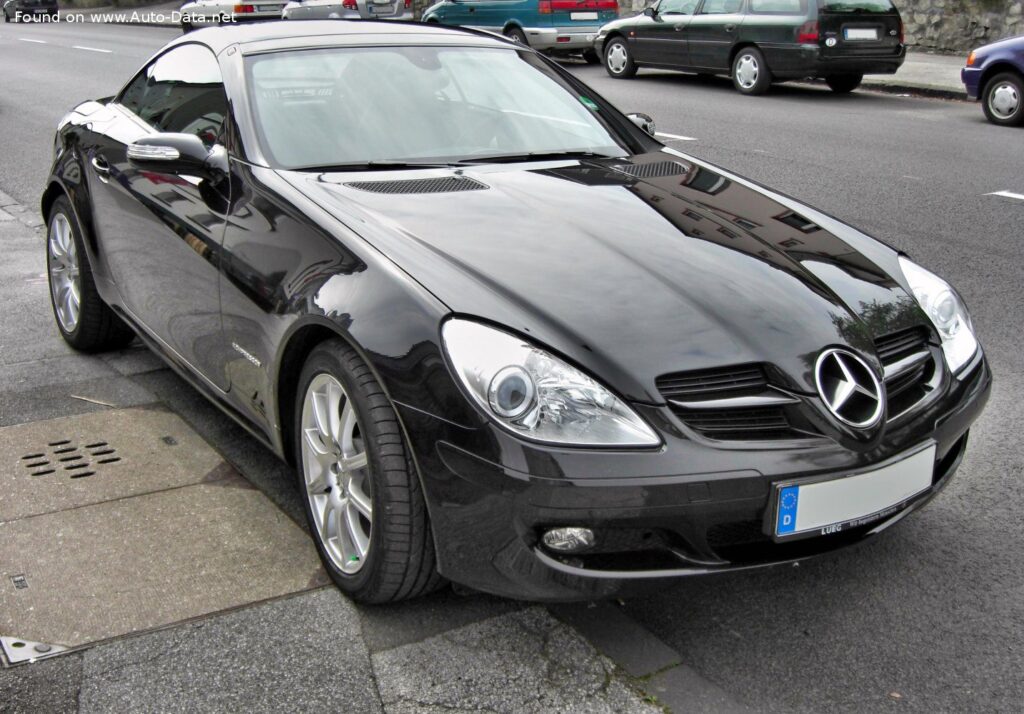
The SLK (R171) generation marked a significant departure from its predecessor in terms of styling, adopting a more aggressive and sporty aesthetic inspired by the McLaren-Mercedes SLR supercar. The SLK 280 V6 retained the quintessential roadster body type, characterized by its two doors and two seats, emphasizing a focus on pure driving enjoyment. Its distinctive features included a longer hood, a sharply raked windshield, and a prominent grille with the iconic three-pointed star, giving it a powerful and dynamic presence.
One of the R171’s most celebrated features was its retractable hardtop, or “vario-roof,” a Mercedes-Benz innovation that allowed the car to transform from a sleek coupe to an open-top roadster in mere seconds. This system offered the best of both worlds: the security and refinement of a coupe when closed, and the exhilarating freedom of a convertible when open. The trunk space, while compact at 7.35 cubic feet (208 liters), was sufficient for weekend getaways, a common compromise in this class of vehicle.
Inside, the cabin of the SLK 280 V6 blended luxury with a sporty ambiance. High-quality materials, ergonomic design, and Mercedes-Benz’s renowned build quality were evident throughout. For its era, the R171 came equipped with a range of advanced features, including standard anti-lock braking system (ABS), a sophisticated independent front McPherson strut suspension, and an independent multi-link rear suspension, both complemented by transverse stabilizers for enhanced handling stability. The hydraulic power steering, a rack and pinion system, offered precise feedback and a minimum turning circle of 34.48 feet (10.51 meters), making it agile in urban environments. The vehicle also featured staggered tire sizes, with 205/55 R 16 91 W at the front and wider 225/50 R 16 92 W at the rear, mounted on 16-inch alloy wheels, optimizing grip and handling balance.
Technical Specifications
| General Information | |
|---|---|
| Brand | Mercedes-Benz |
| Model | SLK |
| Generation | SLK (R171) |
| Type (Engine) | SLK 280 V6 (231 Hp) 7G-TRONIC |
| Start of Production | April, 2005 |
| End of Production | December, 2007 |
| Powertrain Architecture | Internal Combustion Engine |
| Body Type | Roadster |
| Seats | 2 |
| Doors | 2 |
| Performance Specifications | |
| Fuel Consumption (Urban, NEDC) | 12.9-13.1 l/100 km (18.2 – 18 US mpg) |
| Fuel Consumption (Extra Urban, NEDC) | 7.0-7.2 l/100 km (33.6 – 32.7 US mpg) |
| Fuel Consumption (Combined, NEDC) | 9.3-9.5 l/100 km (25.3 – 24.8 US mpg) |
| CO2 Emissions (NEDC) | 222-227 g/km |
| Fuel Type | Petrol (Gasoline) |
| Acceleration 0-60 mph | 5.9 seconds |
| Acceleration 0-62 mph (0-100 km/h) | 6.2 seconds |
| Maximum Speed | 155.34 mph (250 km/h), Electronically Limited |
| Emission Standard | Euro 4 |
| Weight-to-Power Ratio | 5.9 kg/Hp (169.2 Hp/tonne) |
| Weight-to-Torque Ratio | 4.6 kg/Nm (219.8 Nm/tonne) |
| Engine Specifications | |
| Power | 231 Hp @ 6000 rpm |
| Power per Liter | 77.1 Hp/l |
| Torque | 221.27 lb.-ft. (300 Nm) @ 2400-5000 rpm |
| Engine Layout | Front, Longitudinal |
| Engine Model/Code | M 272.942 |
| Engine Displacement | 3.0 Liters (2996 cm3 / 182.83 cu. in.) |
| Number of Cylinders | 6 |
| Engine Configuration | V-engine |
| Cylinder Bore | 3.46 inches (88 mm) |
| Piston Stroke | 3.23 inches (82.1 mm) |
| Compression Ratio | 11.1:1 |
| Number of Valves per Cylinder | 4 |
| Fuel Injection System | Multi-port manifold injection |
| Engine Aspiration | Naturally Aspirated |
| Valvetrain | DOHC |
| Engine Oil Capacity | 8.45 US qt (8 liters) |
| Coolant Capacity | 7.5 US qt (7.1 liters) |
| Dimensions, Volume, and Weights | |
| Kerb Weight (Curb Weight) | 3009.31 lbs (1365 kg) |
| Max. Weight (Gross Vehicle Weight) | 3869.11 lbs (1755 kg) |
| Max Load | 859.8 lbs (390 kg) |
| Trunk (Boot) Space – Minimum | 7.35 cu. ft. (208 liters) |
| Fuel Tank Capacity | 18.49 US gal (70 liters) |
| Max. Roof Load | 110.23 lbs (50 kg) |
| Length | 160.98 inches (4089 mm) |
| Width | 70.39 inches (1788 mm) |
| Width Including Mirrors | 77.56 inches (1970 mm) |
| Height | 51.1 inches (1298 mm) |
| Wheelbase | 95.67 inches (2430 mm) |
| Front Track | 60.08 inches (1526 mm) |
| Rear (Back) Track | 60.98 inches (1549 mm) |
| Drag Coefficient (Cd) | 0.32 |
| Minimum Turning Circle | 34.48 ft (10.51 m) |
| Drivetrain, Brakes, and Suspension | |
| Drivetrain Architecture | Rear-wheel drive, Internal Combustion Engine |
| Drive Wheel | Rear-wheel drive |
| Number of Gears and Type of Gearbox | 7 gears, automatic transmission (7G-TRONIC) |
| Front Suspension | Independent type McPherson, Transverse stabilizer |
| Rear Suspension | Independent multi-link suspension, Transverse stabilizer |
| Front Brakes | Ventilated discs |
| Rear Brakes | Disc |
| Assisting Systems | ABS (Anti-lock Braking System) |
| Steering Type | Steering rack and pinion |
| Power Steering | Hydraulic Steering |
| Front Wheel Tires | 205/55 R 16 91 W |
| Rear Wheel Tires | 225/50 R 16 92 W |
| Front Wheel Rims | 7 J x 16 H 2 |
| Rear Wheel Rims | 8 J x 16 H 2 |
Legacy & Market Impact
The Mercedes-Benz SLK (R171) SLK 280 V6 (231 Hp) 7G-TRONIC enjoyed a strong reputation for its blend of open-top enjoyment, luxury, and engaging performance. During its production run from 2005 to 2007, it carved out a significant niche in the highly competitive luxury roadster segment. Its primary competitors included the BMW Z4, Porsche Boxster, and the Audi TT Roadster. While the Boxster offered a more track-focused experience and the Z4 a sportier, more aggressive edge, the SLK 280 V6 distinguished itself with its quintessential Mercedes-Benz refinement, comfort, and the innovative vario-roof, which was a major selling point.
The R171 generation, and specifically the SLK 280 V6, solidified the SLK’s position as a desirable option for those seeking a stylish and powerful two-seater that didn’t compromise on luxury. Its M 272 V6 engine, shared with other Mercedes-Benz models of the era, was praised for its smooth operation and robust power delivery, perfectly complementing the car’s grand touring aspirations. The 7G-TRONIC transmission was a technological highlight, offering a new level of sophistication and efficiency for automatic gearboxes in the mid-2000s.
Historically, the SLK (R171) represented a pivotal moment for Mercedes-Benz’s compact roadster line, moving it towards a more overtly sporty and visually striking design philosophy. The SLK 280 V6, positioned as a strong mid-range offering, provided a compelling alternative to the more powerful AMG variants while still delivering ample performance for most drivers. Its legacy endures as a well-engineered and aesthetically pleasing roadster that offered a compelling blend of Mercedes-Benz luxury, innovative features, and an enjoyable driving experience, making it a desirable pre-owned vehicle for enthusiasts today.