The Mercedes-Benz SLK (R171) SLK 350 V6 (272 Hp) 7G-TRONIC: A Modern Roadster Icon
The Mercedes-Benz SLK, particularly the R171 generation, represents a significant chapter in the evolution of the luxury compact roadster segment. Introduced in May 2004, the R171 aimed to build upon the success of its groundbreaking predecessor, the R170, by offering a more refined, powerful, and technologically advanced package. Among its various iterations, the Mercedes-Benz SLK (R171) SLK 350 V6 (272 Hp) 7G-TRONIC stood out as a particularly compelling choice, balancing robust performance with the sophisticated comfort and open-air exhilaration that Mercedes-Benz buyers had come to expect. This model, produced until December 2007, quickly established itself as a formidable competitor in its class, renowned for its distinctive design, potent V6 engine, and the innovative retractable hardtop that defined the SLK lineage.
The R171 generation of the SLK was a global success, highly regarded in markets like North America and Europe for its blend of sporty driving dynamics and premium features. It offered a compelling proposition to those seeking a two-seat convertible that could seamlessly transform into a secure, all-weather coupe at the touch of a button. The SLK 350 V6, in particular, was positioned as a performance-oriented variant within the lineup, providing a significant upgrade in power and responsiveness over the entry-level models, making it a favorite among driving enthusiasts.
Engine & Performance: The Heart of the Mercedes-Benz SLK (R171) SLK 350 V6 (272 Hp) 7G-TRONIC
At the core of the SLK 350 V6’s appeal was its meticulously engineered M 272.963 engine. This naturally aspirated V6 powerplant, with a displacement of 3498 cm³ (3.5 liters or 213.46 cubic inches), was a marvel of German engineering, delivering a potent 272 horsepower at 6000 rpm. Its power per liter stood at an impressive 77.8 Hp/l, showcasing its efficiency in generating power from its displacement. Torque output was equally impressive, peaking at 350 Nm (258.15 lb.-ft.) across a broad rev range, from 2400 to 5000 rpm, ensuring robust acceleration and flexible in-gear performance.
The engine featured a V-configuration with six cylinders, each equipped with four valves, totaling 24 valves for optimal airflow and combustion. A Double Overhead Camshaft (DOHC) valvetrain further enhanced its performance characteristics, allowing for precise control over valve timing. Fuel delivery was managed by a multi-port manifold injection system, ensuring efficient and responsive power delivery. With a compression ratio of 10.7:1, the engine was designed for high efficiency and smooth operation, utilizing gasoline as its fuel type.
Power was channeled to the rear wheels via Mercedes-Benz’s advanced 7G-TRONIC automatic transmission. This seven-speed gearbox was a significant technological leap for its time, offering incredibly smooth and rapid shifts. Its numerous ratios allowed the engine to operate within its optimal powerband more frequently, contributing to both exhilarating acceleration and improved fuel economy. The SLK 350 V6 could sprint from 0 to 60 mph in a swift 5.2 seconds (0-100 km/h in 5.5 seconds) and reached an electronically limited top speed of 155.34 mph (250 km/h).
Despite its performance capabilities, the SLK 350 V6 also demonstrated reasonable fuel efficiency for a luxury sports car of its era. The combined fuel consumption was rated at 10.1 l/100 km, which translates to approximately 23.3 US mpg. Its CO2 emissions stood at 242 g/km, adhering to the Euro 4 emission standard, reflecting a commitment to environmental considerations even in a performance-focused package.
Design & Features: Elegance Meets Innovation
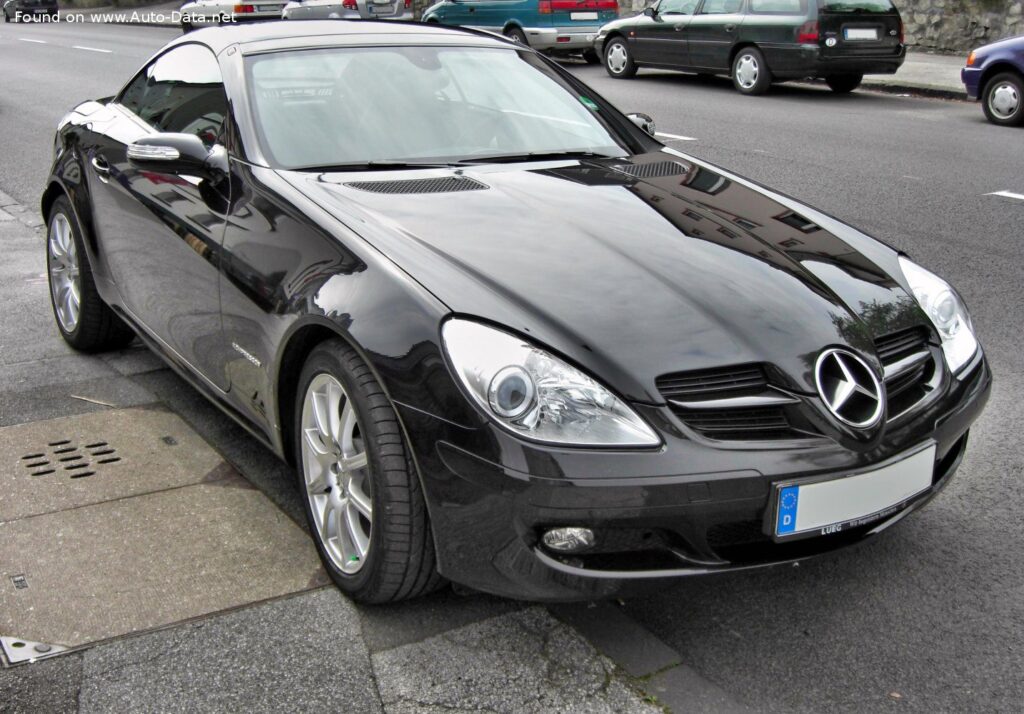
The R171 generation of the Mercedes-Benz SLK represented a dramatic stylistic departure from its predecessor, adopting a more aggressive and angular design language inspired by the McLaren-Mercedes SLR supercar. Its elongated hood, short overhangs, and sharply raked windshield gave it a dynamic and purposeful stance. The distinct “Formula 1” nose, with its prominent three-pointed star, became an instant identifier for the model, signaling its sporting intentions.
As a two-door, two-seat roadster, the SLK 350 V6 offered an intimate driving experience. Its most celebrated feature remained the electro-hydraulically operated “vario-roof” – a retractable hardtop that could transform the car from a sleek coupe to an open-top roadster in mere seconds. This innovation provided the best of both worlds: the security and refinement of a coupe with the freedom and sensory engagement of a convertible, all in one stylish package. When stowed, the trunk space was 7.35 cubic feet (208 liters), ample for weekend getaways.
Inside, the cabin reflected Mercedes-Benz’s commitment to luxury and ergonomic design. High-quality materials, precise fit and finish, and intuitive controls were standard. While specific interior features varied by market and optional packages, the SLK 350 V6 typically included premium leather upholstery, automatic climate control, a sophisticated infotainment system, and a range of comfort and convenience features designed to enhance the driving and passenger experience. Safety was also a priority, with standard features such as ABS (Anti-lock Braking System) and a robust chassis structure providing peace of mind.
The car’s dynamic capabilities were further enhanced by its carefully tuned suspension system. The front utilized an independent McPherson-type setup with a transverse stabilizer, while the rear featured an independent multi-link suspension, also with a transverse stabilizer. This combination provided a balanced ride, offering both sporty handling and comfortable cruising. Braking performance was assured by ventilated discs at the front and disc brakes at the rear. The hydraulic power steering, with its rack and pinion setup, offered precise and communicative feedback, contributing to the engaging driving experience. The SLK 350 V6 rode on staggered wheel and tire sizes: 225/45 R 17 91 W tires on 7.5 J x 17 H 2 rims at the front, and wider 245/40 R 17 91 W tires on 8.5 J x 17 H 2 rims at the rear, optimizing grip and handling.
Technical Specifications
| Category | Specification | US Equivalent |
|---|---|---|
| General Information | ||
| Brand | Mercedes-Benz | |
| Model | SLK | |
| Generation | SLK (R171) | |
| Type (Engine) | SLK 350 V6 (272 Hp) 7G-TRONIC | |
| Start of Production | May, 2004 year | |
| End of Production | December, 2007 year | |
| Powertrain Architecture | Internal Combustion engine | |
| Body type | Roadster | |
| Seats | 2 | |
| Doors | 2 | |
| Performance Specs | ||
| Fuel consumption (economy) – urban (NEDC) | 14.2 l/100 km | 16.6 US mpg |
| Fuel consumption (economy) – extra urban (NEDC) | 7.8 l/100 km | 30.2 US mpg |
| Fuel consumption (economy) – combined (NEDC) | 10.1 l/100 km | 23.3 US mpg |
| CO2 emissions (NEDC) | 242 g/km | |
| Fuel Type | Petrol (Gasoline) | |
| Acceleration 0 – 62 mph | 5.5 sec | |
| Acceleration 0 – 60 mph (Calculated) | 5.2 sec | |
| Maximum speed (Electronically limited) | 250 km/h | 155.34 mph |
| Emission standard | Euro 4 | |
| Weight-to-power ratio | 5.1 kg/Hp | 195.7 Hp/tonne |
| Weight-to-torque ratio | 4 kg/Nm | 251.8 Nm/tonne |
| Engine Specs | ||
| Power | 272 Hp @ 6000 rpm | |
| Power per liter | 77.8 Hp/l | |
| Torque | 350 Nm @ 2400-5000 rpm | 258.15 lb.-ft. @ 2400-5000 rpm |
| Engine layout | Front, Longitudinal | |
| Engine Model/Code | M 272.963 | |
| Engine displacement | 3498 cm³ | 213.46 cu. in. |
| Number of cylinders | 6 | |
| Engine configuration | V-engine | |
| Cylinder Bore | 92.9 mm | 3.66 in. |
| Piston Stroke | 86 mm | 3.39 in. |
| Compression ratio | 10.7:1 | |
| Number of valves per cylinder | 4 | |
| Fuel injection system | Multi-port manifold injection | |
| Engine aspiration | Naturally aspirated engine | |
| Valvetrain | DOHC | |
| Engine oil capacity | 8 l | 8.45 US qt |
| Coolant | 10.2 l | 10.78 US qt |
| Space, Volume and Weights | ||
| Kerb Weight | 1390 kg | 3064.43 lbs. |
| Max. weight | 1780 kg | 3924.23 lbs. |
| Max load | 390 kg | 859.8 lbs. |
| Trunk (boot) space – minimum | 208 l | 7.35 cu. ft. |
| Fuel tank capacity | 70 l | 18.49 US gal |
| Max. roof load | 50 kg | 110.23 lbs. |
| Dimensions | ||
| Length | 4089 mm | 160.98 in. |
| Width | 1788 mm | 70.39 in. |
| Width including mirrors | 1970 mm | 77.56 in. |
| Height | 1298 mm | 51.1 in. |
| Wheelbase | 2430 mm | 95.67 in. |
| Front track | 1526 mm | 60.08 in. |
| Rear (Back) track | 1549 mm | 60.98 in. |
| Drag coefficient (Cd) | 0.32 | |
| Minimum turning circle (turning diameter) | 10.51 m | 34.48 ft. |
| Drivetrain, Brakes and Suspension Specs | ||
| Drivetrain Architecture | The Internal combustion engine (ICE) drives the rear wheels of the vehicle. | |
| Drive wheel | Rear wheel drive | |
| Number of gears and type of gearbox | 7 gears, automatic transmission | |
| Front suspension | Independent type McPherson, Transverse stabilizer | |
| Rear suspension | Independent multi-link suspension, Transverse stabilizer | |
| Front brakes | Ventilated discs | |
| Rear brakes | Disc | |
| Assisting systems | ABS (Anti-lock braking system) | |
| Steering type | Steering rack and pinion | |
| Power steering | Hydraulic Steering | |
| Tires size – Front | 225/45 R 17 91 W | |
| Tires size – Rear | 245/40 R 17 91 W | |
| Wheel rims size – Front | 7.5 J x 17 H 2 | |
| Wheel rims size – Rear | 8.5 J x 17 H 2 | |
Legacy & Market Impact
The Mercedes-Benz SLK (R171) SLK 350 V6 (272 Hp) 7G-TRONIC carved out a significant niche in the competitive luxury compact roadster market during its production run. It faced stiff competition from established rivals such as the BMW Z4, the Porsche Boxster, and the Audi TT Roadster, each offering its unique blend of performance, luxury, and style. However, the SLK 350 V6 distinguished itself with its distinctive styling, the unparalleled versatility of its vario-roof, and the robust, refined performance delivered by its V6 engine and advanced 7G-TRONIC transmission.
The R171 generation, and especially the SLK 350, helped solidify the SLK’s reputation as a desirable choice for consumers seeking a premium two-seater that didn’t compromise on comfort or practicality. It successfully appealed to a broad demographic, from those looking for a stylish daily driver to enthusiasts desiring a spirited weekend car. Its blend of Mercedes-Benz luxury, open-air freedom, and respectable performance made it a compelling package.
Historically, the SLK 350 V6 played a crucial role in maintaining Mercedes-Benz’s presence in the evolving sports car segment. It demonstrated the brand’s capability to innovate with features like the retractable hardtop, which became a benchmark for many competitors. Even today, the R171 SLK 350 is remembered for its engaging driving dynamics, its distinctive “F1 nose” styling, and its overall quality and refinement. It remains a popular choice on the used car market, offering a relatively accessible entry point into luxury roadster ownership, retaining its appeal as a stylish, well-engineered, and enjoyable performance car that embodies the essence of Mercedes-Benz engineering and design from the mid-2000s.