Introduction to the Mercedes-Benz SLK (R172) SLK 200 1.8 (184 Hp)
The Mercedes-Benz SLK (R172) represents the third generation of the brand’s compact luxury roadster, a lineage renowned for combining open-top driving exhilaration with the sophisticated comforts and engineering prowess characteristic of the Stuttgart automaker. Produced from 2011 to 2015, the R172 generation succeeded the popular R171, bringing a more athletic design, enhanced technology, and improved efficiency to the segment. Among its diverse powertrain offerings, the Mercedes-Benz SLK (R172) SLK 200 1.8 (184 Hp) stood out as a compelling entry-level variant, particularly favored in European markets for its balanced performance, fuel economy, and accessible luxury.
Positioned as an agile two-seater, the SLK-Class, and specifically the SLK 200, carved a niche for itself by offering a premium roadster experience. It blended elegant styling with a practical retractable hardtop, making it a versatile choice for enthusiasts seeking both sunny drives and all-weather usability. While the SLK 200 variant with its 1.8-liter turbocharged engine was a cornerstone of the European lineup, providing an efficient yet spirited driving experience, other markets, including the United States, often received larger displacement engines or more performance-oriented AMG variants. Nevertheless, the underlying R172 platform and its advanced engineering principles were universal, establishing a benchmark for compact luxury roadsters of its era.
Powertrain and Performance of the Mercedes-Benz SLK (R172) SLK 200 1.8 (184 Hp)
At the heart of the Mercedes-Benz SLK (R172) SLK 200 1.8 (184 Hp) lies Mercedes-Benz’s M 271.861 engine, a sophisticated 1.8-liter (1796 cm3 or 109.6 cu. in.) inline four-cylinder gasoline unit. This engine was engineered for a harmonious blend of power and efficiency, incorporating advanced technologies such as direct fuel injection and a turbocharger with an intercooler. The use of a turbocharger was crucial in extracting significant output from a relatively small displacement, allowing the SLK 200 to deliver robust performance without compromising on fuel economy.
The powerplant generates a respectable 184 horsepower at 5250 rpm, paired with a substantial 199.14 lb.-ft. (270 Nm) of torque available across a broad rev range, specifically from 1800 to 4600 rpm. This wide torque band ensures responsive acceleration and flexible driving characteristics, whether navigating city streets or cruising on the open highway. Power is transmitted to the rear wheels via a precise 6-speed manual transmission, offering an engaging and direct driving experience that appeals to purists.
In terms of outright performance, the SLK 200 is capable of accelerating from 0 to 60 mph in an estimated 6.9 seconds (0-100 km/h in 7.3 seconds), with a top speed rated at 149.13 mph (240 km/h). These figures demonstrate that despite being an entry-level model, the SLK 200 was no slouch. Furthermore, efficiency was a key focus for this generation. The vehicle achieved a combined fuel economy of 34.6 to 36.8 US mpg (6.4-6.8 l/100 km), with urban figures ranging from 25.3 to 26.4 US mpg and extra-urban figures reaching an impressive 44.4 to 47 US mpg. This efficiency was further aided by the inclusion of a Start & Stop system, an innovative feature for its time that automatically shuts off the engine when the vehicle is stationary, reducing fuel consumption and CO2 emissions, which ranged from 149-158 g/km, meeting Euro 5 emission standards.
Design and Technology Features
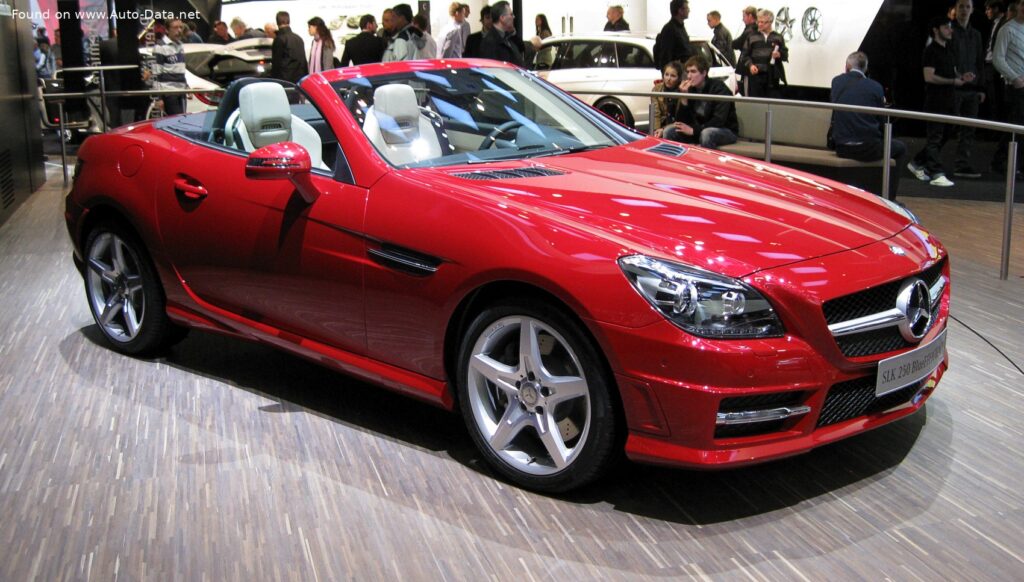
The design of the Mercedes-Benz SLK (R172) marked a significant evolution from its predecessors, adopting a more aggressive and muscular aesthetic inspired by the iconic Mercedes-Benz SLS AMG supercar. This influence was most noticeable in the prominent grille, framed by distinctive headlamps and a longer, more assertive hood. The SLK 200, like all R172 variants, featured the signature two-door roadster body type, offering seating for two occupants. Its compact dimensions – 162.76 inches in length, 71.26 inches in width (78.98 inches including mirrors), and 51.22 inches in height – contributed to its agile handling and nimble character.
A defining feature of the SLK-Class, which continued with the R172, was its innovative “vario-roof” – a retractable hardtop that seamlessly transformed the car from a sleek coupe to an open-air roadster with the push of a button. This engineering marvel provided the best of both worlds: the security and insulation of a fixed roof, and the exhilaration of top-down motoring. The car’s aerodynamic efficiency was commendable, boasting a drag coefficient (Cd) of just 0.30, contributing to both performance and fuel economy.
Underneath, the SLK 200 was built on a sophisticated chassis featuring independent McPherson front suspension with coil springs and an anti-roll bar, complemented by an independent multi-link spring suspension with a stabilizer at the rear. This setup delivered a comfortable ride with sporty handling. Braking power was provided by ventilated discs at the front and solid discs at the rear, supported by an Anti-lock Braking System (ABS) for enhanced safety. Hydraulic rack and pinion steering offered precise control and feedback. The vehicle rode on 205/55 R16 tires mounted on 7J x 16 alloy wheels, providing a good balance of grip and ride comfort.
Inside, the SLK 200 offered a luxurious and driver-focused cockpit, typical of Mercedes-Benz. While specific interior features are not detailed in the raw data, the R172 generation was known for its high-quality materials, ergonomic layout, and available advanced technologies such as the “Airscarf” neck-level heating system (an option that became a signature comfort feature for Mercedes-Benz roadsters) and various infotainment upgrades, ensuring a premium cabin experience.
Technical Specifications
| Category | Specification |
|---|---|
| Brand | Mercedes-Benz |
| Model | SLK |
| Generation | SLK (R172) |
| Type (Engine) | SLK 200 1.8 (184 Hp) |
| Start of Production | 2011 year |
| End of Production | 2015 year |
| Powertrain Architecture | Internal Combustion engine |
| Body Type | Roadster |
| Seats | 2 |
| Doors | 2 |
Performance Specs |
|
| Fuel Consumption (Urban) | 26.4 – 25.3 US mpg (8.9-9.3 l/100 km) |
| Fuel Consumption (Extra Urban) | 47 – 44.4 US mpg (5-5.3 l/100 km) |
| Fuel Consumption (Combined) | 36.8 – 34.6 US mpg (6.4-6.8 l/100 km) |
| CO2 Emissions | 149-158 g/km |
| Fuel Type | Petrol (Gasoline) |
| Acceleration 0-60 mph | 6.9 sec (Calculated) |
| Acceleration 0-100 km/h | 7.3 sec |
| Maximum Speed | 149.13 mph (240 km/h) |
| Emission Standard | Euro 5 |
| Weight-to-Power Ratio | 7.6 kg/Hp, 131.9 Hp/tonne |
| Weight-to-Torque Ratio | 5.2 kg/Nm, 193.5 Nm/tonne |
Engine Specs |
|
| Power | 184 Hp @ 5250 rpm |
| Power per Liter | 102.4 Hp/l |
| Torque | 199.14 lb.-ft. @ 1800-4600 rpm (270 Nm) |
| Engine Layout | Front, Longitudinal |
| Engine Model/Code | M 271.861 |
| Engine Displacement | 109.6 cu. in. (1796 cm3) |
| Number of Cylinders | 4 |
| Engine Configuration | Inline |
| Cylinder Bore | 3.23 in. (82 mm) |
| Piston Stroke | 3.35 in. (85 mm) |
| Compression Ratio | 9.3:1 |
| Number of Valves per Cylinder | 4 |
| Fuel Injection System | Direct injection |
| Engine Aspiration | Turbocharger, Intercooler |
| Valvetrain | DOHC |
| Engine Oil Capacity | 5.81 US qt (5.5 l) |
| Coolant Capacity | 8.45 US qt (8 l) |
| Engine Systems | Start & Stop System |
Space, Volume and Weights |
|
| Kerb Weight | 3075.45 lbs. (1395 kg) |
| Max. Weight | 3858.09 lbs. (1750 kg) |
| Max Load | 782.64 lbs. (355 kg) |
| Trunk (boot) Space – Minimum | 7.95 cu. ft. (225 l) |
| Trunk (boot) Space – Maximum | 11.83 cu. ft. (335 l) |
| Fuel Tank Capacity | 15.85 US gal (60 l) |
Dimensions |
|
| Length | 162.76 in. (4134 mm) |
| Width | 71.26 in. (1810 mm) |
| Width Including Mirrors | 78.98 in. (2006 mm) |
| Height | 51.22 in. (1301 mm) |
| Wheelbase | 95.67 in. (2430 mm) |
| Front Track | 61.38 in. (1559 mm) |
| Rear (Back) Track | 61.61 in. (1565 mm) |
| Front Overhang | 34.25 in. (870 mm) |
| Rear Overhang | 32.83 in. (834 mm) |
| Drag Coefficient (Cd) | 0.30 |
| Minimum Turning Circle | 34.51 ft. (10.52 m) |
Drivetrain, Brakes and Suspension Specs |
|
| Drivetrain Architecture | The Internal combustion engine (ICE) drives the rear wheels of the vehicle. |
| Drive Wheel | Rear wheel drive |
| Number of Gears and Type of Gearbox | 6 gears, manual transmission |
| Front Suspension | Independent, type McPherson with coil spring and anti-roll bar |
| Rear Suspension | Independent multi-link spring suspension with stabilizer |
| Front Brakes | Ventilated discs |
| Rear Brakes | Disc |
| Assisting Systems | ABS (Anti-lock braking system) |
| Steering Type | Steering rack and pinion |
| Power Steering | Hydraulic Steering |
| Tires Size | 205/55 R16 |
| Wheel Rims Size | 7J x 16 |
Legacy and Market Impact of the Mercedes-Benz SLK (R172)
The Mercedes-Benz SLK (R172) SLK 200 1.8 (184 Hp) played a crucial role in maintaining the SLK-Class’s reputation as a desirable and capable compact luxury roadster. Its introduction in 2011 solidified Mercedes-Benz’s commitment to the segment, offering a more contemporary and dynamically styled alternative to its predecessor. While higher-performance variants garnered more attention in some markets, the SLK 200 was instrumental in providing an entry point to the Mercedes-Benz roadster lineup, particularly appealing to European buyers who valued its blend of sophisticated engineering, impressive fuel efficiency, and classic Mercedes-Benz luxury.
The R172 generation, including the SLK 200, was well-received for its improved driving dynamics, a more substantial and aggressive exterior design that resonated with a broader audience, and a cabin that exuded quality and comfort. Its retractable hardtop remained a significant selling point, offering security and refinement that many soft-top competitors couldn’t match. This versatility allowed the SLK to be a genuine year-round daily driver, enhancing its practical appeal.
In the competitive landscape, the SLK 200 faced rivals such as the BMW Z4 sDrive20i, Audi TT Roadster, and potentially even the Porsche Boxster (though the Boxster typically occupied a higher performance and price bracket). The SLK differentiated itself with its unique vario-roof, its distinctively luxurious interior ambiance, and the prestige associated with the Mercedes-Benz badge. While the Z4 offered a sportier edge and the TT a more avant-garde design, the SLK consistently delivered a balanced proposition of comfort, style, and engaging driving.
The SLK 200’s M 271.861 engine, with its turbocharging and direct injection technology, was a testament to Mercedes-Benz’s commitment to downsizing and efficiency without sacrificing performance. This approach became increasingly relevant during its production run as global automotive trends shifted towards more environmentally conscious powertrains. The Start & Stop system was another forward-thinking feature that underscored its modern credentials.
Ultimately, the Mercedes-Benz SLK (R172) SLK 200 1.8 (184 Hp) contributed significantly to the legacy of the SLK-Class. It maintained its position as a stylish, comfortable, and dynamically competent roadster, appealing to those who desired open-air motoring with the assurance of Mercedes-Benz engineering and luxury. The R172 generation was the last to carry the SLK moniker, as Mercedes-Benz rebranded it as the SLC-Class for its final iteration, making the R172 a significant chapter in the history of Mercedes-Benz’s iconic compact roadster.