Introduction to the Mercedes-Benz SLK (R172) SLK 250
The Mercedes-Benz SLK (R172) represented the third generation of the brand’s popular compact luxury roadster, building upon the success of its predecessors with a fresh design, enhanced technology, and a more refined driving experience. Introduced in 2011, the R172 generation aimed to solidify the SLK’s position in the premium two-seater convertible segment, blending the allure of open-air motoring with the comfort and security of a fixed-roof coupe, thanks to its signature retractable vario-roof. The Mercedes-Benz SLK (R172) SLK 250, specifically, served as a compelling mid-range offering, providing a potent balance of performance, efficiency, and Mercedes-Benz luxury for discerning drivers from its start of production in 2011 until its conclusion in June 2015.
Designed as a direct successor to the R171 generation, the R172 SLK 250 adopted a more aggressive and masculine aesthetic, drawing inspiration from the iconic Mercedes-Benz SLS AMG. This generation marked a significant evolution in both styling and engineering, showcasing Mercedes-Benz’s commitment to innovation even in its smaller sports car offerings. With its advanced powertrain architecture, including a turbocharged four-cylinder engine and the sophisticated 7G-TRONIC PLUS automatic transmission, the SLK 250 delivered a dynamic yet comfortable ride, making it a highly attractive option in its competitive market segment.
Powertrain and Performance of the Mercedes-Benz SLK (R172)
Engine and Transmission
At the heart of the Mercedes-Benz SLK (R172) SLK 250 was a sophisticated 1.8-liter (1796 cm3, or 109.6 cubic inches) inline-four gasoline engine, internally designated M 271.861. This powerplant was characterized by its advanced direct injection fuel system and a turbocharger with an intercooler, technologies that allowed it to deliver impressive output for its displacement. The engine produced a robust 204 horsepower at 5500 revolutions per minute (rpm) and a substantial 228.64 pound-feet of torque, available across a broad rev range from 2000 to 4300 rpm. This wide torque band ensured responsive acceleration and flexible performance in various driving conditions, characteristic of Mercedes-Benz engineering.
Power was efficiently managed and delivered to the rear wheels via Mercedes-Benz’s renowned 7G-TRONIC PLUS automatic transmission. This 7-speed gearbox was celebrated for its smooth, quick shifts and its ability to optimize power delivery for both performance and fuel economy. The combination of the turbocharged engine and the advanced automatic transmission, coupled with a standard Start & Stop System, contributed significantly to the vehicle’s overall efficiency and its adherence to the Euro 5 emission standard, producing 144-153 grams of CO2 per kilometer.
Dynamic Capabilities
The performance metrics of the SLK 250 underscored its credentials as a true sports roadster. It could accelerate from 0 to 60 miles per hour (mph) in a swift 6.3 seconds, with 0 to 62 mph (100 km/h) taking just 6.6 seconds. The top speed was electronically limited to 150.99 mph (243 km/h), demonstrating its capability for high-speed cruising. Despite its spirited performance, the SLK 250 also boasted commendable fuel economy figures. On the combined NEDC cycle, it achieved between 35.6 and 37.9 US miles per gallon (6.2-6.6 liters per 100 km). Urban driving yielded 27-28 US mpg (8.4-8.7 l/100 km), while extra-urban cruising saw figures of 43.6-47 US mpg (5-5.4 l/100 km). This blend of brisk acceleration, respectable top speed, and surprising fuel efficiency made the SLK 250 a versatile and appealing choice for daily driving and weekend excursions alike.
Design, Features, and Engineering of the Mercedes-Benz SLK (R172) SLK 250
Exterior and Interior Design
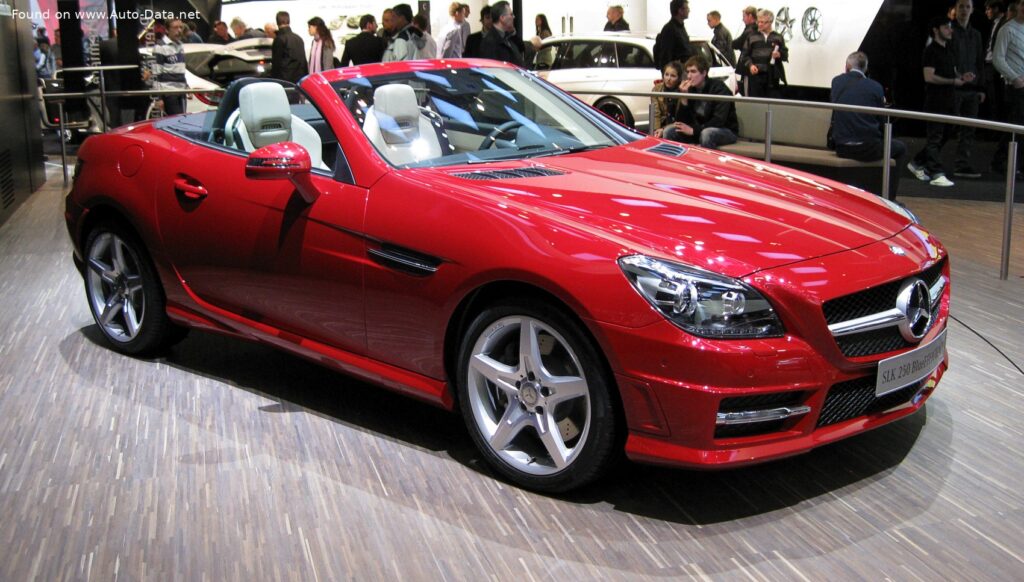
The Mercedes-Benz SLK (R172) SLK 250 presented a striking and athletic appearance. Its exterior design was a clear departure from the softer lines of its predecessor, featuring a more upright radiator grille, reminiscent of the Mercedes-Benz 300 SL Roadster, and a more chiseled, angular body. The compact dimensions – 162.76 inches in length, 71.26 inches in width (78.98 inches including mirrors), and 51.3 inches in height – contributed to its agile stance. The signature element, of course, was the power-retractable hardtop, or vario-roof, which transformed the car from a secure coupe to an exhilarating open-top roadster with the touch of a button, offering the best of both worlds. The drag coefficient of 0.32 was competitive for its class, aiding both performance and efficiency.
Inside, the SLK 250 offered a driver-focused cabin characterized by Mercedes-Benz’s hallmark attention to detail and premium materials. The two-seater configuration provided a snug yet comfortable environment, with high-quality upholstery and trim options. The dashboard layout was intuitive, placing essential controls within easy reach. While compact, the trunk space was practical for a roadster, ranging from 7.95 cubic feet (225 liters) with the roof down to 11.83 cubic feet (335 liters) with the roof up, allowing for weekend luggage or shopping. The fuel tank capacity was 15.85 US gallons (60 liters), providing a decent cruising range.
Chassis and Safety
Underpinning the SLK 250 was a carefully engineered chassis designed to deliver a balanced ride and responsive handling. The front suspension utilized an independent McPherson strut setup with coil springs and an anti-roll bar, while the rear featured an independent multi-link spring suspension with a stabilizer. This configuration provided a comfortable ride over varied surfaces while maintaining composure during spirited driving. Steering was handled by a hydraulic rack and pinion system, offering direct feedback to the driver. Braking performance was robust, with 322 mm ventilated discs at the front and 300 mm discs at the rear, complemented by an Anti-lock Braking System (ABS) for enhanced stopping power and control.
The SLK 250 came equipped with a range of safety features standard for a premium vehicle of its era. Beyond ABS, Mercedes-Benz’s comprehensive approach to occupant protection included multiple airbags, electronic stability control, and a rigid body structure designed to absorb impact forces. The vehicle’s curb weight of 3141.59 pounds (1425 kg) and maximum allowable weight of 4001.39 pounds (1815 kg) further attested to its solid construction. The car rode on a choice of 17-inch or 18-inch wheels, with front tire sizes of 225/45 R17 or 225/40 R18 and rear tire sizes of 245/40 R17 or 245/35 R18, providing ample grip and contributing to its planted feel.
Technical Specifications
| Category | Specification |
|---|---|
| Brand | Mercedes-Benz |
| Model | SLK |
| Generation | SLK (R172) |
| Type (Engine) | SLK 250 (204 Hp) 7G-TRONIC PLUS |
| Start of Production | 2011 year |
| End of Production | June, 2015 year |
| Powertrain Architecture | Internal Combustion engine |
| Body type | Roadster |
| Seats | 2 |
| Doors | 2 |
| Fuel Type | Petrol (Gasoline) |
| Engine Layout | Front, Longitudinal |
| Engine Model/Code | M 271.861 |
| Engine Displacement | 1796 cm3 (109.6 cu. in.) |
| Number of Cylinders | 4 |
| Engine Configuration | Inline |
| Cylinder Bore | 82 mm (3.23 in.) |
| Piston Stroke | 85 mm (3.35 in.) |
| Compression Ratio | 9.3:1 |
| Number of Valves per Cylinder | 4 |
| Fuel Injection System | Direct injection |
| Engine Aspiration | Turbocharger, Intercooler |
| Valvetrain | DOHC |
| Power | 204 Hp @ 5500 rpm |
| Power per Liter | 113.6 Hp/l |
| Torque | 310 Nm @ 2000-4300 rpm (228.64 lb.-ft.) |
| Acceleration 0 – 60 mph | 6.3 sec |
| Acceleration 0 – 100 km/h | 6.6 sec |
| Maximum Speed | 243 km/h (150.99 mph) |
| Fuel Consumption (economy) – urban (NEDC) | 8.4-8.7 l/100 km (27-28 US mpg) |
| Fuel Consumption (economy) – extra urban (NEDC) | 5-5.4 l/100 km (43.6-47 US mpg) |
| Fuel Consumption (economy) – combined (NEDC) | 6.2-6.6 l/100 km (35.6-37.9 US mpg) |
| CO2 Emissions (NEDC) | 144-153 g/km |
| Emission Standard | Euro 5 |
| Engine Oil Capacity | 5.5 l (5.81 US qt) |
| Coolant Capacity | 9.6 l (10.14 US qt) |
| Engine Systems | Start & Stop System |
| Drivetrain Architecture | Rear wheel drive |
| Number of Gears and Type of Gearbox | 7 gears, automatic transmission 7G-TRONIC PLUS |
| Front Suspension | Independent, type McPherson with coil spring and anti-roll bar |
| Rear Suspension | Independent multi-link spring suspension with stabilizer |
| Front Brakes | Ventilated discs, 322 mm |
| Rear Brakes | Disc, 300 mm |
| Assisting Systems | ABS (Anti-lock braking system) |
| Steering Type | Steering rack and pinion |
| Power Steering | Hydraulic Steering |
| Front Wheel Tires | 225/45 R17; 225/40 R18 |
| Rear Wheel Tires | 245/40 R17; 245/35 R18 |
| Front Wheel Rims | 7.5J x 17; 7.5J x 18 |
| Rear Wheel Rims | 8.5J x 17; 8.5J x 18 |
| Length | 4134 mm (162.76 in.) |
| Width | 1810 mm (71.26 in.) |
| Width Including Mirrors | 2006 mm (78.98 in.) |
| Height | 1303 mm (51.3 in.) |
| Wheelbase | 2430 mm (95.67 in.) |
| Front Track | 1551 mm (61.06 in.) |
| Rear Track | 1568 mm (61.73 in.) |
| Front Overhang | 870 mm (34.25 in.) |
| Rear Overhang | 834 mm (32.83 in.) |
| Minimum Turning Circle (Turning Diameter) | 10.52 m (34.51 ft.) |
| Drag Coefficient (Cd) | 0.32 |
| Kerb Weight | 1425 kg (3141.59 lbs.) |
| Max. Weight | 1815 kg (4001.39 lbs.) |
| Max Load | 390 kg (859.8 lbs.) |
| Trunk (boot) space – minimum | 225 l (7.95 cu. ft.) |
| Trunk (boot) space – maximum | 335 l (11.83 cu. ft.) |
| Fuel Tank Capacity | 60 l (15.85 US gal) |
| Weight-to-Power Ratio | 7 kg/Hp, 143.2 Hp/tonne |
| Weight-to-Torque Ratio | 4.6 kg/Nm, 217.5 Nm/tonne |
Legacy and Market Impact of the Mercedes-Benz SLK (R172)
The Mercedes-Benz SLK (R172) SLK 250, alongside its more powerful siblings, carved out a significant niche in the luxury compact roadster segment during its production run from 2011 to 2015. It faced stiff competition from rivals such as the BMW Z4, the Audi TT Roadster, and the Porsche Boxster. However, the SLK 250 distinguished itself with a unique blend of attributes: the prestige of the Mercedes-Benz badge, the practicality and security of its retractable hardtop, and a driving experience that prioritized refined comfort and sophisticated performance over raw, unadulterated sportiness.
The R172 generation was largely praised for its improved cabin quality, more assertive styling, and the efficiency gains brought by its turbocharged four-cylinder engine and advanced 7G-TRONIC PLUS transmission. It appealed to buyers who desired a stylish, open-top luxury vehicle for daily use, offering a quieter and more insulated ride than traditional soft-top roadsters when the roof was up. This dual personality made it a highly versatile choice, capable of being an elegant cruiser for city driving or a comfortable grand tourer for longer journeys. Its reputation was built on reliability, solid build quality, and an accessible entry point into Mercedes-Benz’s sports car lineup.
Historically, the SLK (R172) represented a pivotal step in the evolution of Mercedes-Benz’s compact roadsters, transitioning from the more playful R170 and R171 generations to a more mature and technologically advanced offering. It cemented the SLK’s role as a sophisticated alternative in the segment, bridging the gap between pure sports cars and luxury cruisers. While the SLK nameplate was eventually retired and replaced by the SLC (R172) in 2016 as part of Mercedes-Benz’s revised nomenclature, the SLK 250 (R172) remains a testament to Mercedes-Benz’s ability to blend elegant design, advanced engineering, and practical luxury into a compelling compact roadster package, leaving a legacy of accessible open-top motoring for the brand.