Introduction to the Mercedes-Benz SLS AMG Roadster (R197) GT 6.2 V8 (591 Hp) AMG SPEEDSHIFT DCT
The Mercedes-Benz SLS AMG Roadster (R197) GT 6.2 V8 (591 Hp) AMG SPEEDSHIFT DCT represents the pinnacle of Mercedes-Benz’s high-performance grand touring roadsters during its brief but impactful production run. Unveiled in October 2012 and concluding production in December 2013, this specific GT variant of the SLS AMG Roadster was a more potent and refined iteration of the already formidable R197 platform. As a spiritual successor to the iconic 300 SL Gullwing, the SLS AMG was a standalone project developed entirely by AMG, Mercedes-Benz’s performance division, and it quickly established itself as a modern classic. The Roadster variant offered an exhilarating open-air driving experience without compromising the raw power and sophisticated engineering synonymous with AMG.
Positioned in the exclusive segment of luxury super sports cars, the SLS AMG GT Roadster combined stunning aesthetics, a handcrafted naturally aspirated V8 engine, and advanced drivetrain technology. Its limited production and specialized “GT” designation signified an enhancement in both performance and dynamic capabilities over the standard SLS AMG models, making it a highly coveted machine for enthusiasts and collectors alike. This article delves into the intricate details of its engineering, design, and lasting legacy, emphasizing its role as a significant chapter in Mercedes-Benz and AMG history.
Engineering and Performance of the Mercedes-Benz SLS AMG Roadster (R197) GT 6.2 V8 (591 Hp) AMG SPEEDSHIFT DCT
Powertrain and Dynamic Capabilities
At the heart of the Mercedes-Benz SLS AMG Roadster (R197) GT 6.2 V8 (591 Hp) AMG SPEEDSHIFT DCT lies the legendary M 159.980 engine, a naturally aspirated 6.2-liter (6208 cm³ or 378.84 cu. in.) V8 powerhouse. This front-longitudinal engine, known for its incredible throttle response and distinctive exhaust note, produced an impressive 591 horsepower at 6800 rpm. Its maximum torque output stood at 479.42 lb.-ft. (650 Nm) at 4750 rpm, ensuring robust acceleration across the rev range. With a high compression ratio of 11.3:1 and a DOHC valvetrain with four valves per cylinder, the engine was a masterpiece of internal combustion engineering, capable of revving up to a maximum of 7200 rpm.
Power was delivered to the rear wheels via an advanced AMG SPEEDSHIFT DCT 7-speed automatic transmission. This dual-clutch transaxle gearbox, mounted at the rear for optimal weight distribution, offered lightning-fast gear changes, contributing significantly to the car’s exceptional performance. The SLS AMG GT Roadster could rocket from 0 to 60 mph in a mere 3.6 seconds (0-100 km/h in 3.7 seconds) and achieve a top speed of 198.84 mph (320 km/h). Despite its supercar performance, the GT variant adhered to the Euro 5 emission standard, with CO2 emissions rated at 308 g/km. Fuel economy, while not its primary focus, was rated at a combined 17.8 US mpg (NEDC cycle), showcasing a remarkable balance of power and relative efficiency for its class.
The car’s weight-to-power ratio of 2.8 kg/Hp (356 Hp/tonne) underscored its formidable performance credentials. The meticulous engineering extended to the drivetrain architecture, which ensured that the internal combustion engine precisely drove the rear wheels, providing a pure and engaging driving experience.
Design and Features
Aesthetics, Interior, and Chassis
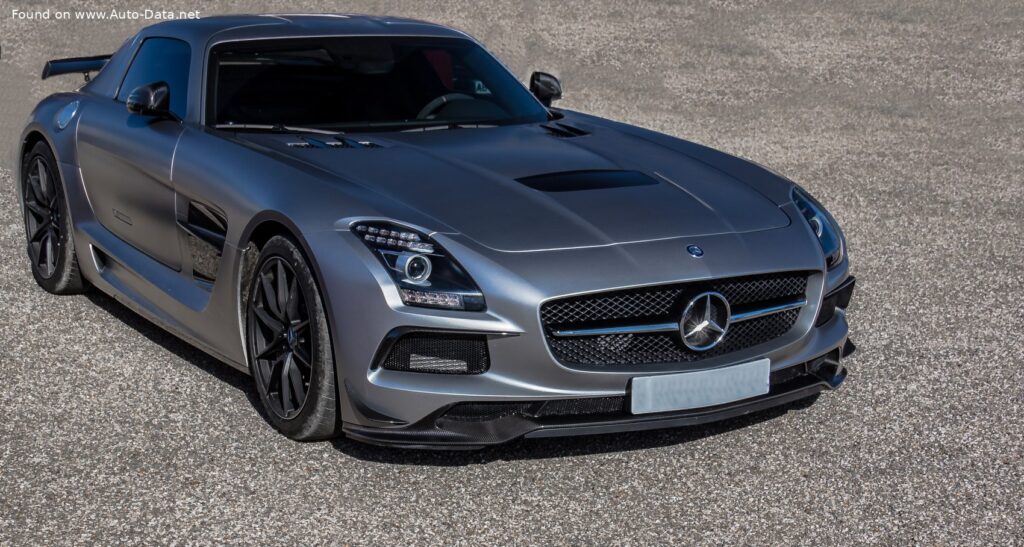
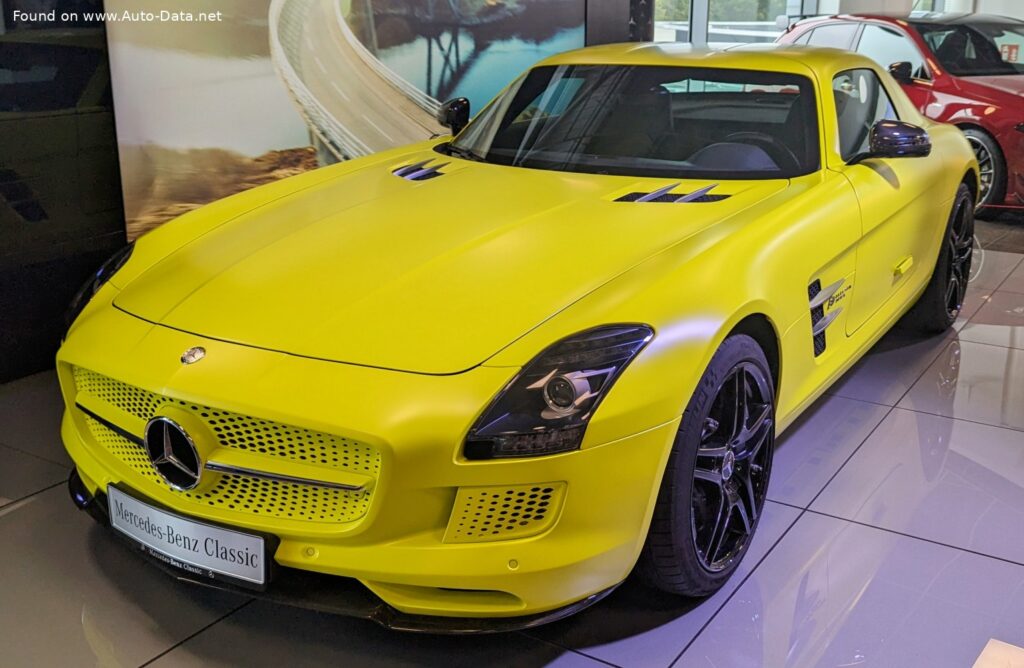
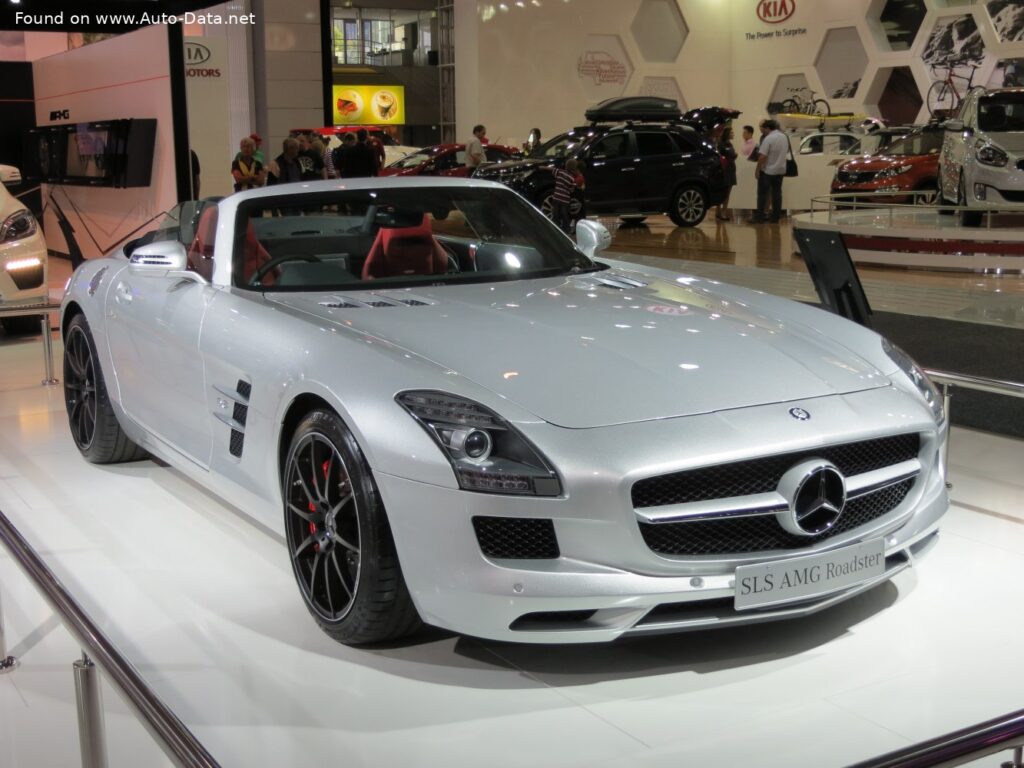
The design of the SLS AMG Roadster (R197) GT is a modern interpretation of classic sports car proportions, characterized by an exceptionally long hood, a compact cabin, and a muscular rear end. While the coupe featured distinctive gullwing doors, the Roadster adopted conventional, front-hinged doors, complementing its soft-top roof. The elegant fabric roof could be opened or closed in mere seconds, transforming the car’s profile and enhancing the open-air driving experience. With an overall length of 182.6 inches (4638 mm), a width of 76.34 inches (1939 mm), and a height of 49.65 inches (1261 mm), the SLS AMG GT Roadster possessed an imposing presence on the road. Its wheelbase of 105.51 inches (2680 mm) provided a stable platform for high-speed maneuvers.
The interior of the two-seater roadster exuded luxury and sportiness. High-quality materials, including premium leather, carbon fiber, and aluminum trim, adorned the cabin. The driver-focused cockpit featured AMG-specific instrumentation, a flat-bottomed steering wheel, and deeply bolstered sports seats designed for both comfort and support during spirited driving. Practicality, though secondary, was considered with a trunk space of 6.11 cu. ft. (173 liters), adequate for weekend getaways.
Underneath its sculpted body, the SLS AMG GT Roadster featured a sophisticated chassis designed for precision handling. It utilized a double-wishbone suspension system both at the front and rear, complemented by transverse stabilizers to minimize body roll. The hydraulic power steering, a rack and pinion system, offered direct and communicative feedback to the driver. Braking performance was handled by massive ventilated discs: 390×36 mm at the front and 360×26 mm at the rear, coupled with an Anti-lock Braking System (ABS) for optimal stopping power. The staggered tire setup, with 265/35 R19 on the front and wider 295/30 R20 on the rear, mounted on 9.5J x 19 and 11J x 20 rims respectively, ensured exceptional grip and stability. The car’s drag coefficient of 0.36 was respectable for a high-performance roadster, balancing aerodynamic efficiency with its aggressive styling.
Technical Specifications
| Category | Feature | Value |
|---|---|---|
| General Information | Brand | Mercedes-Benz |
| Model | SLS AMG | |
| Generation | SLS AMG Roadster (R197) | |
| Type (Engine) | GT 6.2 V8 (591 Hp) AMG SPEEDSHIFT DCT | |
| Start of Production | October, 2012 | |
| End of Production | December, 2013 | |
| Powertrain Architecture | Internal Combustion engine | |
| Body Type, Seats, Doors | Roadster, 2 Seats, 2 Doors | |
| Performance Specs | Fuel Consumption (Urban, NEDC) | 19.9 l/100 km (11.8 US mpg) |
| Fuel Consumption (Extra Urban, NEDC) | 9.3 l/100 km (25.3 US mpg) | |
| Fuel Consumption (Combined, NEDC) | 13.2 l/100 km (17.8 US mpg) | |
| CO2 Emissions (NEDC) | 308 g/km | |
| Fuel Type | Petrol (Gasoline) | |
| Acceleration 0-60 mph | 3.6 sec | |
| Acceleration 0-100 km/h | 3.7 sec | |
| Maximum Speed | 320 km/h (198.84 mph) | |
| Emission Standard | Euro 5 | |
| Engine Specs | Power | 591 Hp @ 6800 rpm |
| Power per liter | 95.2 Hp/l | |
| Torque | 650 Nm (479.42 lb.-ft.) @ 4750 rpm | |
| Maximum Engine Speed | 7200 rpm | |
| Engine Layout | Front, Longitudinal | |
| Engine Model/Code | M 159.980 | |
| Engine Displacement | 6208 cm³ (378.84 cu. in.) | |
| Number of Cylinders | 8 | |
| Engine Configuration | V-engine | |
| Compression Ratio | 11.3:1 | |
| Fuel Injection System | Multi-port manifold injection | |
| Engine Aspiration | Naturally aspirated engine | |
| Dimensions, Volume & Weights | Kerb Weight | 1660 kg (3659.67 lbs) |
| Max. Weight | 1960 kg (4321.06 lbs) | |
| Max Load | 300 kg (661.39 lbs) | |
| Length | 4638 mm (182.6 in.) | |
| Width | 1939 mm (76.34 in.) | |
| Height | 1261 mm (49.65 in.) | |
| Wheelbase | 2680 mm (105.51 in.) | |
| Drivetrain, Brakes & Suspension | Drive Wheel | Rear wheel drive |
| Number of Gears & Gearbox Type | 7 gears, automatic transmission AMG SPEEDSHIFT DCT | |
| Front Suspension | Double wishbone, Transverse stabilizer | |
| Rear Suspension | Double wishbone, Transverse stabilizer | |
| Front Brakes | Ventilated discs, 390×36 mm | |
| Rear Brakes | Ventilated discs, 360×26 mm | |
| Assisting Systems | ABS (Anti-lock braking system) | |
| Steering Type | Steering rack and pinion, Hydraulic Steering | |
| Front Wheel Tires | 265/35 R19 | |
| Rear Wheel Tires | 295/30 R20 | |
| Other Specifications | Trunk (boot) Space – minimum | 173 l (6.11 cu. ft.) |
| Fuel Tank Capacity | 85 l (22.45 US gal) | |
| Engine Oil Capacity | 9.5 l (10.04 US qt) | |
| Coolant Capacity | 14 l (14.79 US qt) | |
| Minimum Turning Circle | 11.9 m (39.04 ft) |
Legacy and Market Impact
The Mercedes-Benz SLS AMG Roadster (R197) GT 6.2 V8 (591 Hp) AMG SPEEDSHIFT DCT carved out a distinctive niche in the high-performance automotive landscape. It was more than just a fast car; it was a statement, a modern interpretation of Mercedes-Benz’s rich racing heritage, and a testament to AMG’s engineering prowess. Its reputation was built on a foundation of unadulterated power, a visceral driving experience, and an unmistakable aesthetic that paid homage to its legendary ancestor, the 300 SL, while firmly establishing its own identity.
In its competitive landscape, the SLS AMG GT Roadster faced formidable rivals such as the Porsche 911 Turbo Cabriolet, the Audi R8 Spyder, the Ferrari 458 Spider, and the Aston Martin V12 Vantage Roadster. What set the SLS AMG apart was its unique front-mid engine layout, its naturally aspirated AMG V8 engine, which by then was becoming a rarity among its turbocharged competitors, and its blend of luxury grand touring comfort with supercar levels of performance. The “GT” designation further enhanced its appeal, signifying sharper dynamics and a slight power bump that made it the most desirable version of the Roadster.
Historically, the SLS AMG GT Roadster holds significant importance as one of the last naturally aspirated AMG supercars. As the automotive industry rapidly shifted towards forced induction and electrification, the M159 engine stood as a glorious swansong to a bygone era of large-displacement, free-breathing performance. Its relatively short production run, especially for the GT variant, contributed to its exclusivity and desirability among collectors. Today, the SLS AMG, particularly the GT models, are considered modern classics and highly sought-after vehicles, appreciating in value due to their performance, design, and their position as a landmark model in AMG’s independent development history.
The SLS AMG GT Roadster’s impact extended beyond sales figures; it solidified AMG’s reputation as a world-class performance brand capable of creating a complete car from the ground up. It demonstrated Mercedes-Benz’s commitment to delivering exhilarating driving experiences while maintaining the brand’s hallmark of luxury and engineering excellence. Its legacy continues to influence subsequent AMG models, serving as a benchmark for performance, design, and emotional appeal in the realm of high-performance luxury vehicles.