
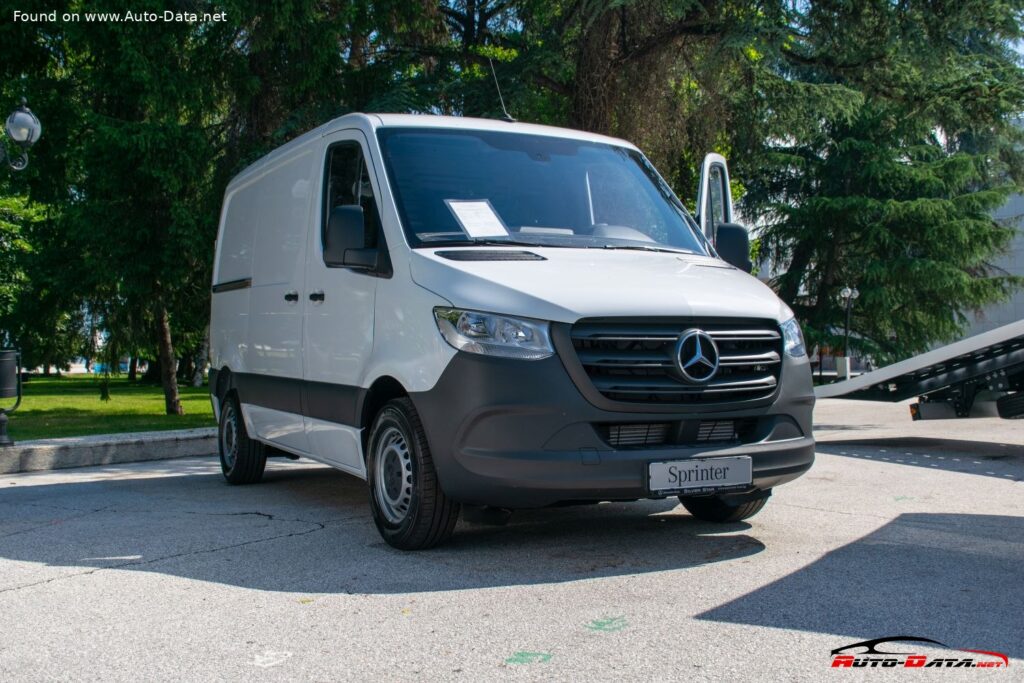
The Mercedes-Benz Sprinter Panel Van Compact (W907/W910) 211 CDI (114 Hp) W910: A Pillar of European Commercial Logistics
The Mercedes-Benz Sprinter has long stood as a benchmark in the commercial van segment, renowned for its versatility, durability, and advanced engineering. The specific variant, the Mercedes-Benz Sprinter Panel Van Compact (W907/W910) 211 CDI (114 Hp) W910, represents a crucial offering within the third generation of this iconic workhorse, which commenced production in 2018. While the Sprinter is a globally recognized nameplate, this particular 211 CDI configuration, with its 114 horsepower output, is primarily tailored for the demanding European market, where efficiency, maneuverability, and lower operating costs are paramount for urban and regional delivery services. This compact panel van, designated internally as W907/W910 (or VS30 in some markets), continues the Sprinter’s legacy as a front-runner in light commercial transportation, offering a robust platform designed for a multitude of business applications.
Engine and Performance
At the heart of the Mercedes-Benz Sprinter Panel Van Compact (W907/W910) 211 CDI (114 Hp) W910 lies a sophisticated 2.1-liter (2143 cm3 or 130.77 cu. in.) inline four-cylinder diesel engine, internally designated as OM 651.955. This powerplant is a testament to Mercedes-Benz’s commitment to efficiency and reliability in its commercial vehicle lineup. Producing a respectable 114 horsepower at 3800 rpm, this engine is optimized not for outright speed, but for consistent, usable power delivery throughout the rev range, which is critical for a vehicle constantly navigating urban environments or carrying significant loads.
A key characteristic of this engine is its substantial torque output. It delivers 300 Nm (221.27 lb.-ft.) of torque across a broad and accessible band, from a low 1200 rpm up to 2200 rpm. This wide torque plateau is instrumental in the Sprinter’s ability to effortlessly pull away from a standstill, climb grades, and maintain momentum, even when fully laden. The engine’s architecture features a front, transverse layout, and benefits from a common-rail diesel fuel injection system, which precisely controls fuel delivery for optimal combustion, contributing to both power and fuel efficiency.
Further enhancing its performance and efficiency, the OM 651.955 engine is equipped with a turbocharger and intercooler. This forced induction system not only boosts power output from a relatively small displacement but also ensures a responsive throttle feel and improved fuel economy. With four valves per cylinder, the engine breathes efficiently, contributing to its overall performance and meeting the stringent Euro VI emission standards, thanks in part to an integrated particulate filter. Power is transmitted to the front wheels via a durable 6-speed manual transmission, offering drivers precise control and contributing to the vehicle’s excellent fuel economy figures: a combined 7.7-7.9 l/100 km (30.5 – 29.8 US mpg). This powertrain configuration is specifically geared towards providing a cost-effective and dependable solution for businesses requiring a capable, yet economical, light commercial vehicle.
Design and Features
The Mercedes-Benz Sprinter Panel Van Compact (W907/W910) 211 CDI (114 Hp) W910 is designed with practicality and functionality at its core. As a “Panel Van Compact,” it offers a balance between maneuverability in congested urban settings and ample cargo capacity. The body type features five doors, typically comprising two front doors, a sliding side door for easy cargo access, and rear barn doors. The cabin is configured with three seats, accommodating a driver and two passengers, making it suitable for small crews or for a driver needing extra space for paperwork and small items.
Measuring 207.36 inches (5267 mm) in length, 79.53 inches (2020 mm) in width (92.32 inches or 2345 mm including mirrors), and 92.76 inches (2356 mm) in height, the compact dimensions belie a significant internal volume. The Sprinter boasts an impressive maximum trunk (boot) space of 275.45 cubic feet (7800 liters), providing ample room for goods, tools, or equipment. This generous cargo capacity, combined with a maximum payload of 2380.99 lbs (1080 kg), underscores its utility as a dedicated commercial vehicle.
The W907/W910 generation introduced a more refined and driver-centric interior, though the specific 211 CDI variant would focus more on robust, durable materials suitable for commercial use. Safety features are fundamental, with standard equipment including ABS (Anti-lock Braking System) to ensure stable braking performance, especially under load. The vehicle rides on 225/65 R16 tires mounted on 6.5J x 16 wheel rims, providing a solid contact patch and contributing to its stable handling characteristics. The suspension system, featuring leaf springs at both the front and rear (with hydraulic elements at the rear), is engineered to manage heavy loads and provide a comfortable ride, even over varied road conditions. With a curb weight of 4232.88 lbs (1920 kg) and a maximum permissible weight of 6613.87 lbs (3000 kg), the Sprinter is built to be a reliable workhorse. Furthermore, its towing capabilities are substantial, with a permitted trailer load of 4409.25 lbs (2000 kg) with brakes and 1653.47 lbs (750 kg) without brakes, adding to its versatility.
Technical Specifications
| Category | Specification |
|---|---|
| General Information | |
| Brand | Mercedes-Benz |
| Model | Sprinter |
| Generation | Sprinter Panel Van Compact (W907/W910) |
| Type (Engine) | 211 CDI (114 Hp) W910 |
| Start of Production | 2018 year |
| Powertrain Architecture | Internal Combustion engine |
| Body type | Van |
| Seats | 3 |
| Doors | 5 |
| Performance Specs | |
| Fuel consumption (economy) – urban (NEDC) | 9.1-9.4 l/100 km (25.8 – 25 US mpg) |
| Fuel consumption (economy) – extra urban (NEDC) | 7.0-7.3 l/100 km (33.6 – 32.2 US mpg) |
| Fuel consumption (economy) – combined (NEDC) | 7.7-7.9 l/100 km (30.5 – 29.8 US mpg) |
| CO2 emissions (NEDC) | 201-208 g/km |
| Fuel Type | Diesel |
| Emission standard | Euro VI |
| Weight-to-power ratio | 16.8 kg/Hp, 59.4 Hp/tonne |
| Weight-to-torque ratio | 6.4 kg/Nm, 156.3 Nm/tonne |
| Engine Specs | |
| Power | 114 Hp @ 3800 rpm |
| Power per litre | 53.2 Hp/l |
| Torque | 300 Nm (221.27 lb.-ft.) @ 1200-2200 rpm |
| Engine layout | Front, Transverse |
| Engine Model/Code | OM 651.955 |
| Engine displacement | 2143 cm3 (2.1 l, 130.77 cu. in.) |
| Number of cylinders | 4 |
| Engine configuration | Inline |
| Number of valves per cylinder | 4 |
| Fuel injection system | Diesel Commonrail |
| Engine aspiration | Turbocharger, Intercooler |
| Engine oil capacity | 11.5 l (12.15 US qt) |
| Coolant | 9.5 l (10.04 US qt) |
| Engine systems | Particulate filter |
| Space, Volume and Weights | |
| Kerb Weight | 1920 kg (4232.88 lbs) |
| Max. weight | 3000 kg (6613.87 lbs) |
| Max load | 1080 kg (2380.99 lbs) |
| Trunk (boot) space – maximum | 7800 l (275.45 cu. ft.) |
| Fuel tank capacity | 65 l (17.17 US gal) |
| AdBlue tank | 22 l (5.81 US gal) |
| Max. roof load | 300 kg (661.39 lbs) |
| Permitted trailer load with brakes (12%) | 2000 kg (4409.25 lbs) |
| Permitted trailer load without brakes | 750 kg (1653.47 lbs) |
| Dimensions | |
| Length | 5267 mm (207.36 in.) |
| Width | 2020 mm (79.53 in.) |
| Width including mirrors | 2345 mm (92.32 in.) |
| Height | 2356 mm (92.76 in.) |
| Wheelbase | 3259 mm (128.31 in.) |
| Front track | 1759 mm (69.25 in.) |
| Rear (Back) track | 1770 mm (69.69 in.) |
| Front overhang | 1012 mm (39.84 in.) |
| Rear overhang | 996 mm (39.21 in.) |
| Ride height (ground clearance) | 143 mm (5.63 in.) |
| Minimum turning circle (turning diameter) | 13 m (42.65 ft.) |
| Drivetrain, Brakes and Suspension Specs | |
| Drivetrain Architecture | The Internal combustion engine (ICE) drives the front wheels of the vehicle. |
| Drive wheel | Front wheel drive |
| Number of gears and type of gearbox | 6 gears, manual transmission |
| Front suspension | Leaf spring |
| Rear suspension | Hydraulic elements, Leaf spring |
| Front brakes | Disc |
| Rear brakes | Disc |
| Assisting systems | ABS (Anti-lock braking system) |
| Tires size | 225/65 R16 |
| Wheel rims size | 6.5J x 16 |
Legacy and Market Impact
The Mercedes-Benz Sprinter has carved out an indelible legacy in the global commercial vehicle market, and the W907/W910 generation, including the 211 CDI (114 Hp) W910 variant, significantly contributes to this esteemed reputation. In its primary European market, where the 211 CDI is a popular choice, the Sprinter faces stiff competition from established rivals such as the Ford Transit, Volkswagen Crafter, Renault Master, and Fiat Ducato. However, the Sprinter consistently stands out due to its premium brand image, perceived reliability, advanced safety features (even in base models), and a comprehensive dealer network.
The 211 CDI variant, with its emphasis on efficiency and lower power output, is particularly impactful in urban logistics and last-mile delivery services. Its compact dimensions for a full-size van, coupled with a highly efficient diesel engine, make it an ideal choice for businesses operating in densely populated cities with strict emission regulations and narrow streets. The front-wheel-drive architecture of this specific configuration further enhances its appeal in such environments, offering a lower load floor for easier access and improved traction in certain conditions, while also potentially reducing manufacturing costs.
Historically, the Sprinter revolutionized the van segment upon its introduction in 1995, setting new standards for ergonomics, safety, and driver comfort. The W907/W910 generation built upon this foundation, integrating modern technology like advanced driver-assistance systems (though perhaps optional or higher trims than the base 211 CDI), improved connectivity, and even more efficient powertrains. The 211 CDI (114 Hp) W910 encapsulates the Sprinter’s commitment to offering a tailored solution for every commercial need, balancing robust performance with economic operation. Its ability to carry substantial loads, tow trailers, and operate reliably day in and day out has solidified its position as a go-to vehicle for tradespeople, couriers, and various other businesses across Europe, affirming its role as a vital component of the continent’s commercial infrastructure. The Sprinter’s enduring success lies in its adaptability and Mercedes-Benz’s unwavering dedication to engineering a vehicle that truly serves the demanding requirements of the commercial sector.
