
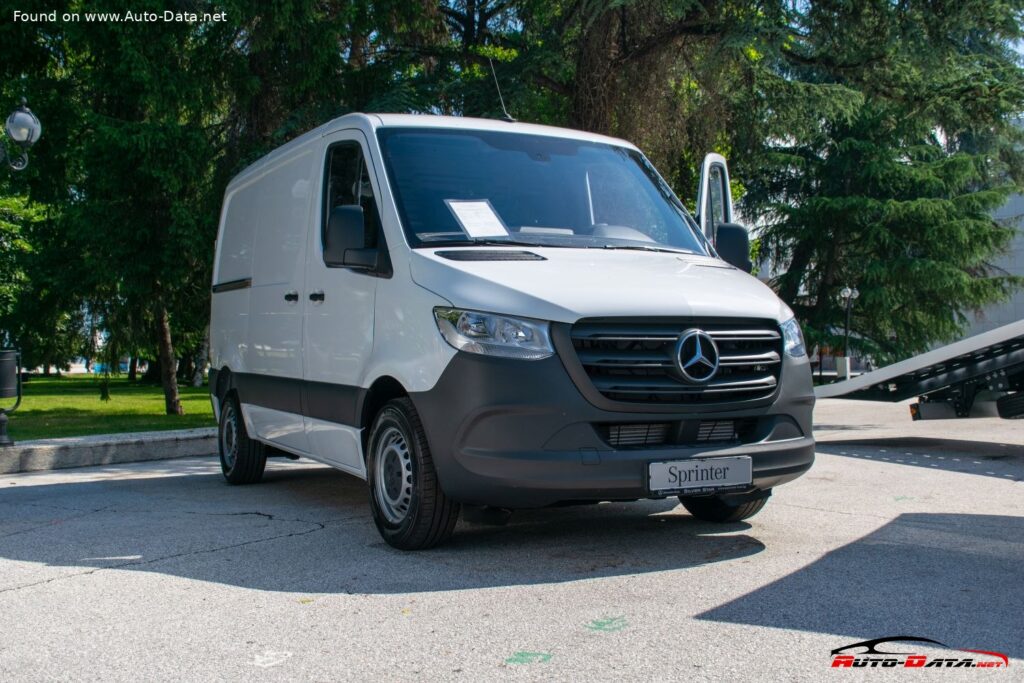
The Mercedes-Benz Sprinter Panel Van Compact (W907/W910) 211 CDI (114 Hp) W910 9G-TRONIC: A Global Workhorse
The Mercedes-Benz Sprinter stands as an icon in the commercial vehicle segment, renowned worldwide for its versatility, robust engineering, and advanced technology. The specific variant, the Mercedes-Benz Sprinter Panel Van Compact (W907/W910) 211 CDI (114 Hp) W910 9G-TRONIC, represents a crucial part of the Sprinter’s third generation, introduced in 2018. This particular model, designated W910 for its front-wheel-drive architecture and featuring the 211 CDI engine, is engineered to meet the demanding requirements of urban delivery, logistics, and various vocational applications. While the Sprinter is a familiar sight on American roads, often sold as a Mercedes-Benz or Freightliner, this 211 CDI (114 Hp) configuration is more commonly found in European and international markets where diesel engines and specific power outputs are tailored to local regulations and operational needs. Nevertheless, its underlying platform and technological advancements are consistent with the global Sprinter lineup, emphasizing efficiency, safety, and driver comfort.
Engine and Performance of the Mercedes-Benz Sprinter Panel Van Compact
At the heart of the Mercedes-Benz Sprinter Panel Van Compact 211 CDI lies the OM 651.955 engine, a 2.1-liter (2143 cm³ or 130.77 cu. in.) inline four-cylinder diesel unit. This powerplant is a testament to Mercedes-Benz’s commitment to efficiency and durability in its commercial vehicles. Equipped with a turbocharger and intercooler, the engine delivers a respectable 114 horsepower (Hp) at 3800 rpm. More critically for a commercial vehicle, it produces a substantial 300 Nm (221.27 lb.-ft.) of torque, available across a broad and usable range from 1200 to 2200 rpm. This low-end torque is vital for hauling heavy loads, navigating city traffic, and ensuring responsive acceleration from a standstill, making it a highly practical choice for its intended purpose.
Power is efficiently managed and transmitted to the front wheels via Mercedes-Benz’s sophisticated 9G-TRONIC automatic transmission. This nine-speed gearbox is a significant upgrade, offering a wider ratio spread compared to previous transmissions. The additional gears allow the engine to operate more frequently in its optimal efficiency range, leading to improved fuel economy and reduced emissions. For the 211 CDI, combined fuel consumption is rated at 7.8-8.3 liters per 100 km, translating to an impressive 30.2 – 28.3 US miles per gallon. This efficiency is critical for businesses looking to minimize operational costs. Furthermore, the vehicle meets the stringent Euro VI emission standard, thanks in part to its common rail fuel injection system and a particulate filter, underscoring its environmental responsibility. The front-wheel-drive architecture also contributes to a lower loading floor and increased cargo volume, a significant advantage for a panel van.
Design and Features
The Mercedes-Benz Sprinter Panel Van Compact (W907/W910) is designed first and foremost for utility and practicality. As a panel van, its primary function is to transport goods efficiently and securely. The “Compact” designation refers to its specific length of 5267 mm (207.36 inches), making it maneuverable in urban environments while still offering substantial cargo capacity. With a width of 2020 mm (79.53 inches) and a height of 2356 mm (92.76 inches), it strikes a balance between interior volume and exterior footprint.
The interior is configured with three seats, prioritizing driver and front passenger comfort for long working hours. The design emphasizes ergonomics, with intuitive controls and ample storage for documents and personal items. The cargo area is the vehicle’s true highlight, offering a maximum trunk (boot) space of 7800 liters (275.45 cu. ft.). This generous volume, combined with a maximum payload capacity of 1080 kg (2380.99 lbs.), allows for a wide array of goods to be transported. The robust construction is evident in its kerb weight of 1920 kg (4232.88 lbs.) and a maximum permissible weight of 3000 kg (6613.87 lbs.).
Safety features are paramount in a commercial vehicle, and the Sprinter includes essential systems like ABS (Anti-lock Braking System) as standard. The braking system utilizes discs on both the front and rear axles for reliable stopping power. Suspension components are designed for durability and load-bearing capability, featuring leaf springs at the front and a combination of hydraulic elements and leaf springs at the rear. The tire size of 225/65 R16 on 6.5J x 16 wheel rims ensures a stable ride and good traction. Other practical features include a 65-liter (17.17 US gal) fuel tank and a 22-liter (5.81 US gal) AdBlue tank to support its Euro VI emissions compliance.
Technical Specifications
| Category | Specification |
|---|---|
| General Information | |
| Brand | Mercedes-Benz |
| Model | Sprinter |
| Generation | Sprinter Panel Van Compact (W907/W910) |
| Type (Engine) | 211 CDI (114 Hp) W910 9G-TRONIC |
| Start of Production | 2018 year |
| Powertrain Architecture | Internal Combustion engine |
| Body Type | Van |
| Seats | 3 |
| Doors | 5 |
| Performance Specs | |
| Fuel Consumption (Economy) – urban (NEDC) | 8.1-9.5 l/100 km (29 – 24.8 US mpg) |
| Fuel Consumption (Economy) – extra urban (NEDC) | 7.5-7.8 l/100 km (31.4 – 30.2 US mpg) |
| Fuel Consumption (Economy) – combined (NEDC) | 7.8-8.3 l/100 km (30.2 – 28.3 US mpg) |
| CO2 Emissions (NEDC) | 205-218 g/km |
| Fuel Type | Diesel |
| Emission Standard | Euro VI |
| Weight-to-Power Ratio | 16.8 kg/Hp, 59.4 Hp/tonne |
| Weight-to-Torque Ratio | 6.4 kg/Nm, 156.3 Nm/tonne |
| Engine Specs | |
| Power | 114 Hp @ 3800 rpm |
| Power per liter | 53.2 Hp/l |
| Torque | 300 Nm (221.27 lb.-ft.) @ 1200-2200 rpm |
| Engine Layout | Front, Transverse |
| Engine Model/Code | OM 651.955 |
| Engine Displacement | 2143 cm³ (2.1 liters / 130.77 cu. in.) |
| Number of Cylinders | 4 |
| Engine Configuration | Inline |
| Number of Valves per Cylinder | 4 |
| Fuel Injection System | Diesel Commonrail |
| Engine Aspiration | Turbocharger, Intercooler |
| Engine Oil Capacity | 11.5 l (12.15 US qt) |
| Coolant Capacity | 9.5 l (10.04 US qt) |
| Engine Systems | Particulate filter |
| Space, Volume and Weights | |
| Kerb Weight | 1920 kg (4232.88 lbs.) |
| Max. Weight | 3000 kg (6613.87 lbs.) |
| Max Load | 1080 kg (2380.99 lbs.) |
| Trunk (boot) Space – maximum | 7800 l (275.45 cu. ft.) |
| Fuel Tank Capacity | 65 l (17.17 US gal) |
| AdBlue Tank Capacity | 22 l (5.81 US gal) |
| Max. Roof Load | 300 kg (661.39 lbs.) |
| Permitted Trailer Load with brakes (12%) | 2000 kg (4409.25 lbs.) |
| Permitted Trailer Load without brakes | 750 kg (1653.47 lbs.) |
| Dimensions | |
| Length | 5267 mm (207.36 in.) |
| Width | 2020 mm (79.53 in.) |
| Width including mirrors | 2345 mm (92.32 in.) |
| Height | 2356 mm (92.76 in.) |
| Wheelbase | 3259 mm (128.31 in.) |
| Front Track | 1759 mm (69.25 in.) |
| Rear (Back) Track | 1770 mm (69.69 in.) |
| Front Overhang | 1012 mm (39.84 in.) |
| Rear Overhang | 996 mm (39.21 in.) |
| Ride Height (Ground Clearance) | 143 mm (5.63 in.) |
| Minimum Turning Circle (Turning Diameter) | 13 m (42.65 ft.) |
| Drivetrain, Brakes and Suspension Specs | |
| Drivetrain Architecture | The Internal combustion engine (ICE) drives the front wheels of the vehicle. |
| Drive Wheel | Front wheel drive |
| Number of Gears and Type of Gearbox | 9 gears, automatic transmission G-TRONIC |
| Front Suspension | Leaf spring |
| Rear Suspension | Hydraulic elements, Leaf spring |
| Front Brakes | Disc |
| Rear Brakes | Disc |
| Assisting Systems | ABS (Anti-lock braking system) |
| Tires Size | 225/65 R16 |
| Wheel Rims Size | 6.5J x 16 |
Legacy and Market Impact
The Mercedes-Benz Sprinter, including the Panel Van Compact (W907/W910) 211 CDI variant, has cemented its legacy as a global benchmark in the commercial van segment. Since its inception, the Sprinter has consistently pushed boundaries in terms of design, safety, and operational efficiency, setting high standards for its competitors. Its reputation for reliability and durability makes it a preferred choice for businesses that depend on uninterrupted service.
In its primary markets, particularly Europe, the 211 CDI (114 Hp) version of the Sprinter competes fiercely with other major players such as the Ford Transit, Volkswagen Crafter, Fiat Ducato (and its PSA derivatives like the Citroën Jumper and Peugeot Boxer), and the Renault Master. What often distinguishes the Sprinter is its premium build quality, advanced technological integration, and the extensive Mercedes-Benz service network, which provides peace of mind for commercial operators.
The W907/W910 generation further enhanced the Sprinter’s appeal with its improved connectivity features, advanced driver-assistance systems (though specific to higher trims and options, the platform supports them), and refined powertrains like the 9G-TRONIC transmission. The front-wheel-drive configuration of the W910 variant, in particular, allowed for a lower loading floor, optimizing cargo access and maximizing interior volume, which is a significant practical advantage for delivery services and tradespeople.
Historically, the Sprinter has been a pioneer in many aspects, from introducing common rail diesel technology to incorporating sophisticated safety features typically found in passenger cars. Its modular design allows for a vast array of customizations, from simple panel vans to specialized conversions for ambulances, motorhomes, and shuttle buses, demonstrating its incredible adaptability. The 211 CDI (114 Hp) W910 9G-TRONIC model, while perhaps not the most powerful in the lineup, offers an optimal blend of fuel efficiency, sufficient torque for urban and regional transport, and the inherent quality and robustness expected from a Mercedes-Benz commercial vehicle. It continues to be a vital component of countless businesses’ fleets, contributing significantly to the global logistics and service industries.
