
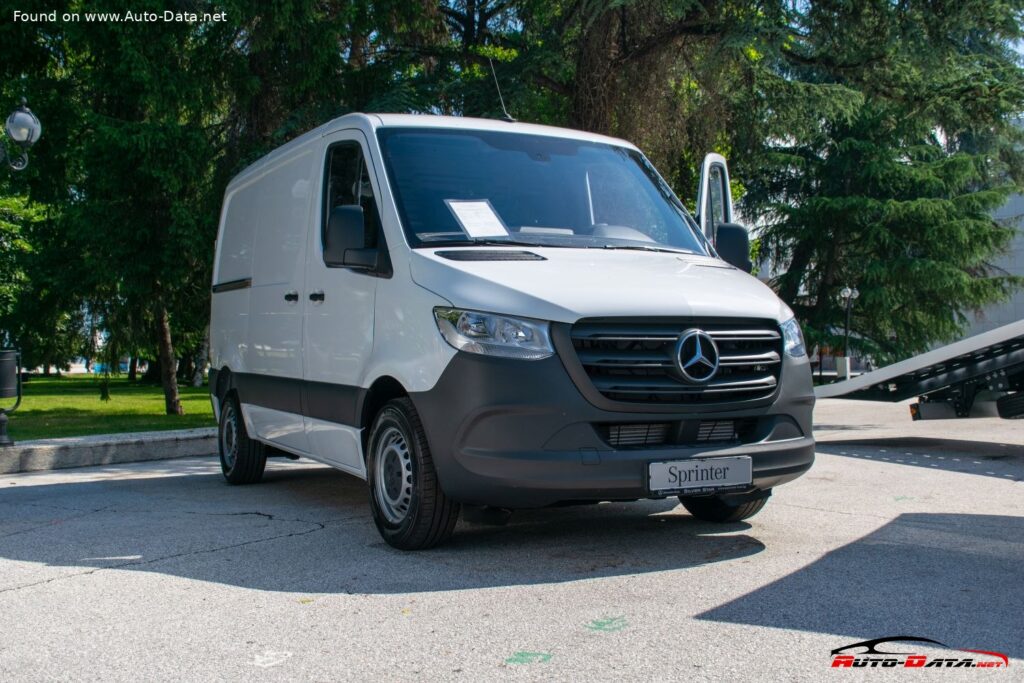
Mercedes-Benz Sprinter Panel Van Compact (W907/W910) 214 CDI (143 Hp) W910 9G-TRONIC
The Mercedes-Benz Sprinter Panel Van Compact (W907/W910) represents the third generation of Mercedes-Benz’s highly successful and globally recognized light commercial vehicle. Launched in 2018, this iteration, particularly the 214 CDI (143 Hp) W910 9G-TRONIC variant, cemented the Sprinter’s reputation as a versatile, efficient, and technologically advanced workhorse in the commercial van segment. While the Sprinter nameplate is synonymous with reliability and capability worldwide, the W907/W910 generation introduced significant advancements in powertrain technology, driver assistance systems, and connectivity, catering to the evolving demands of modern logistics and service industries.
The “Compact” designation in this specific model refers to its shorter overall length and wheelbase compared to other Sprinter variants, making it particularly adept for urban environments where maneuverability is paramount. Despite its more modest dimensions, it still offers substantial cargo capacity and a robust platform. The 214 CDI engine, paired with the sophisticated 9G-TRONIC automatic transmission, highlights a focus on optimizing fuel economy and reducing emissions, while still providing ample power and torque for daily operations. This model serves as a prime example of Mercedes-Benz’s commitment to delivering premium utility vehicles that blend practicality with the brand’s signature engineering excellence.
Engine and Performance of the Mercedes-Benz Sprinter Panel Van Compact (W907/W910)
At the heart of the Mercedes-Benz Sprinter Panel Van Compact (W907/W910) 214 CDI (143 Hp) W910 9G-TRONIC lies the highly regarded OM 651 diesel engine. This 2.1-liter (2143 cubic centimeters) inline four-cylinder unit is equipped with a turbocharger and intercooler, ensuring efficient air intake and combustion. The common rail direct injection system precisely meters fuel, contributing to both power output and fuel efficiency. With a maximum power output of 143 horsepower at 3800 rpm and a substantial 243.4 lb.-ft. (330 Nm) of torque available across a broad range from 1200 to 2400 rpm, this engine is perfectly tuned for commercial applications. The wide torque band means the Sprinter can effortlessly pull away from a standstill, navigate city traffic, and maintain speed on highways, even when fully loaded.
The power is delivered to the front wheels via Mercedes-Benz’s advanced 9G-TRONIC automatic transmission. This nine-speed gearbox is a key feature, offering a wider spread of ratios than previous generations. This not only results in smoother acceleration and more refined cruising but also significantly contributes to improved fuel economy by allowing the engine to operate in its most efficient rev range more often. The front-wheel-drive architecture, specific to this variant, provides advantages such as a lower load floor for easier cargo access and potentially better traction in certain conditions, alongside benefits for overall vehicle packaging and weight distribution.
In terms of efficiency, the Sprinter 214 CDI demonstrates impressive figures for a vehicle of its size and capability. The combined fuel consumption is rated at approximately 28.7 to 29.4 US miles per gallon (8.0-8.2 l/100 km), which is highly competitive in the segment. Urban driving yields around 27.4 to 27.7 US mpg (8.5-8.6 l/100 km), while extra-urban cycles can see figures of 29 to 30.2 US mpg (7.8-8.1 l/100 km). These figures, combined with CO2 emissions of 210-216 g/km and adherence to the stringent Euro VI emission standard, underscore Mercedes-Benz’s commitment to environmental responsibility. The inclusion of a particulate filter and an AdBlue tank further reduces harmful emissions, making it a cleaner option for fleet operators and businesses. The 17.17 US gallon fuel tank and a 5.81 US gallon AdBlue tank ensure a practical operating range for commercial duties.
Design and Features
The Mercedes-Benz Sprinter Panel Van Compact (W907/W910) maintains the iconic Sprinter silhouette, but with a refined and modern aesthetic that aligns with Mercedes-Benz’s contemporary design language. As a panel van, its primary function is utility, offering a robust and practical solution for cargo transport. This compact variant features five doors (including the rear cargo doors and a side sliding door) and a three-seat cabin, providing essential seating for a driver and two passengers while maximizing cargo volume.
Despite being the “Compact” version, the Sprinter boasts impressive dimensions for its class. With a length of 207.36 inches (5267 mm), a width of 79.53 inches (2020 mm) (92.32 inches including mirrors), and a height of 92.76 inches (2356 mm), it strikes an excellent balance between interior space and external maneuverability. The 128.31-inch (3259 mm) wheelbase contributes to its stable ride while still allowing for a minimum turning circle of 42.65 feet (13 meters), a crucial attribute for navigating tight city streets and loading docks.
The cargo area is truly the heart of any panel van, and the Sprinter Compact excels here, offering a maximum trunk space of 275.45 cubic feet (7800 liters). This generous volume, combined with a maximum payload capacity of 2380.99 pounds (1080 kg), makes it suitable for a wide array of goods and equipment. The vehicle’s robust construction also allows for a permitted trailer load with brakes of 4409.25 pounds (2000 kg), further enhancing its utility. The suspension system, featuring leaf springs at the front and a combination of hydraulic elements and leaf springs at the rear, is engineered to handle heavy loads with stability and durability, a hallmark of commercial vehicles.
Safety and driver assistance features are paramount in modern commercial vehicles. The Sprinter comes standard with Anti-lock Braking System (ABS), ensuring stable braking performance under various conditions. While not explicitly detailed in the provided data, modern Sprinters typically offer a host of advanced safety technologies, including Electronic Stability Program (ESP), Crosswind Assist, and Active Brake Assist, reflecting Mercedes-Benz’s commitment to driver and cargo safety. The interior is designed for ergonomic efficiency, with intuitive controls and durable materials built to withstand the rigors of daily commercial use. The tire size of 225/65 R16 on 6.5J x 16 wheel rims provides a good balance of load-carrying capability and ride comfort.
Technical Specifications
| Category | Specification |
|---|---|
| General Information | |
| Brand | Mercedes-Benz |
| Model | Sprinter |
| Generation | Sprinter Panel Van Compact (W907/W910) |
| Type (Engine) | 214 CDI (143 Hp) W910 9G-TRONIC |
| Start of Production | 2018 year |
| Powertrain Architecture | Internal Combustion engine |
| Body Type | Van |
| Seats | 3 |
| Doors | 5 |
| Performance Specifications | |
| Fuel Consumption (Urban, NEDC) | 27.4 – 27.7 US mpg (8.5-8.6 l/100 km) |
| Fuel Consumption (Extra Urban, NEDC) | 29 – 30.2 US mpg (7.8-8.1 l/100 km) |
| Fuel Consumption (Combined, NEDC) | 28.7 – 29.4 US mpg (8.0-8.2 l/100 km) |
| CO2 Emissions (NEDC) | 210-216 g/km |
| Fuel Type | Diesel |
| Emission Standard | Euro VI |
| Weight-to-Power Ratio | 13.4 kg/Hp (74.5 Hp/tonne) |
| Weight-to-Torque Ratio | 5.8 kg/Nm (171.9 Nm/tonne) |
| Engine Specifications | |
| Power | 143 Hp @ 3800 rpm |
| Power per Liter | 66.7 Hp/l |
| Torque | 243.4 lb.-ft. (330 Nm) @ 1200-2400 rpm |
| Engine Layout | Front, Transverse |
| Engine Model/Code | OM 651 |
| Engine Displacement | 2.1 Liters (2143 cm3 / 130.77 cu. in.) |
| Number of Cylinders | 4 |
| Engine Configuration | Inline |
| Number of Valves per Cylinder | 4 |
| Fuel Injection System | Diesel Commonrail |
| Engine Aspiration | Turbocharger, Intercooler |
| Engine Oil Capacity | 12.15 US qt (11.5 l) |
| Coolant Capacity | 10.04 US qt (9.5 l) |
| Engine Systems | Particulate filter |
| Space, Volume, and Weights | |
| Kerb Weight | 4232.88 lbs. (1920 kg) |
| Max. Weight (GVWR) | 6613.87 lbs. (3000 kg) |
| Max Load (Payload) | 2380.99 lbs. (1080 kg) |
| Trunk (Boot) Space – Maximum | 275.45 cu. ft. (7800 l) |
| Fuel Tank Capacity | 17.17 US gal (65 l) |
| AdBlue Tank Capacity | 5.81 US gal (22 l) |
| Max. Roof Load | 661.39 lbs. (300 kg) |
| Permitted Trailer Load with Brakes (12%) | 4409.25 lbs. (2000 kg) |
| Permitted Trailer Load without Brakes | 1653.47 lbs. (750 kg) |
| Dimensions | |
| Length | 207.36 in. (5267 mm) |
| Width | 79.53 in. (2020 mm) |
| Width Including Mirrors | 92.32 in. (2345 mm) |
| Height | 92.76 in. (2356 mm) |
| Wheelbase | 128.31 in. (3259 mm) |
| Front Track | 69.25 in. (1759 mm) |
| Rear (Back) Track | 69.69 in. (1770 mm) |
| Front Overhang | 39.84 in. (1012 mm) |
| Rear Overhang | 39.21 in. (996 mm) |
| Ride Height (Ground Clearance) | 5.63 in. (143 mm) |
| Minimum Turning Circle (Turning Diameter) | 42.65 ft. (13 m) |
| Drivetrain, Brakes, and Suspension | |
| Drivetrain Architecture | The Internal combustion engine (ICE) drives the front wheels of the vehicle. |
| Drive Wheel | Front wheel drive |
| Number of Gears and Type of Gearbox | 9 gears, automatic transmission (9G-TRONIC) |
| Front Suspension | Leaf spring |
| Rear Suspension | Hydraulic elements, Leaf spring |
| Front Brakes | Disc |
| Rear Brakes | Disc |
| Assisting Systems | ABS (Anti-lock braking system) |
| Tires Size | 225/65 R16 |
| Wheel Rims Size | 6.5J x 16 |
Legacy and Market Impact
The Mercedes-Benz Sprinter has long been a benchmark in the light commercial vehicle sector, and the W907/W910 generation, including the Mercedes-Benz Sprinter Panel Van Compact (W907/W910) 214 CDI (143 Hp) W910 9G-TRONIC, continues this legacy of excellence. Globally, and particularly in markets like North America and Europe, the Sprinter is renowned for its durability, versatility, and advanced engineering, making it a premium choice for businesses requiring reliable transportation solutions.
Its reputation is built on a foundation of robust construction and sophisticated powertrains, which translate into lower operating costs and greater uptime for fleet owners. The Sprinter’s adaptability is another key factor in its impact; it serves a vast range of industries, from parcel delivery and construction to passenger transport (as a cutaway chassis or passenger van) and specialized conversions like ambulances or RVs. The W907/W910 generation specifically introduced a new level of technology, including advanced driver-assistance systems and improved infotainment options, which further enhanced its appeal to modern businesses.
In the competitive commercial van market, the Sprinter faces rivals such as the Ford Transit, Ram ProMaster, and Volkswagen Crafter. However, it consistently distinguishes itself through its premium brand perception, superior build quality, and a focus on driver comfort and safety that often surpasses its competitors. The compact panel van variant, like the 214 CDI, specifically targets urban delivery services and small businesses that need a highly maneuverable yet capacious vehicle. Its efficient diesel engine and advanced 9G-TRONIC transmission offer a compelling package of performance and economy, crucial for businesses operating within tight margins.
Historically, the Sprinter revolutionized the commercial van segment by introducing car-like driving dynamics, enhanced safety features, and greater fuel efficiency than its predecessors and many competitors. This particular generation continued that evolution, integrating more digital services and connectivity options, positioning the Sprinter not just as a vehicle, but as a mobile hub for businesses. Its enduring success underscores its significance as a vital tool for economic activity, solidifying its place as an industry leader and a testament to Mercedes-Benz’s engineering prowess in the commercial vehicle domain.
