
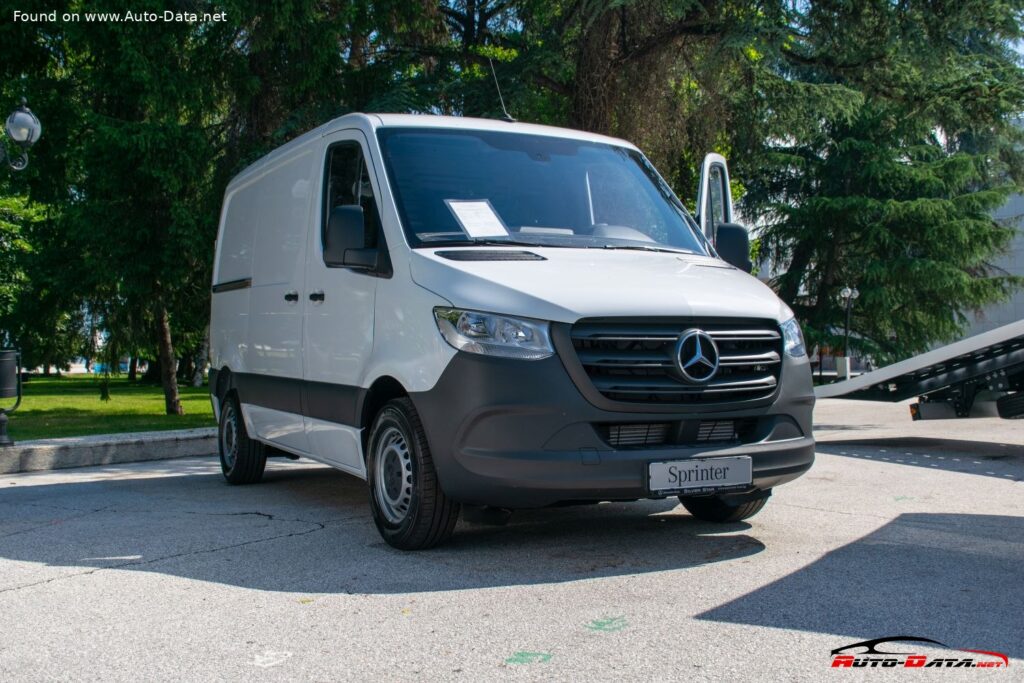
Mercedes-Benz Sprinter Panel Van Compact (W907/W910)
The Mercedes-Benz Sprinter is a highly successful line of light commercial vehicles, renowned globally for its versatility, durability, and advanced engineering. The specific variant, the Mercedes-Benz Sprinter Panel Van Compact (W907/W910) 311 CDI (114 Hp) W907, represents a key offering within the third generation of this iconic workhorse. Introduced in 2018, the W907/W910 generation built upon the Sprinter’s established reputation, integrating modern technology, improved ergonomics, and enhanced efficiency to meet the evolving demands of commercial operations worldwide. This particular model, starting production in 2019, is characterized by its “Compact” designation, indicating a shorter wheelbase and overall length compared to other Sprinter variants, making it particularly adept for urban environments and tighter delivery routes while still offering substantial cargo capacity. As a panel van, its primary role is the transportation of goods, serving a vast array of businesses from logistics and construction to mobile services.
Engine and Performance of the Mercedes-Benz Sprinter Panel Van Compact (W907/W910)
At the heart of the Mercedes-Benz Sprinter Panel Van Compact (W907/W910) 311 CDI (114 Hp) W907 lies a robust and efficient powertrain designed for commercial duty. This model is equipped with Mercedes-Benz’s OM 651 engine, a 2.1-liter (2143 cm3 or 130.77 cu. in.) inline-four diesel unit. This engine configuration is a staple in Mercedes-Benz’s commercial vehicle lineup, known for its balance of power, fuel economy, and reliability. The “311 CDI” designation signifies an output of 114 horsepower (Hp) delivered at 3800 rpm, paired with a substantial 300 Nm (221.27 lb.-ft.) of torque available across a broad range from 1200 to 2200 rpm. This low-end torque is crucial for a commercial van, providing excellent pulling power for heavy loads and smooth acceleration from a standstill, which is particularly beneficial in stop-and-go urban traffic.
The engine features a sophisticated common rail fuel injection system and is boosted by a turbocharger with an intercooler, ensuring optimal combustion and efficiency. With four valves per cylinder, the engine breathes effectively, contributing to its responsive character. Power is sent to the rear wheels via a 6-speed manual transmission, a choice that offers drivers direct control and can contribute to fuel efficiency through precise gear selection. The powertrain architecture, with its front-mounted, transverse engine driving the rear wheels, is a classic and proven layout for commercial vans, offering excellent traction under load and a robust design. Fuel economy figures for this variant are competitive for its class, with a combined NEDC rating of 8.2-8.3 liters per 100 km (28.7 – 28.3 US mpg). Emissions are managed to meet the stringent Euro VI standard, reflecting Mercedes-Benz’s commitment to environmental responsibility in its commercial fleet, featuring a particulate filter and an AdBlue tank (22 liters or 5.81 US gallons) for exhaust aftertreatment.
Design and Features
The Mercedes-Benz Sprinter Panel Van Compact (W907/W910), as its name suggests, is designed with utility and practicality at its core. Its panel van body type, featuring five doors and seating for three occupants, prioritizes cargo space and ease of access. The “Compact” dimensions, with an overall length of 207.36 inches (5267 mm) and a width of 79.53 inches (2020 mm), make it one of the more maneuverable options within the Sprinter range. Despite its compact nature, it boasts an impressive maximum trunk (boot) space of 264.86 cubic feet (7500 liters), offering substantial volume for goods and equipment. The cargo area is easily accessible through large rear doors and typically a sliding side door, facilitating efficient loading and unloading.
The W907/W910 generation introduced a more refined and driver-centric cabin. While specific interior features vary by trim, the Sprinter generally offers a comfortable and ergonomic workspace for drivers, with modern infotainment options and advanced driver-assistance systems. For this 2019 model, essential safety features include an Anti-lock Braking System (ABS), which is critical for maintaining control under heavy braking, especially when carrying a full load. The vehicle’s robust construction and thoughtful design contribute to its high maximum payload capacity of 3373.07 – 3417.17 lbs (1530-1550 kg), allowing businesses to transport significant quantities of goods. The suspension system, featuring leaf springs at both the front and rear (with hydraulic elements at the rear), is engineered to handle heavy loads and provide a stable ride, a crucial aspect for commercial vehicles that often operate at or near their maximum gross vehicle weight (7760.27 lbs or 3520 kg). Disc brakes on both axles ensure reliable stopping power.
Technical Specifications
| General Information | |
| Brand | Mercedes-Benz |
| Model | Sprinter |
| Generation | Sprinter Panel Van Compact (W907/W910) |
| Type (Engine) | 311 CDI (114 Hp) W907 |
| Start of Production | 2019 year |
| Powertrain Architecture | Internal Combustion engine |
| Body Type | Van |
| Seats | 3 |
| Doors | 5 |
| Performance Specs | |
| Fuel Consumption (Urban, NEDC) | 9.4-9.6 l/100 km (25 – 24.5 US mpg) |
| Fuel Consumption (Extra Urban, NEDC) | 7.5-7.6 l/100 km (31.4 – 30.9 US mpg) |
| Fuel Consumption (Combined, NEDC) | 8.2-8.3 l/100 km (28.7 – 28.3 US mpg) |
| CO2 Emissions (NEDC) | 215-219 g/km |
| Fuel Type | Diesel |
| Emission Standard | Euro VI |
| Weight-to-Power Ratio | 17.3 kg/Hp, 57.9 Hp/tonne |
| Weight-to-Torque Ratio | 6.6 kg/Nm, 152.3 Nm/tonne |
| Engine Specs | |
| Power | 114 Hp @ 3800 rpm |
| Power per Liter | 53.2 Hp/l |
| Torque | 300 Nm (221.27 lb.-ft.) @ 1200-2200 rpm |
| Engine Layout | Front, Transverse |
| Engine Model/Code | OM 651 |
| Engine Displacement | 2143 cm3 (2.1 liters / 130.77 cu. in.) |
| Number of Cylinders | 4 |
| Engine Configuration | Inline |
| Number of Valves per Cylinder | 4 |
| Fuel Injection System | Diesel Commonrail |
| Engine Aspiration | Turbocharger, Intercooler |
| Engine Oil Capacity | 11.5 l (12.15 US qt) |
| Coolant Capacity | 9.5 l (10.04 US qt) |
| Engine Systems | Particulate filter |
| Space, Volume and Weights | |
| Kerb Weight | 1970-1990 kg (4343.11 – 4387.2 lbs) |
| Max. Weight (GVWR) | 3520 kg (7760.27 lbs) |
| Max Load (Payload) | 1530-1550 kg (3373.07 – 3417.17 lbs) |
| Trunk (Boot) Space – Maximum | 7500 l (264.86 cu. ft.) |
| Fuel Tank Capacity | 71 l (18.76 US gal) |
| AdBlue Tank Capacity | 22 l (5.81 US gal) |
| Max. Roof Load | 300 kg (661.39 lbs) |
| Permitted Trailer Load with Brakes (12%) | 2000 kg (4409.25 lbs) |
| Permitted Trailer Load without Brakes | 750 kg (1653.47 lbs) |
| Dimensions | |
| Length | 5267 mm (207.36 in.) |
| Width | 2020 mm (79.53 in.) |
| Width Including Mirrors | 2345 mm (92.32 in.) |
| Height | 2356 mm (92.76 in.) |
| Wheelbase | 3250 mm (127.95 in.) |
| Front Track | 1759 mm (69.25 in.) |
| Rear (Back) Track | 1770 mm (69.69 in.) |
| Front Overhang | 1021 mm (40.2 in.) |
| Rear Overhang | 996 mm (39.21 in.) |
| Ride Height (Ground Clearance) | 143 mm (5.63 in.) |
| Minimum Turning Circle (Turning Diameter) | 12.1 m (39.7 ft.) |
| Drivetrain, Brakes and Suspension Specs | |
| Drivetrain Architecture | The Internal combustion engine (ICE) drives the rear wheels of the vehicle. |
| Drive Wheel | Rear wheel drive |
| Number of Gears and Type of Gearbox | 6 gears, manual transmission |
| Front Suspension | Leaf spring |
| Rear Suspension | Hydraulic elements, Leaf spring |
| Front Brakes | Disc |
| Rear Brakes | Disc |
| Assisting Systems | ABS (Anti-lock braking system) |
| Tires Size | 225/65 R16 |
| Wheel Rims Size | 6.5J x 16 |
Legacy and Market Impact
The Mercedes-Benz Sprinter has carved out an indelible legacy in the global commercial vehicle market since its inception in 1995. The W907/W910 generation, including the Mercedes-Benz Sprinter Panel Van Compact (W907/W910) 311 CDI (114 Hp) W907, continues this tradition of excellence, solidifying the Sprinter’s reputation as a premium, reliable, and highly adaptable work vehicle. In its primary markets, particularly across Europe and North America, the Sprinter is a dominant force in the large van segment, often setting the benchmark for other manufacturers.
The “Compact” variant specifically addresses the growing demand for efficient last-mile delivery solutions and urban logistics. Its manageable dimensions and tight turning circle (39.7 feet or 12.1 meters) make it an ideal choice for navigating congested city streets and tight loading docks, areas where larger vans might struggle. Competitors in this segment vary by region but generally include vehicles like the Ford Transit, Ram ProMaster (Fiat Ducato in Europe), Volkswagen Crafter, and Renault Master (Nissan NV in some markets). The Sprinter distinguishes itself through its Mercedes-Benz pedigree, which implies superior build quality, advanced safety features, and often a higher level of driver comfort and technology compared to some rivals. While the 311 CDI with 114 Hp might be considered an entry-level power output for the Sprinter, it provides a cost-effective and fuel-efficient option for businesses where maximum power is less critical than operational economy and reliability.
Historically, the Sprinter has been instrumental in shaping the modern large van segment, popularizing features like a tall roof and a spacious, easy-to-customize cargo area. The W907/W910 generation further enhanced this with improved connectivity, more sophisticated driver assistance systems, and a broader range of configurations, making it adaptable for everything from parcel delivery to mobile workshops and passenger transport. The 311 CDI Compact variant, with its focus on efficiency and urban maneuverability, embodies Mercedes-Benz’s strategic approach to offering tailored solutions for diverse commercial needs, ensuring its continued relevance and strong market position in the competitive world of light commercial vehicles.
