
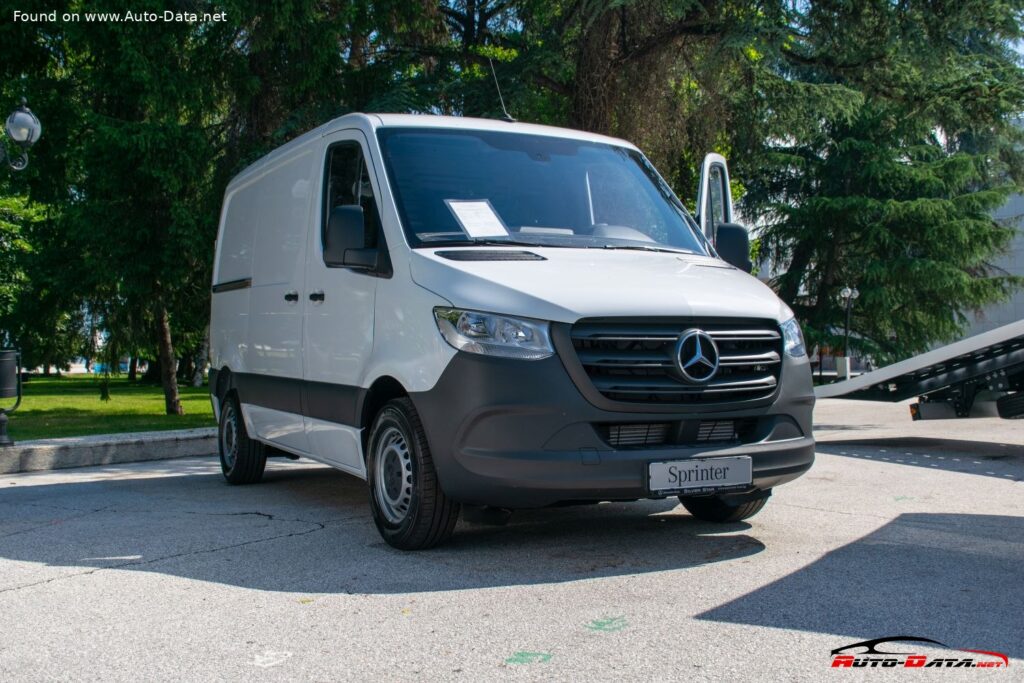
The Mercedes-Benz Sprinter is an iconic nameplate in the light commercial vehicle segment, renowned globally for its versatility, durability, and advanced engineering. The specific model under review, the Mercedes-Benz Sprinter Panel Van Compact (W907/W910) 311 CDI (114 Hp) W907 G-TRONIC, represents a key configuration from the third generation (W907/W910), which commenced production in 2019. This variant, a “Compact” panel van, is strategically positioned to offer a blend of maneuverability and substantial cargo capacity, making it an ideal choice for urban deliveries, service trades, and a wide array of commercial applications where a full-size van might be excessive but significant hauling capability is still required. It embodies Mercedes-Benz’s commitment to efficiency, driver comfort, and robust construction in the commercial sector, leveraging sophisticated diesel powertrain technology and a state-of-the-art automatic transmission.
Engineering and Performance of the Mercedes-Benz Sprinter Panel Van Compact (W907/W910)
At the heart of the Mercedes-Benz Sprinter Panel Van Compact (W907/W910) 311 CDI (114 Hp) W907 G-TRONIC lies a robust and efficient powertrain designed for demanding commercial use. This particular variant is equipped with Mercedes-Benz’s well-regarded OM 651 engine, a 2.1-liter (2143 cm3) inline four-cylinder diesel unit. This engine features a common rail fuel injection system and is boosted by a turbocharger and intercooler, ensuring both responsive power delivery and excellent fuel efficiency. It generates a respectable 114 horsepower at 3800 rpm, which, while not the highest output available in the Sprinter lineup, is perfectly suited for the “311 CDI” designation, indicating its gross vehicle weight class and power level for reliable daily operations.
More crucial for a commercial vehicle is torque, and the 311 CDI delivers a substantial 300 Nm (221.27 lb.-ft.) available across a broad and usable range from 1200 to 2200 rpm. This low-end torque is vital for strong acceleration from a standstill, effortless hauling of heavy loads, and maintaining momentum without constant downshifting, particularly in urban environments or on inclines. Power is managed by a sophisticated 7-speed G-TRONIC PLUS automatic transmission, which provides smooth and precise gear changes, contributing to driver comfort and optimizing fuel economy. The drivetrain architecture is rear-wheel drive, a traditional and preferred setup for commercial vans due to its superior traction when loaded and its ability to handle higher payloads effectively.
Fuel efficiency is a significant factor for commercial operators, and the Sprinter 311 CDI performs admirably. According to NEDC (New European Driving Cycle) standards, combined fuel consumption ranges from 7.8 to 8.3 liters per 100 kilometers, translating to an impressive 30.2 to 28.3 US miles per gallon. Urban consumption is rated at 8.1-8.5 l/100 km (29-27.7 US mpg), while extra-urban driving achieves 7.6-8 l/100 km (30.9-29.4 US mpg). These figures underscore the efficiency of the OM 651 engine and the G-TRONIC transmission. Furthermore, the vehicle complies with the stringent Euro VI emission standard, with CO2 emissions ranging from 204-217 g/km, reflecting Mercedes-Benz’s commitment to environmental responsibility. A particulate filter is standard, further reducing harmful emissions. The engine also features a substantial 11.5-liter oil capacity and a 9.5-liter coolant capacity, designed for extended service intervals and robust operation under strenuous conditions.
Design and Features
The Mercedes-Benz Sprinter Panel Van Compact (W907/W910) is designed with functionality and practicality at its core, while still retaining the recognizable Mercedes-Benz aesthetic. As a panel van, its primary purpose is cargo transport, and this “Compact” variant offers an intelligent balance of external dimensions and internal load space. Measuring 207.36 inches in length, 79.53 inches in width (92.32 inches including mirrors), and 92.76 inches in height, it is agile enough for city driving and parking while providing a generous 127.95-inch wheelbase for stability and load-carrying capability. The minimum turning circle of 39.7 feet further enhances its maneuverability in tight urban settings.
The body style features five doors – typically two front cabin doors, a sliding side door, and two rear barn doors – facilitating easy access to the cargo area from multiple angles. The cabin is designed for three occupants, offering a comfortable and ergonomic workspace for the driver and crew. The cargo area is truly impressive for a “compact” designation, boasting a maximum trunk space of 7500 liters (264.86 cubic feet). This vast, customizable space allows businesses to configure the interior with shelving, racks, or specialized equipment to suit their specific needs, making the Sprinter a versatile mobile workshop or delivery unit.
The vehicle’s chassis and suspension are engineered for heavy-duty use. It features leaf springs at the front and a combination of hydraulic elements and leaf springs at the rear, providing a robust platform capable of handling substantial payloads. The maximum gross vehicle weight is 7760.27 pounds, with a permitted trailer load of 4409.25 pounds with brakes and 1653.47 pounds without brakes, showcasing its significant towing capabilities. Disc brakes are fitted on both the front and rear axles, complemented by an Anti-lock Braking System (ABS) for enhanced safety and control during braking, especially under varying load conditions. The tires are sized 225/65 R16 on 6.5J x 16 wheel rims, providing a good balance of load capacity and ride comfort.
Beyond the fundamental utility, modern Sprinters, including this 2019 model, integrate advanced driver-assistance systems and connectivity features typical of a Mercedes-Benz. While specific details beyond ABS are not provided in the technical data, it is customary for vehicles of this era and brand to include features like Electronic Stability Program (ESP), Crosswind Assist, Attention Assist, and potentially more advanced options such as Active Brake Assist or Lane Keeping Assist, all designed to enhance safety and reduce driver fatigue during long working hours. The interior is generally characterized by high-quality materials, intuitive controls, and options for infotainment systems, transforming the van into a comfortable and productive mobile office.
Technical Specifications
| Category | Specification |
|---|---|
| General Information | |
| Brand | Mercedes-Benz |
| Model | Sprinter |
| Generation | Sprinter Panel Van Compact (W907/W910) |
| Type (Engine) | 311 CDI (114 Hp) W907 G-TRONIC |
| Start of Production | 2019 year |
| Powertrain Architecture | Internal Combustion engine |
| Body Type | Van |
| Seats | 3 |
| Doors | 5 |
| Performance Specs | |
| Fuel Consumption (Urban, NEDC) | 8.1-8.5 l/100 km (29 – 27.7 US mpg) |
| Fuel Consumption (Extra Urban, NEDC) | 7.6-8 l/100 km (30.9 – 29.4 US mpg) |
| Fuel Consumption (Combined, NEDC) | 7.8-8.3 l/100 km (30.2 – 28.3 US mpg) |
| CO2 Emissions (NEDC) | 204-217 g/km |
| Fuel Type | Diesel |
| Emission Standard | Euro VI |
| Engine Specs | |
| Power | 114 Hp @ 3800 rpm |
| Power per Liter | 53.2 Hp/l |
| Torque | 300 Nm (221.27 lb.-ft.) @ 1200-2200 rpm |
| Engine Layout | Front, Transverse |
| Engine Model/Code | OM 651 |
| Engine Displacement | 2143 cm3 (2.1 Liters / 130.77 cu. in.) |
| Number of Cylinders | 4 |
| Engine Configuration | Inline |
| Number of Valves per Cylinder | 4 |
| Fuel Injection System | Diesel Commonrail |
| Engine Aspiration | Turbocharger, Intercooler |
| Engine Oil Capacity | 11.5 l (12.15 US qt) |
| Coolant Capacity | 9.5 l (10.04 US qt) |
| Engine Systems | Particulate filter |
| Space, Volume and Weights | |
| Max. Weight | 3520 kg (7760.27 lbs.) |
| Trunk (Boot) Space – Maximum | 7500 l (264.86 cu. ft.) |
| Fuel Tank Capacity | 71 l (18.76 US gal) |
| AdBlue Tank Capacity | 22 l (5.81 US gal) |
| Max. Roof Load | 300 kg (661.39 lbs.) |
| Permitted Trailer Load with Brakes (12%) | 2000 kg (4409.25 lbs.) |
| Permitted Trailer Load without Brakes | 750 kg (1653.47 lbs.) |
| Dimensions | |
| Length | 5267 mm (207.36 in.) |
| Width | 2020 mm (79.53 in.) |
| Width Including Mirrors | 2345 mm (92.32 in.) |
| Height | 2356 mm (92.76 in.) |
| Wheelbase | 3250 mm (127.95 in.) |
| Front Track | 1759 mm (69.25 in.) |
| Rear (Back) Track | 1770 mm (69.69 in.) |
| Front Overhang | 1021 mm (40.2 in.) |
| Rear Overhang | 996 mm (39.21 in.) |
| Ride Height (Ground Clearance) | 143 mm (5.63 in.) |
| Minimum Turning Circle (Turning Diameter) | 12.1 m (39.7 ft.) |
| Drivetrain, Brakes and Suspension Specs | |
| Drivetrain Architecture | Internal combustion engine (ICE) drives the rear wheels of the vehicle. |
| Drive Wheel | Rear wheel drive |
| Number of Gears and Type of Gearbox | 7 gears, automatic transmission G-TRONIC PLUS |
| Front Suspension | Leaf spring |
| Rear Suspension | Hydraulic elements, Leaf spring |
| Front Brakes | Disc |
| Rear Brakes | Disc |
| Assisting Systems | ABS (Anti-lock braking system) |
| Tires Size | 225/65 R16 |
| Wheel Rims Size | 6.5J x 16 |
Legacy and Market Impact of the Mercedes-Benz Sprinter
The Mercedes-Benz Sprinter has carved out an indelible legacy in the global commercial vehicle market since its inception in 1995. It virtually defined the modern large commercial van segment, moving away from traditional body-on-frame designs towards a unibody construction that offered superior ride comfort, handling, and fuel efficiency without compromising cargo capacity. The W907/W910 generation, launched in 2018 (with the 2019 model year for this specific variant), continued this tradition of innovation, solidifying the Sprinter’s reputation as a premium, technologically advanced, and highly adaptable workhorse.
In its primary markets, including Europe and North America, the Sprinter consistently sets benchmarks for quality, reliability, and total cost of ownership. Its robust construction and Mercedes-Benz engineering translate into vehicles that endure demanding daily use, providing long service life and strong residual values. The Mercedes-Benz Sprinter Panel Van Compact (W907/W910) 311 CDI (114 Hp) W907 G-TRONIC, with its efficient diesel engine and smooth automatic transmission, is particularly well-suited for businesses that prioritize fuel economy and driver comfort for their fleet operations. Its “compact” designation within the Sprinter family makes it an agile contender for urban logistics, last-mile delivery services, and various trades that require significant cargo volume in a more manageable footprint than the largest Sprinter variants.
The Sprinter faces stiff competition from a range of formidable rivals. In the North American market, key competitors include the Ford Transit, Ram ProMaster (a rebadged Fiat Ducato), and to some extent, the traditional body-on-frame Chevrolet Express and GMC Savana. Globally, it competes with models like the Volkswagen Crafter (which was once based on the Sprinter platform), Renault Master, and Iveco Daily. Despite the intense competition, the Sprinter consistently stands out due to its superior build quality, advanced safety features (many of which are standard or optional on the W907/W910 generation), and the prestige associated with the Mercedes-Benz brand. Its wide array of configurations, including cargo vans, passenger vans, and chassis cabs, allows for unparalleled customization, further enhancing its market appeal.
Historically, the Sprinter has been a pioneer in introducing car-like driving dynamics and advanced safety systems to the commercial van segment. Its continuous evolution, incorporating features like adaptive cruise control, lane-keeping assist, and sophisticated infotainment systems, has elevated the expectations for what a commercial vehicle can offer. Its impact extends beyond individual businesses, playing a crucial role in the efficiency of supply chains, the growth of e-commerce, and the mobility of various service industries worldwide. The ongoing development of electric Sprinter variants (eSprinter) further underscores its adaptability and relevance in a rapidly changing automotive landscape, ensuring its legacy as a leader in the commercial van sector continues well into the future.
