
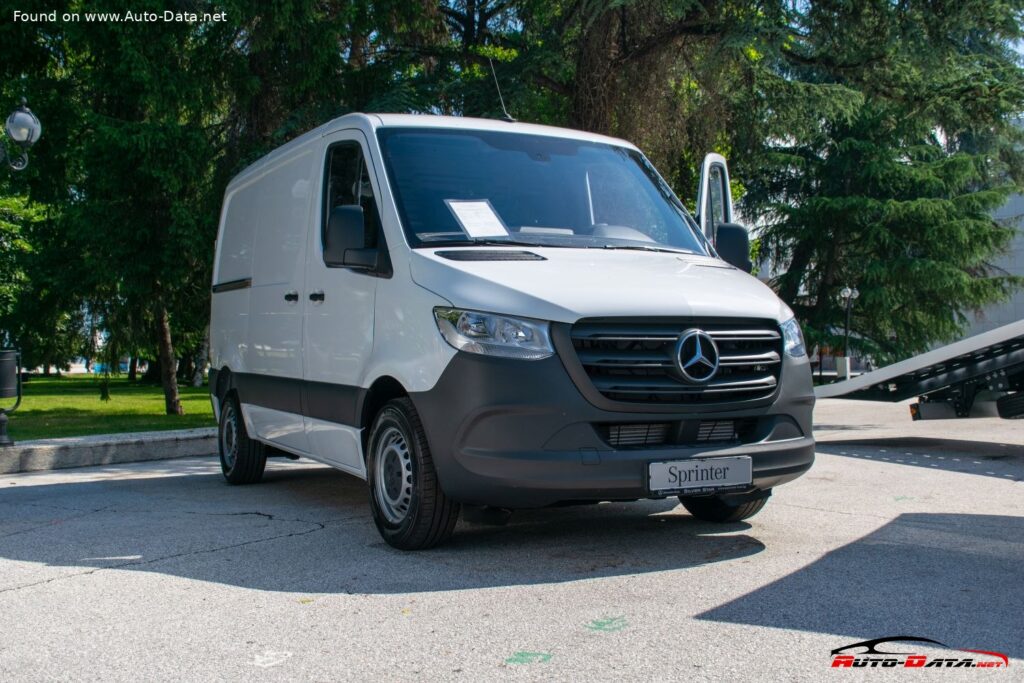
Mercedes-Benz Sprinter Panel Van Compact (W907/W910)
The Mercedes-Benz Sprinter is a highly successful and widely recognized light commercial vehicle, manufactured by Daimler AG (now Mercedes-Benz Group AG). It has established itself as a global benchmark in the large van segment, known for its versatility, robust engineering, and premium brand appeal. The specific model under review, the Mercedes-Benz Sprinter Panel Van Compact (W907/W910) 314 CDI (143 Hp) W907, represents a crucial part of the third generation of the Sprinter, which commenced production in 2018. This generation, internally designated W907 for rear-wheel-drive variants and W910 for front-wheel-drive variants (though this specific model is RWD), continued to build upon the Sprinter’s legacy of innovation and adaptability.
The “Compact” designation refers to one of the shorter body length options available for the Sprinter panel van, offering a balance between maneuverability in urban environments and substantial cargo capacity. As a panel van, its primary role is commercial, serving businesses across various sectors, from logistics and delivery services to trades and mobile workshops. While the Sprinter is a global product, its robust diesel powertrains, like the 314 CDI, are particularly popular in European and other international markets where diesel remains a preferred fuel for commercial vehicles due to its efficiency and torque characteristics. In the United States, the Sprinter is also a strong contender, though diesel options often compete with gasoline engines for market share.
Engine and Performance of the Mercedes-Benz Sprinter Panel Van Compact (W907/W910)
Powering the Mercedes-Benz Sprinter Panel Van Compact (W907/W910) 314 CDI (143 Hp) W907 is the highly regarded OM 651 engine, a 2.1-liter (2143 cm3 or 130.77 cu. in.) inline four-cylinder diesel unit. This engine is a cornerstone of Mercedes-Benz’s commercial vehicle and passenger car lineup, known for its durability, efficiency, and refined operation. It features a modern common-rail fuel injection system, which precisely controls fuel delivery for optimal combustion, and is equipped with a turbocharger and intercooler to maximize power output and efficiency across the RPM range.
The 314 CDI variant produces a respectable 143 horsepower (Hp) at 3800 rpm, which translates to a power-per-liter figure of 66.7 Hp/l. More critically for a commercial vehicle, it delivers a robust 330 Nm (243.4 lb.-ft.) of torque available across a broad rev range, specifically from 1200 to 2400 rpm. This wide torque band is essential for effortless acceleration, strong pulling power, and maintaining speed, especially when the van is fully loaded or towing. The engine’s layout is front-mounted and transverse, driving the rear wheels, a traditional and robust architecture for commercial vehicles that prioritizes load-carrying and traction.
The powertrain is mated to a 6-speed manual transmission, offering drivers precise control over gear selection and contributing to the vehicle’s overall fuel efficiency. The rear-wheel-drive configuration ensures excellent traction, particularly beneficial when carrying heavy loads or navigating challenging terrain. To meet stringent environmental standards, the engine is compliant with Euro 6 emission regulations and includes a particulate filter, demonstrating Mercedes-Benz’s commitment to reducing environmental impact. Fuel economy figures, measured under the NEDC cycle, are quite impressive for a vehicle of this size and capability: urban consumption is 8-8.2 l/100 km (29.4 – 28.7 US mpg), extra-urban is 6.8-7.1 l/100 km (34.6 – 33.1 US mpg), and combined consumption stands at 7.2-7.5 l/100 km (32.7 – 31.4 US mpg), with CO2 emissions ranging from 191-197 g/km.
Design and Features
The W907/W910 generation of the Sprinter maintains its characteristic utilitarian yet sophisticated design. As a Panel Van Compact, its exterior dimensions are optimized for urban delivery and accessibility without sacrificing significant cargo volume. With a length of 207.36 inches (5267 mm), a width of 79.53 inches (2020 mm) (92.32 inches or 2345 mm including mirrors), and a height of 92.76 inches (2356 mm), it strikes a balance between interior space and exterior footprint. The wheelbase measures 127.95 inches (3250 mm), contributing to its stable ride and respectable turning circle of 39.7 feet (12.1 m).
The body type is a classic panel van with five doors, including large rear doors for cargo access and side sliding doors, enhancing loading and unloading efficiency. The cabin is designed to accommodate three occupants, providing a practical and comfortable workspace for the driver and crew. The primary focus of the interior is functionality and durability, with hard-wearing materials built to withstand the rigors of daily commercial use. Safety features are standard, with ABS (Anti-lock Braking System) ensuring stable braking performance, a critical aspect for a vehicle that often operates with varying loads. The suspension system, featuring leaf springs at the front and a combination of hydraulic elements and leaf springs at the rear, is engineered to handle substantial payloads while maintaining ride comfort and stability. Disc brakes on both front and rear axles provide reliable stopping power.
Cargo capacity is a strong suit for the Sprinter Panel Van Compact, offering a maximum trunk volume of 7500 liters (264.86 cu. ft.). With a kerb weight of 4343.11 lbs. (1970 kg) and a maximum permissible weight of 7716.18 lbs. (3500 kg), it boasts an impressive maximum payload capacity of 3373.07 lbs. (1530 kg). The vehicle is also capable of towing, with a permitted trailer load of 4409.25 lbs. (2000 kg) with brakes and 1653.47 lbs. (750 kg) without brakes. The fuel tank capacity is 18.76 US gallons (71 liters), complemented by a 5.81 US gallon (22 liters) AdBlue tank for emission control, providing a good operating range for commercial routes.
Technical Specifications
| Category | Specification | Metric Value | US/Imperial Value |
|---|---|---|---|
| General Information | |||
| Brand | Mercedes-Benz | ||
| Model | Sprinter | ||
| Generation | Sprinter Panel Van Compact (W907/W910) | ||
| Type (Engine) | 314 CDI (143 Hp) W907 | ||
| Start of Production | 2018 | ||
| Powertrain Architecture | Internal Combustion Engine | ||
| Body Type | Van | ||
| Seats | 3 | ||
| Doors | 5 | ||
| Performance Specifications | |||
| Fuel Consumption (Urban, NEDC) | 8-8.2 l/100 km | 29.4 – 28.7 US mpg | |
| Fuel Consumption (Extra Urban, NEDC) | 6.8-7.1 l/100 km | 34.6 – 33.1 US mpg | |
| Fuel Consumption (Combined, NEDC) | 7.2-7.5 l/100 km | 32.7 – 31.4 US mpg | |
| CO2 Emissions (NEDC) | 191-197 g/km | ||
| Fuel Type | Diesel | ||
| Emission Standard | Euro 6 | ||
| Weight-to-Power Ratio | 13.8 kg/Hp | 72.6 Hp/tonne | |
| Weight-to-Torque Ratio | 6 kg/Nm | 167.5 Nm/tonne | |
| Engine Specifications | |||
| Power | 143 Hp @ 3800 rpm | ||
| Power per Liter | 66.7 Hp/l | ||
| Torque | 330 Nm @ 1200-2400 rpm | 243.4 lb.-ft. @ 1200-2400 rpm | |
| Engine Layout | Front, Transverse | ||
| Engine Model/Code | OM 651 | ||
| Engine Displacement | 2143 cm3 | 130.77 cu. in. | |
| Number of Cylinders | 4 | ||
| Engine Configuration | Inline | ||
| Number of Valves per Cylinder | 4 | ||
| Fuel Injection System | Diesel Commonrail | ||
| Engine Aspiration | Turbocharger, Intercooler | ||
| Engine Oil Capacity | 11.5 l | 12.15 US qt | |
| Engine Oil Specification | Not specified | ||
| Coolant Capacity | 9.5 l | 10.04 US qt | |
| Engine Systems | Particulate filter | ||
| Space, Volume and Weights | |||
| Kerb Weight | 1970 kg | 4343.11 lbs. | |
| Max. Weight (GVWR) | 3500 kg | 7716.18 lbs. | |
| Max Load (Payload) | 1530 kg | 3373.07 lbs. | |
| Trunk (Boot) Space – Maximum | 7500 l | 264.86 cu. ft. | |
| Fuel Tank Capacity | 71 l | 18.76 US gal | |
| AdBlue Tank Capacity | 22 l | 5.81 US gal | |
| Max. Roof Load | 300 kg | 661.39 lbs. | |
| Permitted Trailer Load with Brakes (12%) | 2000 kg | 4409.25 lbs. | |
| Permitted Trailer Load without Brakes | 750 kg | 1653.47 lbs. | |
| Dimensions | |||
| Length | 5267 mm | 207.36 in. | |
| Width | 2020 mm | 79.53 in. | |
| Width including Mirrors | 2345 mm | 92.32 in. | |
| Height | 2356 mm | 92.76 in. | |
| Wheelbase | 3250 mm | 127.95 in. | |
| Front Track | 1759 mm | 69.25 in. | |
| Rear Track | 1770 mm | 69.69 in. | |
| Front Overhang | 1021 mm | 40.2 in. | |
| Rear Overhang | 996 mm | 39.21 in. | |
| Ride Height (Ground Clearance) | 143 mm | 5.63 in. | |
| Minimum Turning Circle (Turning Diameter) | 12.1 m | 39.7 ft. | |
| Drivetrain, Brakes and Suspension | |||
| Drivetrain Architecture | The Internal combustion engine (ICE) drives the rear wheels of the vehicle. | ||
| Drive Wheel | Rear wheel drive | ||
| Number of Gears and Type of Gearbox | 6 gears, manual transmission | ||
| Front Suspension | Leaf spring | ||
| Rear Suspension | Hydraulic elements, Leaf spring | ||
| Front Brakes | Disc | ||
| Rear Brakes | Disc | ||
| Assisting Systems | ABS (Anti-lock braking system) | ||
| Tires Size | 225/65 R16 | ||
| Wheel Rims Size | 6.5J x 16 | ||
Legacy and Market Impact
The Mercedes-Benz Sprinter, including the W907/W910 generation and its 314 CDI (143 Hp) variant, holds a formidable reputation in the global commercial vehicle market. Since its inception, the Sprinter has consistently set benchmarks for quality, reliability, safety, and driver comfort in the large van segment. Its modular platform allows for a vast array of configurations, body styles, and powertrains, making it an incredibly adaptable solution for diverse business needs. The “Compact” panel van, in particular, caters to businesses requiring significant cargo capacity combined with enhanced maneuverability for urban logistics, last-mile delivery, and service operations.
In its primary markets, such as Europe and North America, the Sprinter faces stiff competition from rivals like the Ford Transit, Ram ProMaster (based on the Fiat Ducato), Volkswagen Crafter, and the Renault Master/Nissan NV400. However, the Sprinter consistently distinguishes itself through its premium build quality, advanced technology (including safety and driver-assistance features in higher trims, even if not fully detailed for this base model), and the prestige of the Mercedes-Benz badge, which often translates to higher resale values and lower total cost of ownership for fleet operators. The OM 651 diesel engine, as featured in the 314 CDI, is a key contributor to its success, offering a proven track record of efficiency and robustness.
The W907/W910 generation further solidified the Sprinter’s position by introducing new levels of connectivity and digital integration, although the core mechanical package, as seen in this 2018 model, remained focused on reliable performance and utility. Its strong payload capacity, efficient diesel engine, and durable rear-wheel-drive architecture make it an ideal choice for businesses prioritizing reliability and cost-effectiveness. The Sprinter’s legacy is one of continuous evolution, adapting to changing market demands for efficiency, emissions, and driver comfort, while always maintaining its core identity as a versatile and dependable workhorse. Its significant market impact stems from its ability to effectively serve a broad spectrum of commercial applications, from parcel delivery to specialized conversions, cementing its status as a leader in the global van market.
