
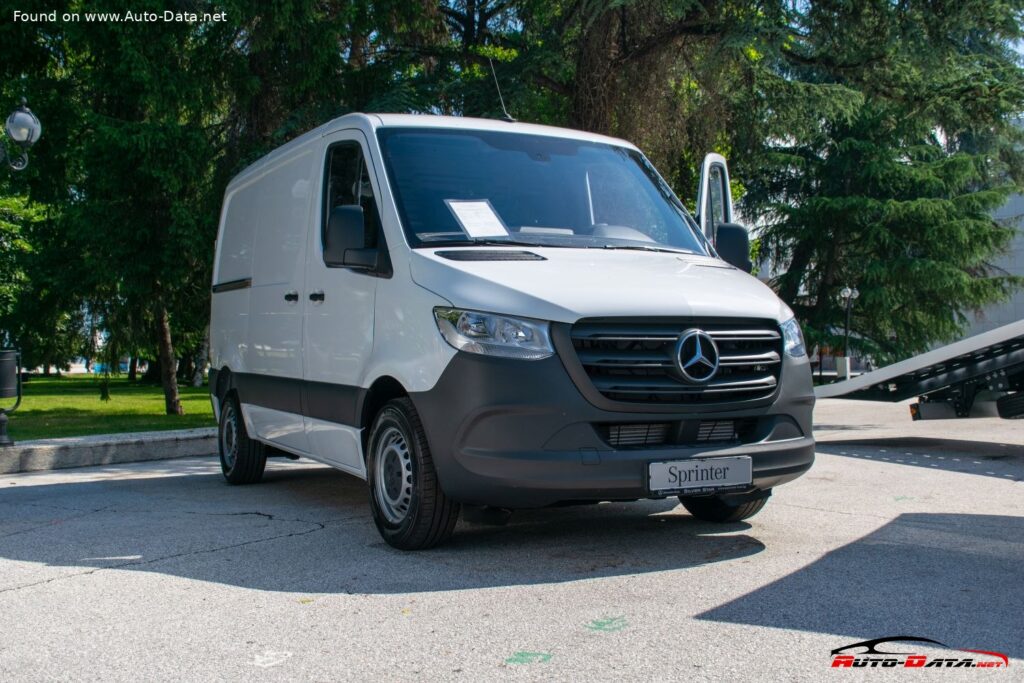
Introduction to the Mercedes-Benz Sprinter Panel Van Compact (W907/W910)
The Mercedes-Benz Sprinter has long been recognized as a benchmark in the commercial van segment, celebrated for its robust construction, versatile configurations, and advanced engineering. Introduced in 2018, the W907/W910 generation represents a significant evolution of this iconic workhorse, building upon its predecessors’ legacy while integrating modern technology, enhanced efficiency, and improved driver comfort. This particular variant, the Mercedes-Benz Sprinter Panel Van Compact (W907/W910) 314 CDI (143 Hp) W910, is engineered to meet the demanding needs of urban logistics and various professional applications, offering a compelling blend of maneuverability, load capacity, and economical operation.
As a global product, the Sprinter serves markets across North America, Europe, Asia, and beyond, with specific configurations tailored to regional requirements. While the “CDI” (Common Rail Direct Injection) designation and Euro 6 emission standard are particularly prominent in European markets, the underlying principles of durability, efficiency, and advanced diesel technology resonate with commercial operators worldwide. This compact panel van, with its 143 horsepower diesel engine, is positioned as an agile and capable solution for businesses requiring a reliable vehicle for deliveries, service calls, and general cargo transport, especially in congested urban environments where its dimensions offer a distinct advantage.
Engineering and Performance of the Mercedes-Benz Sprinter Panel Van Compact (W907/W910)
At the heart of the Mercedes-Benz Sprinter Panel Van Compact (W907/W910) 314 CDI (143 Hp) W910 lies a formidable 2.1-liter (2143 cm³) inline-four diesel engine, designated as the OM 651. This powerplant is a testament to Mercedes-Benz’s commitment to efficiency and performance in commercial applications. Featuring common rail direct injection, a turbocharger, and an intercooler, the engine is meticulously engineered to deliver optimal power output alongside impressive fuel economy and reduced emissions.
The engine generates a robust 143 horsepower at 3800 rpm, providing ample power for navigating city streets and highway stretches, even when fully loaded. More critically for a commercial vehicle, it produces a substantial 243.4 lb.-ft. (330 Nm) of torque, available across a broad and usable range from 1200 to 2400 rpm. This low-end torque is crucial for effortless starts, strong acceleration, and maintaining momentum, especially when hauling heavy cargo or operating in stop-and-go traffic. The engine’s front, transverse layout contributes to efficient packaging and weight distribution, enhancing the vehicle’s handling characteristics.
Power is delivered to the front wheels via a durable 6-speed manual transmission, offering drivers precise control and contributing to the vehicle’s overall fuel efficiency. The front-wheel-drive architecture is a notable feature for this Sprinter variant, often chosen for its advantages in terms of cargo floor height and traction in certain conditions. Fuel economy figures are competitive for its class, with a combined NEDC rating of 29-28.7 US mpg (8.1-8.2 l/100 km). This efficiency, coupled with a 17.17 US gallon (65 l) fuel tank and a 5.81 US gallon (22 l) AdBlue tank, ensures a practical operating range, minimizing downtime for refueling. Adherence to the Euro 6 emission standard further underscores its environmental responsibility, featuring a particulate filter to reduce harmful emissions.
Design and Features
The design of the Mercedes-Benz Sprinter Panel Van Compact (W907/W910) is inherently functional, prioritizing utility, durability, and ease of use. As a panel van, its primary purpose is to transport goods, and every aspect of its design reflects this. The “Compact” designation refers to its shorter length (207.36 inches or 5267 mm) and wheelbase (128.31 inches or 3259 mm), making it particularly adept at maneuvering through tight urban streets, parking in smaller spaces, and navigating loading docks with greater agility compared to its longer counterparts.
The van features five doors, typically including two front cabin doors, a sliding side door for convenient access to the cargo area, and a rear door configuration (often split barn doors) for easy loading and unloading. With three seats in the cabin, it can comfortably accommodate a driver and two passengers, suitable for work crews or co-drivers. The cargo area is vast for its compact dimensions, offering a maximum trunk space of 275.45 cubic feet (7800 liters). This generous volume, combined with a maximum payload capacity of 3483.3 lbs. (1580 kg) and a maximum roof load of 661.39 lbs. (300 kg), makes it an incredibly versatile platform for various businesses.
From a technological and safety standpoint, the W907/W910 Sprinter is well-equipped for its era. While specific advanced driver-assistance systems can vary by trim and optional packages, standard features like ABS (Anti-lock Braking System) are foundational for safe operation. The vehicle’s robust suspension system, comprising leaf springs at the front and a combination of hydraulic elements and leaf springs at the rear, is designed to handle heavy loads while maintaining stability and ride comfort. Disc brakes on both front and rear axles provide reliable stopping power. The 225/65 R16 tires on 6.5J x 16 wheels ensure a solid grip and contribute to the vehicle’s stable demeanor on the road.
Technical Specifications
| Mercedes-Benz Sprinter Panel Van Compact (W907/W910) 314 CDI (143 Hp) W910 – Technical Specifications | |
|---|---|
| General Information | |
| Brand | Mercedes-Benz |
| Model | Sprinter |
| Generation | Sprinter Panel Van Compact (W907/W910) |
| Type (Engine) | 314 CDI (143 Hp) W910 |
| Start of Production | 2018 year |
| Powertrain Architecture | Internal Combustion Engine |
| Body Type | Van |
| Seats | 3 |
| Doors | 5 |
| Performance Specifications | |
| Fuel Consumption (Urban – NEDC) | 26.1 – 24.2 US mpg (9-9.7 l/100 km) |
| Fuel Consumption (Extra Urban – NEDC) | 32.2 – 30.5 US mpg (7.3-7.7 l/100 km) |
| Fuel Consumption (Combined – NEDC) | 29 – 28.7 US mpg (8.1-8.2 l/100 km) |
| CO2 Emissions (NEDC) | 213-217 g/km |
| Fuel Type | Diesel |
| Emission Standard | Euro 6 |
| Weight-to-Power Ratio | 13.4 kg/Hp, 74.5 Hp/tonne |
| Weight-to-Torque Ratio | 5.8 kg/Nm, 171.9 Nm/tonne |
| Engine Specifications | |
| Power | 143 Hp @ 3800 rpm |
| Power per Liter | 66.7 Hp/l |
| Torque | 243.4 lb.-ft. (330 Nm) @ 1200-2400 rpm |
| Engine Layout | Front, Transverse |
| Engine Model/Code | OM 651 |
| Engine Displacement | 130.77 cu. in. (2143 cm³) |
| Number of Cylinders | 4 |
| Engine Configuration | Inline |
| Number of Valves per Cylinder | 4 |
| Fuel Injection System | Diesel Commonrail |
| Engine Aspiration | Turbocharger, Intercooler |
| Engine Oil Capacity | 12.15 US qt (11.5 l) |
| Coolant Capacity | 10.04 US qt (9.5 l) |
| Engine Systems | Particulate filter |
| Space, Volume, and Weights | |
| Kerb Weight | 4232.88 lbs. (1920 kg) |
| Max. Weight (GVWR) | 7716.18 lbs. (3500 kg) |
| Max Load (Payload) | 3483.3 lbs. (1580 kg) |
| Trunk (Boot) Space – Maximum | 275.45 cu. ft. (7800 l) |
| Fuel Tank Capacity | 17.17 US gal (65 l) |
| AdBlue Tank | 5.81 US gal (22 l) |
| Max. Roof Load | 661.39 lbs. (300 kg) |
| Permitted Trailer Load with Brakes (12%) | 4409.25 lbs. (2000 kg) |
| Permitted Trailer Load without Brakes | 1653.47 lbs. (750 kg) |
| Dimensions | |
| Length | 207.36 in. (5267 mm) |
| Width | 79.53 in. (2020 mm) |
| Width Including Mirrors | 92.32 in. (2345 mm) |
| Height | 92.76 in. (2356 mm) |
| Wheelbase | 128.31 in. (3259 mm) |
| Front Track | 69.25 in. (1759 mm) |
| Rear Track | 69.69 in. (1770 mm) |
| Front Overhang | 39.84 in. (1012 mm) |
| Rear Overhang | 39.21 in. (996 mm) |
| Ride Height (Ground Clearance) | 5.63 in. (143 mm) |
| Minimum Turning Circle (Diameter) | 42.65 ft. (13 m) |
| Drivetrain, Brakes, and Suspension | |
| Drivetrain Architecture | Front-wheel drive (ICE drives front wheels) |
| Drive Wheel | Front wheel drive |
| Number of Gears and Type of Gearbox | 6 gears, manual transmission |
| Front Suspension | Leaf spring |
| Rear Suspension | Hydraulic elements, Leaf spring |
| Front Brakes | Disc |
| Rear Brakes | Disc |
| Assisting Systems | ABS (Anti-lock braking system) |
| Tires Size | 225/65 R16 |
| Wheel Rims Size | 6.5J x 16 |
Legacy and Market Impact
The Mercedes-Benz Sprinter has cultivated an unparalleled legacy as a global leader in the light commercial vehicle segment. Since its inception in 1995, it has consistently set standards for innovation, reliability, and versatility. The W907/W910 generation, launched in 2018, continues this tradition, further solidifying the Sprinter’s reputation as a premium work van that offers more than just cargo space.
In its primary markets, particularly in Europe and North America, the Sprinter faces stiff competition from rivals such as the Ford Transit, Ram ProMaster (based on the Fiat Ducato), Volkswagen Crafter, and the Renault Master/Nissan NV400. However, the Sprinter distinguishes itself through its perceived quality, advanced technology, and the prestige associated with the Mercedes-Benz brand. This specific Mercedes-Benz Sprinter Panel Van Compact (W907/W910) 314 CDI (143 Hp) W910 variant, with its compact dimensions and efficient diesel powertrain, plays a crucial role in urban logistics, last-mile delivery services, and for tradespeople who require a vehicle that is nimble enough for city driving yet capable of handling substantial loads.
Its impact on the market is evident in its widespread adoption by major parcel delivery companies, small businesses, and conversion specialists. The Sprinter’s robust chassis and flexible design make it an ideal platform for various upfits, from mobile workshops to refrigerated transport and even recreational camper vans. The 314 CDI engine, with its balance of power and fuel economy, appeals to operators focused on minimizing running costs and environmental footprint, especially in regions with stringent emission regulations like Europe.
Historically, the Sprinter has been instrumental in popularizing the “large European van” segment globally, influencing competitors to adopt similar unibody constructions and offering more car-like driving dynamics compared to traditional body-on-frame vans. The W907/W910 generation further pushed boundaries with connectivity features, enhanced safety systems (beyond the basic ABS listed), and ergonomic improvements designed to reduce driver fatigue. While this particular data set highlights a more fundamental configuration, it represents the core utility and engineering excellence that underpins the entire Sprinter lineup. Its enduring appeal lies in its ability to combine practicality with a premium ownership experience, making it a sound investment for businesses seeking a dependable and efficient commercial vehicle.
