
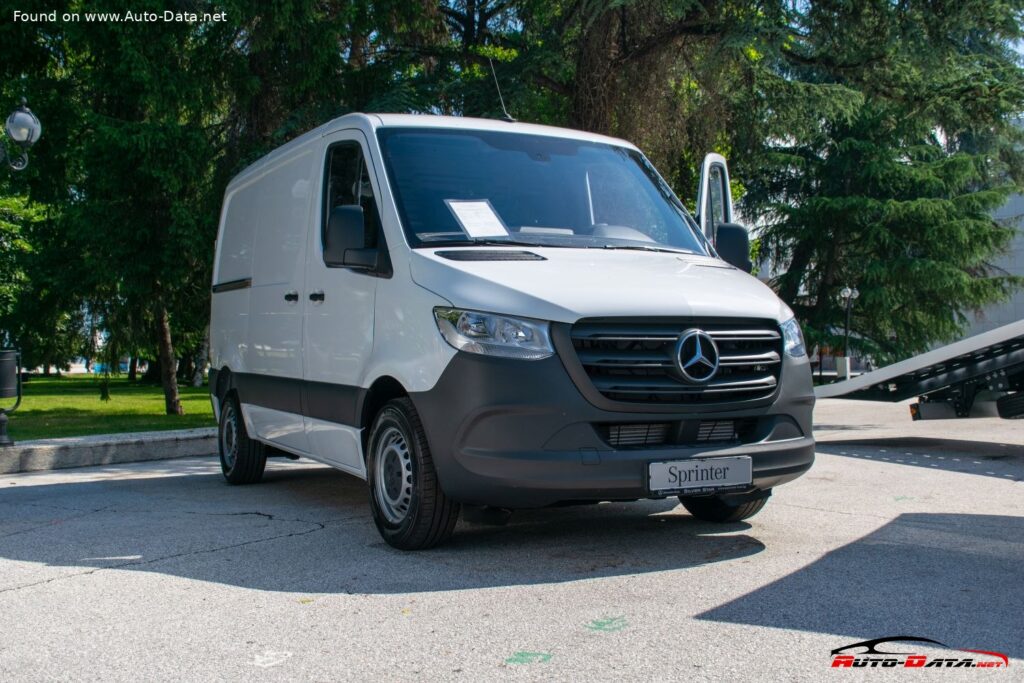
Introduction to the Mercedes-Benz Sprinter Panel Van Compact (W907/W910) 414 CDI (143 Hp) W907
The Mercedes-Benz Sprinter has long been a benchmark in the commercial van segment, renowned for its versatility, durability, and advanced engineering. The specific model under review, the Mercedes-Benz Sprinter Panel Van Compact (W907/W910) 414 CDI (143 Hp) W907, represents a crucial iteration of this iconic vehicle, introduced in 2018. As part of the W907/W910 generation, this Sprinter variant continues to uphold the brand’s reputation for innovation in the light commercial vehicle (LCV) market. While the Sprinter is a global product, its presence in the United States has been significant, offering businesses a premium, highly capable solution for their logistical and transportation needs. This particular configuration, a panel van in a “compact” size, is designed to strike an optimal balance between maneuverability in urban environments and substantial cargo capacity, making it an ideal choice for a wide array of commercial applications, from last-mile delivery services to specialized trade operations.
The W907/W910 generation, which began production in 2018, brought with it a host of technological advancements, improved ergonomics, and enhanced efficiency, solidifying the Sprinter’s position as a leader. The “414 CDI” designation indicates a specific gross vehicle weight class and engine output, with the “143 Hp” signifying its horsepower rating. The “W907” refers to the chassis code for this generation, which is often paired with W910 depending on the specific variant and market. This model, powered by an internal combustion diesel engine, is engineered to deliver reliable performance and impressive fuel economy, critical factors for any commercial enterprise looking to optimize operating costs.
The Mercedes-Benz Sprinter Panel Van Compact (W907/W910): A Modern Commercial Standard
Since its inception, the Mercedes-Benz Sprinter has consistently set standards in the commercial van sector, and the W907/W910 generation, launched in 2018, is no exception. This latest iteration of the Sprinter builds upon a legacy of robust design and advanced engineering, adapting to the evolving demands of modern businesses. The “Panel Van Compact” designation highlights its strategic positioning in the market: a vehicle that offers the renowned Sprinter capability in a more manageable footprint, perfect for navigating congested city streets while still providing ample space for goods and equipment. Its global availability underscores its adaptability to diverse market requirements, with specific configurations tailored for regions like Europe, Asia, and North America.
In the American market, the Sprinter has garnered a strong following among various industries, including parcel delivery, construction, mobile workshops, and even as a platform for recreational vehicle conversions. The W907/W910 generation introduced significant upgrades in connectivity, driver assistance systems, and powertrain options, further enhancing its appeal. The focus on efficiency and reduced emissions, exemplified by the 414 CDI model, aligns with global trends towards more sustainable commercial operations. This Sprinter is not merely a cargo hauler; it’s a sophisticated mobile workspace designed to support the productivity and safety of its operators.
Engine & Performance
At the heart of the Mercedes-Benz Sprinter Panel Van Compact (W907/W910) 414 CDI (143 Hp) W907 lies a highly efficient and robust powertrain designed for demanding commercial use. This model is equipped with the OM 651 engine, a 2.1-liter (2143 cm³) inline 4-cylinder diesel unit. This engine configuration is celebrated for its balance of power, torque, and fuel economy, making it a workhorse for various applications. With four valves per cylinder and a sophisticated Diesel Commonrail fuel injection system, the engine ensures precise fuel delivery and optimal combustion.
Performance figures for the 414 CDI are impressive for a commercial vehicle of its size. It generates a healthy 143 horsepower (Hp) at 3800 rpm, providing ample power for accelerating and maintaining speed, even when fully loaded. More critically for a commercial van, the torque output is substantial: 243.4 lb.-ft. (330 Nm), available across a broad and usable range from 1200 to 2400 rpm. This wide torque band is crucial for effortless starts, strong pulling power, and minimizing the need for frequent gear changes, especially when navigating inclines or merging onto highways. The engine benefits from a turbocharger and intercooler, which not only boost power but also enhance efficiency and responsiveness.
Fuel efficiency is a paramount concern for fleet operators, and the Sprinter 414 CDI delivers commendable figures. According to NEDC (New European Driving Cycle) standards, its combined fuel consumption ranges from 8.2-8.6 liters per 100 km, which translates to an estimated 28.7 – 27.4 US miles per gallon. Urban consumption is rated at 9.4-10.3 l/100 km (25 – 22.8 US mpg), while extra-urban driving yields 7.5-7.6 l/100 km (31.4 – 30.9 US mpg). These figures underscore the Sprinter’s commitment to reducing operating costs. Furthermore, the engine adheres to the stringent Euro VI emission standard, featuring a particulate filter and an AdBlue tank (22 liters or 5.81 US gallons) to significantly reduce harmful emissions, making it an environmentally conscious choice for modern businesses.
Power is transmitted to the rear wheels via a durable 6-speed manual transmission. This rear-wheel-drive architecture is a traditional choice for commercial vans, offering superior traction under heavy loads and better weight distribution for towing. The robust drivetrain ensures reliability and longevity, essential attributes for a vehicle designed for continuous commercial operation. The weight-to-power ratio stands at 15.6 kg/Hp (64.3 Hp/tonne), and the weight-to-torque ratio is 6.7 kg/Nm (148.3 Nm/tonne), indicating a well-matched powertrain for its intended purpose.
Design & Features
The Mercedes-Benz Sprinter Panel Van Compact (W907/W910) is designed first and foremost for utility, but without sacrificing the brand’s characteristic attention to detail and quality. As a panel van, its primary function is to transport goods, and its design reflects this with a robust and functional aesthetic. The body type is a classic van configuration with 5 doors, providing easy access to the cargo area, and typically configured with 3 seats in the cabin for driver and passengers.
Despite being labeled “Compact,” the Sprinter maintains substantial dimensions that contribute to its impressive cargo capacity. It measures 207.36 inches (5267 mm) in length, 79.53 inches (2020 mm) in width (92.32 inches or 2345 mm including mirrors), and 92.76 inches (2356 mm) in height. The wheelbase of 127.95 inches (3250 mm) contributes to a stable ride, while the minimum turning circle of 39.7 feet (12.1 m) ensures remarkable maneuverability for a vehicle of its size, a critical advantage in urban settings. The front track is 69.25 inches (1759 mm) and the rear track is 69.69 inches (1770 mm), providing a solid stance on the road.
The cargo bay is a key highlight, offering a maximum trunk (boot) space of an enormous 264.86 cubic feet (7500 liters). This vast volume allows for the transport of a wide variety of goods, equipment, and tools, making it highly adaptable to different business needs. The vehicle’s kerb weight is 4905.29 lbs. (2225 kg), but its maximum permitted weight is 9038.95 lbs. (4100 kg), allowing for a substantial maximum payload of 4133.67 lbs. (1875 kg). This payload capacity is a testament to the Sprinter’s heavy-duty construction and engineering, making it suitable for even the most demanding loads.
Practical features extend beyond just cargo space. The Sprinter has a maximum roof load capacity of 661.39 lbs. (300 kg), enabling the transport of ladders, pipes, or other oversized items. It also boasts impressive towing capabilities, with a permitted trailer load with brakes (12%) of 4409.25 lbs. (2000 kg) and without brakes of 1653.47 lbs. (750 kg), further enhancing its utility for businesses that need to haul additional equipment or trailers.
For ride comfort and durability, the Sprinter features a robust suspension system. The front suspension utilizes leaf springs, while the rear suspension combines leaf springs with hydraulic elements, designed to handle heavy loads and provide a stable ride even on uneven surfaces. Braking performance is ensured by disc brakes on both the front and rear axles, complemented by an Anti-lock Braking System (ABS) for enhanced safety and control during emergency braking maneuvers. The vehicle rides on 225/65 R16 tires mounted on 6.5J x 16 wheel rims, providing a good balance of load capacity and road contact.
The fuel tank capacity is 18.76 US gallons (71 liters), offering a decent range between refueling stops, which is beneficial for long-distance deliveries or routes in remote areas. The inclusion of an AdBlue tank underscores its compliance with modern emission standards, a feature that is increasingly important for fleet operators concerned with environmental impact and regulatory adherence.
Technical Specifications
The following table provides a comprehensive overview of the technical specifications for the Mercedes-Benz Sprinter Panel Van Compact (W907/W910) 414 CDI (143 Hp) W907:
| Category | Specification | Metric Value | US/Imperial Value |
|---|---|---|---|
| Brand | Mercedes-Benz | ||
| Model | Sprinter | ||
| Generation | Sprinter Panel Van Compact (W907/W910) | ||
| Type (Engine) | 414 CDI (143 Hp) W907 | ||
| Start of production | 2018 year | ||
| Powertrain Architecture | Internal Combustion engine | ||
| Body type | Van | ||
| Seats | 3 | ||
| Doors | 5 | ||
| Performance Specs | |||
| Fuel consumption (economy) – urban (NEDC) | 9.4-10.3 l/100 km | 25 – 22.8 US mpg | |
| Fuel consumption (economy) – extra urban (NEDC) | 7.5-7.6 l/100 km | 31.4 – 30.9 US mpg | |
| Fuel consumption (economy) – combined (NEDC) | 8.2-8.6 l/100 km | 28.7 – 27.4 US mpg | |
| CO2 emissions (NEDC) | 215-226 g/km | ||
| Fuel Type | Diesel | ||
| Emission standard | Euro VI | ||
| Weight-to-power ratio | 15.6 kg/Hp | 64.3 Hp/tonne | |
| Weight-to-torque ratio | 6.7 kg/Nm | 148.3 Nm/tonne | |
| Engine Specs | |||
| Power | 143 Hp @ 3800 rpm | ||
| Power per liter | 66.7 Hp/l | ||
| Torque | 330 Nm @ 1200-2400 rpm | 243.4 lb.-ft. @ 1200-2400 rpm | |
| Engine layout | Front, Transverse | ||
| Engine Model/Code | OM 651 | ||
| Engine displacement | 2143 cm3 | 130.77 cu. in. | |
| Number of cylinders | 4 | ||
| Engine configuration | Inline | ||
| Number of valves per cylinder | 4 | ||
| Fuel injection system | Diesel Commonrail | ||
| Engine aspiration | Turbocharger, Intercooler | ||
| Engine oil capacity | 11.5 l | 12.15 US qt | |
| Coolant | 9.5 l | 10.04 US qt | |
| Engine systems | Particulate filter | ||
| Space, Volume and Weights | |||
| Kerb Weight | 2225 kg | 4905.29 lbs. | |
| Max. weight | 4100 kg | 9038.95 lbs. | |
| Max load | 1875 kg | 4133.67 lbs. | |
| Trunk (boot) space – maximum | 7500 l | 264.86 cu. ft. | |
| Fuel tank capacity | 71 l | 18.76 US gal | |
| AdBlue tank | 22 l | 5.81 US gal | |
| Max. roof load | 300 kg | 661.39 lbs. | |
| Permitted trailer load with brakes (12%) | 2000 kg | 4409.25 lbs. | |
| Permitted trailer load without brakes | 750 kg | 1653.47 lbs. | |
| Dimensions | |||
| Length | 5267 mm | 207.36 in. | |
| Width | 2020 mm | 79.53 in. | |
| Width including mirrors | 2345 mm | 92.32 in. | |
| Height | 2356 mm | 92.76 in. | |
| Wheelbase | 3250 mm | 127.95 in. | |
| Front track | 1759 mm | 69.25 in. | |
| Rear track | 1770 mm | 69.69 in. | |
| Front overhang | 1021 mm | 40.2 in. | |
| Rear overhang | 996 mm | 39.21 in. | |
| Ground clearance | 143 mm | 5.63 in. | |
| Minimum turning circle (turning diameter) | 12.1 m | 39.7 ft. | |
| Drivetrain, Brakes and Suspension Specs | |||
| Drivetrain Architecture | The Internal combustion engine (ICE) drives the rear wheels of the vehicle. | ||
| Drive wheel | Rear wheel drive | ||
| Number of gears and type of gearbox | 6 gears, manual transmission | ||
| Front suspension | Leaf spring | ||
| Rear suspension | Hydraulic elements, Leaf spring | ||
| Front brakes | Disc | ||
| Rear brakes | Disc | ||
| Assisting systems | ABS (Anti-lock braking system) | ||
| Tires size | 225/65 R16 | ||
| Wheel rims size | 6.5J x 16 | ||
Legacy & Market Impact
The Mercedes-Benz Sprinter has cultivated an unparalleled legacy in the commercial vehicle market, and the W907/W910 generation, including the 414 CDI Panel Van Compact, continues to solidify this standing. Its reputation for reliability, versatility, and efficiency makes it a top choice for businesses worldwide. In the highly competitive US market, the Sprinter faces strong contenders such as the Ford Transit, Ram ProMaster, and Nissan NV. However, the Sprinter consistently differentiates itself through a combination of factors that appeal to a discerning commercial clientele.
One of the Sprinter’s enduring strengths is its premium engineering and build quality. While competitors offer compelling packages, Mercedes-Benz imbues the Sprinter with a level of refinement, advanced technology, and driver-focused ergonomics that often set it apart. The 414 CDI’s efficient diesel powertrain, for instance, provides a compelling argument for fleet operators seeking lower fuel costs and extended service intervals, especially when compared to gasoline-only offerings from some rivals. The robust OM 651 engine and its Euro VI compliance also mean a forward-looking approach to environmental regulations, which can be a significant advantage for companies with sustainability goals.
The Sprinter’s impact is also seen in its adaptability. Its robust chassis and spacious cargo area make it a popular platform for a
