
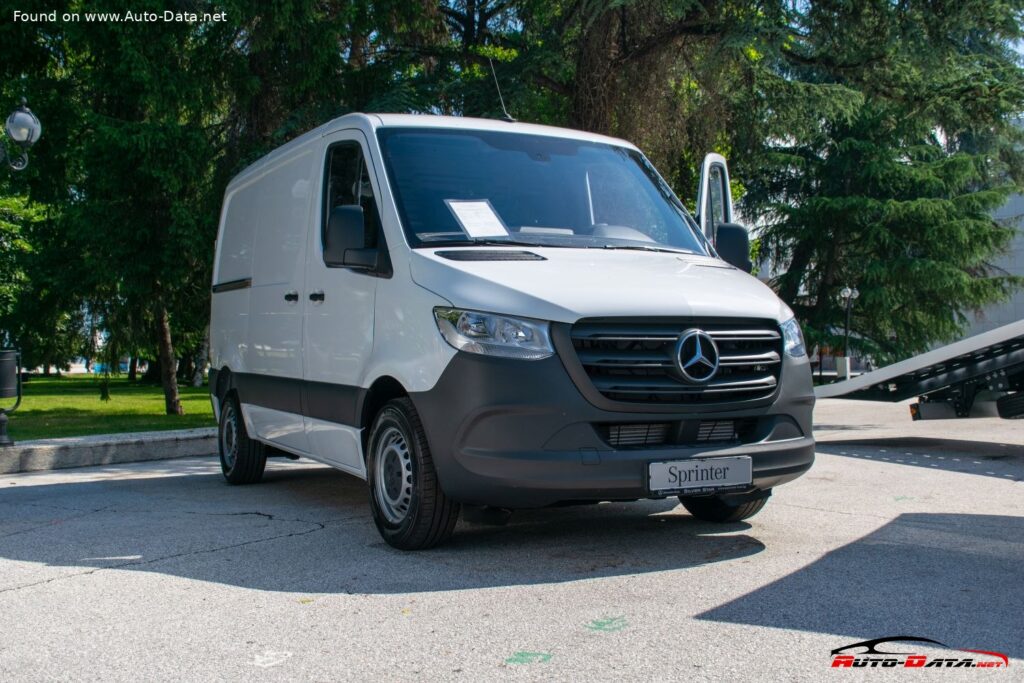
The Mercedes-Benz Sprinter has long been a benchmark in the commercial van segment, renowned for its versatility, durability, and advanced engineering. The specific variant under review, the Mercedes-Benz Sprinter Panel Van Compact (W907/W910) 414 CDI (143 Hp) W910, represents the third generation of this iconic vehicle, introduced in 2018. Designed primarily for urban delivery, trades, and various business applications, this compact panel van configuration offers a compelling balance of maneuverability, cargo capacity, and fuel efficiency. While the Sprinter is a global product, its robust design and comprehensive feature set have made it a favorite across North America, Europe, and other key markets, adapting its configurations to suit regional demands. This particular model, with its 143 horsepower diesel engine, is engineered to provide reliable performance and economical operation for businesses requiring a capable and sophisticated work vehicle.
The Mercedes-Benz Sprinter Panel Van Compact (W907/W910): Engineering for Efficiency
The W907/W910 generation of the Mercedes-Benz Sprinter marked a significant evolution in the van’s design and technological offerings. While retaining the core principles of robustness and practicality, this iteration introduced enhanced connectivity, advanced driver-assistance systems, and refined powertrains designed to meet stringent emission standards like Euro 6. The “Compact” designation refers to its shorter wheelbase and overall length within the Sprinter family, making it particularly adept at navigating congested city streets and tight delivery zones, a crucial advantage for urban logistics and service providers. This focus on operational efficiency and driver comfort underscores Mercedes-Benz’s commitment to delivering a premium experience even in a utilitarian vehicle segment.
Engine & Performance
At the heart of the Mercedes-Benz Sprinter Panel Van Compact (W907/W910) 414 CDI (143 Hp) W910 lies a sophisticated 2.1-liter (2143 cm³ or 130.77 cu. in.) inline-four diesel engine, designated OM 651. This powerplant is positioned transversely at the front, driving the front wheels, a configuration that optimizes interior space and contributes to better fuel economy. The engine produces a respectable 143 horsepower at 3800 rpm, which, combined with a robust 330 Nm (243.4 lb.-ft.) of torque available across a broad range from 1200 to 2400 rpm, provides ample pulling power for urban and highway driving, even when fully loaded. The torque delivery at low RPMs is particularly beneficial for commercial applications, ensuring strong acceleration from a standstill and reducing the need for frequent gear changes.
Fuel delivery is managed by a Diesel Commonrail injection system, complemented by a turbocharger and intercooler, which together optimize combustion efficiency and power output while minimizing emissions. The engine is designed to meet Euro 6 emission standards, a testament to its clean operation. Fuel economy figures are impressive for a vehicle of its size and capability: a combined NEDC rating of 7.8-7.9 liters per 100 km (30.2-29.8 US mpg) highlights its cost-effectiveness. The vehicle’s weight-to-power ratio stands at 13.6 kg/Hp (73.3 Hp/tonne), while the weight-to-torque ratio is 5.9 kg/Nm (169.2 Nm/tonne), indicating a well-engineered balance for hauling and performance. A 6-speed manual transmission ensures precise control over the power delivery, allowing drivers to maximize efficiency or performance as needed. Furthermore, the inclusion of a particulate filter is standard, further contributing to its environmental compliance.
Design & Features
The Mercedes-Benz Sprinter Panel Van Compact (W907/W910) is a purpose-built van, featuring a pragmatic yet modern design. Its body type is a classic panel van, providing a secure and expansive cargo area. With five doors—typically two front doors, two side sliding doors, and a rear barn door configuration—and seating for three occupants, it prioritizes functionality and accessibility for both driver and cargo. The exterior dimensions, with a length of 207.36 inches, a width of 79.53 inches (92.32 inches including mirrors), and a height of 92.76 inches, are optimized for its compact designation, allowing for easier navigation and parking in tight urban environments compared to its larger siblings.
Inside, the focus is on a driver-centric cockpit and a highly adaptable cargo space. The maximum trunk (boot) space of 7800 liters (275.45 cu. ft.) is substantial for a compact van, making it suitable for a wide array of goods and equipment. With a maximum payload capacity of 2150 kg (4739.94 lbs.) and a robust kerb weight of 1950 kg (4299.01 lbs.), the Sprinter 414 CDI is engineered to handle significant loads. Practical features include a 65-liter (17.17 US gal) fuel tank and a 22-liter (5.81 US gal) AdBlue tank, ensuring decent range and compliance with diesel exhaust fluid requirements. Safety features are paramount for commercial vehicles, and this Sprinter comes equipped with ABS (Anti-lock Braking System) as standard, enhancing braking control. The suspension system, featuring leaf springs at the front and a combination of hydraulic elements and leaf springs at the rear, is designed for durability and stability under load. Disc brakes are fitted on both the front and rear axles, providing strong stopping power. The vehicle rides on 225/65 R16 tires paired with 6.5J x 16 wheel rims, a common and robust setup for commercial use.
Technical Specifications for the Mercedes-Benz Sprinter Panel Van Compact (W907/W910) 414 CDI (143 Hp) W910
| Category | Specification | US Equivalent |
|---|---|---|
| General Information | ||
| Brand | Mercedes-Benz | |
| Model | Sprinter | |
| Generation | Sprinter Panel Van Compact (W907/W910) | |
| Type (Engine) | 414 CDI (143 Hp) W910 | |
| Start of Production | 2018 year | |
| Powertrain Architecture | Internal Combustion engine | |
| Body Type | Van | |
| Seats | 3 | |
| Doors | 5 | |
| Performance Specs | ||
| Fuel Consumption (Urban, NEDC) | 9.2-9.4 l/100 km | 25.6 – 25 US mpg |
| Fuel Consumption (Extra Urban, NEDC) | 7.2-7.3 l/100 km | 32.7 – 32.2 US mpg |
| Fuel Consumption (Combined, NEDC) | 7.8-7.9 l/100 km | 30.2 – 29.8 US mpg |
| CO2 Emissions (NEDC) | 205-208 g/km | |
| Fuel Type | Diesel | |
| Emission Standard | Euro 6 | |
| Weight-to-Power Ratio | 13.6 kg/Hp, 73.3 Hp/tonne | |
| Weight-to-Torque Ratio | 5.9 kg/Nm, 169.2 Nm/tonne | |
| Engine Specs | ||
| Power | 143 Hp @ 3800 rpm | |
| Power per Liter | 66.7 Hp/l | |
| Torque | 330 Nm @ 1200-2400 rpm | 243.4 lb.-ft. @ 1200-2400 rpm |
| Engine Layout | Front, Transverse | |
| Engine Model/Code | OM 651 | |
| Engine Displacement | 2143 cm³ | 130.77 cu. in. |
| Number of Cylinders | 4 | |
| Engine Configuration | Inline | |
| Number of Valves per Cylinder | 4 | |
| Fuel Injection System | Diesel Commonrail | |
| Engine Aspiration | Turbocharger, Intercooler | |
| Engine Oil Capacity | 11.5 l | 12.15 US qt |
| Coolant Capacity | 9.5 l | 10.04 US qt |
| Engine Systems | Particulate filter | |
| Space, Volume and Weights | ||
| Kerb Weight | 1950 kg | 4299.01 lbs. |
| Max. Weight (GVWR) | 4100 kg | 9038.95 lbs. |
| Max Load (Payload) | 2150 kg | 4739.94 lbs. |
| Trunk (Boot) Space – Maximum | 7800 l | 275.45 cu. ft. |
| Fuel Tank Capacity | 65 l | 17.17 US gal |
| AdBlue Tank | 22 l | 5.81 US gal |
| Max. Roof Load | 300 kg | 661.39 lbs. |
| Permitted Trailer Load with Brakes (12%) | 2000 kg | 4409.25 lbs. |
| Permitted Trailer Load without Brakes | 750 kg | 1653.47 lbs. |
| Dimensions | ||
| Length | 5267 mm | 207.36 in. |
| Width | 2020 mm | 79.53 in. |
| Width Including Mirrors | 2345 mm | 92.32 in. |
| Height | 2356 mm | 92.76 in. |
| Wheelbase | 3259 mm | 128.31 in. |
| Front Track | 1759 mm | 69.25 in. |
| Rear (Back) Track | 1770 mm | 69.69 in. |
| Front Overhang | 1012 mm | 39.84 in. |
| Rear Overhang | 996 mm | 39.21 in. |
| Ride Height (Ground Clearance) | 143 mm | 5.63 in. |
| Minimum Turning Circle (Diameter) | 13 m | 42.65 ft. |
| Drivetrain, Brakes and Suspension Specs | ||
| Drivetrain Architecture | The Internal combustion engine (ICE) drives the front wheels of the vehicle. | |
| Drive Wheel | Front wheel drive | |
| Number of Gears and Type of Gearbox | 6 gears, manual transmission | |
| Front Suspension | Leaf spring | |
| Rear Suspension | Hydraulic elements, Leaf spring | |
| Front Brakes | Disc | |
| Rear Brakes | Disc | |
| Assisting Systems | ABS (Anti-lock braking system) | |
| Tires Size | 225/65 R16 | |
| Wheel Rims Size | 6.5J x 16 | |
Legacy & Market Impact
The Mercedes-Benz Sprinter has established itself as a formidable player in the global commercial vehicle market, consistently setting benchmarks for innovation, safety, and operational efficiency. The W907/W910 generation, particularly the Sprinter Panel Van Compact (W907/W910) 414 CDI (143 Hp) W910, continues this legacy by offering a highly competitive package for businesses. Its reputation for robust build quality and long-term reliability makes it a preferred choice for fleet operators and independent contractors alike. In the North American market, the Sprinter competes fiercely with rivals such as the Ford Transit and the Ram ProMaster, while in Europe, it faces competition from vehicles like the Volkswagen Crafter and the Fiat Ducato. What often distinguishes the Sprinter is its premium feel, advanced technology suite (even in basic configurations), and the extensive Mercedes-Benz service network, which provides peace of mind for commercial users where vehicle uptime is critical.
The 414 CDI variant, with its 143 Hp diesel engine, strikes an excellent balance between power for hauling and fuel economy, making it a cost-effective solution for many applications. Its compact dimensions ensure it remains highly practical for urban deliveries and trades requiring access to confined spaces, without significantly compromising on crucial cargo volume. The Sprinter’s enduring appeal lies in its adaptability; it serves roles ranging from parcel delivery and mobile workshops to passenger transport (in different configurations) and recreational vehicles. This particular panel van configuration solidifies its position as a go-to vehicle for businesses seeking a dependable, efficient, and technologically advanced workhorse that upholds the Mercedes-Benz brand’s reputation for engineering excellence and quality. Its impact on the market continues to be significant, influencing design trends and technological advancements within the light commercial vehicle segment globally.
