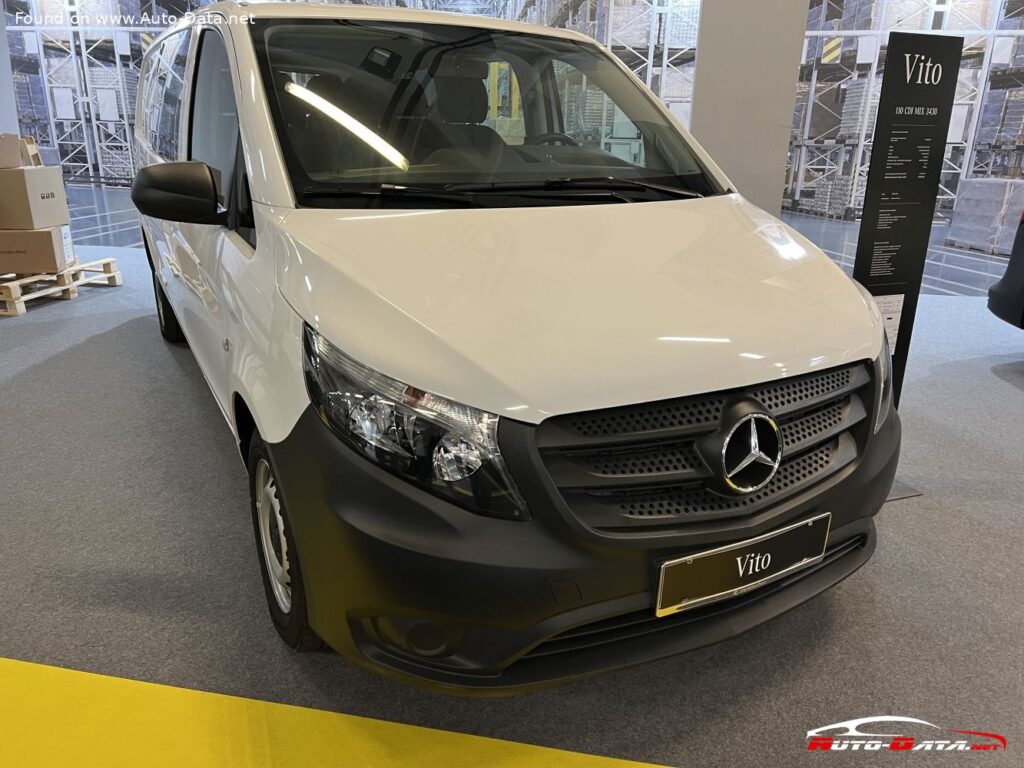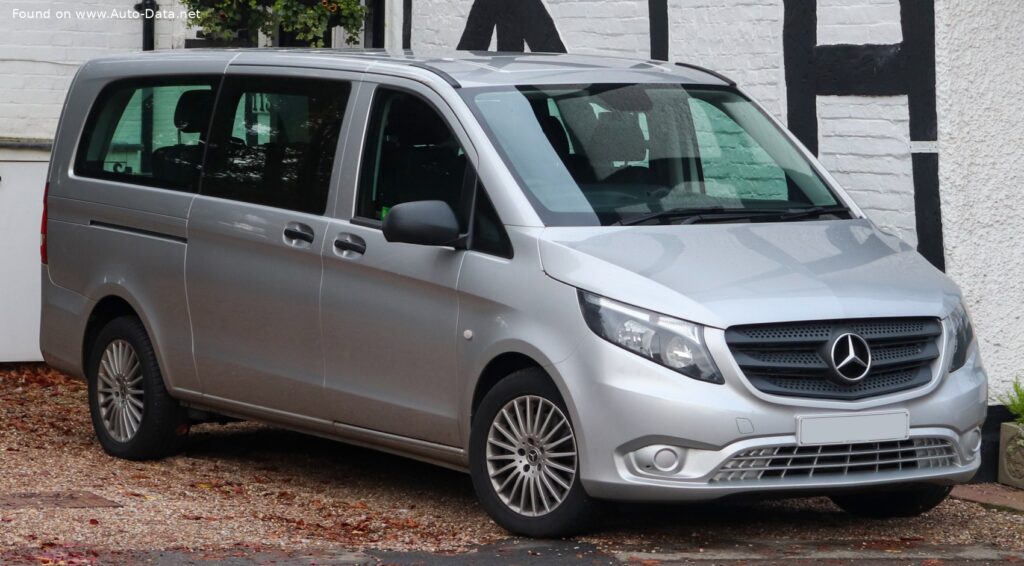
The Mercedes-Benz Vito (W447) Tourer Extra Long 116 CDI (163 Hp) represents a significant offering in the European and international light commercial vehicle (LCV) and multi-purpose vehicle (MPV) segments. This particular iteration, part of the W447 generation produced from October 2014 to February 2019, was engineered to combine the renowned Mercedes-Benz hallmarks of quality and durability with exceptional passenger carrying capacity and cargo versatility. As a Tourer Extra Long variant, it was specifically designed to accommodate up to nine occupants comfortably, making it an ideal choice for shuttle services, large families, and businesses requiring robust and efficient people transport solutions. Its diesel powertrain, designated 116 CDI, provided a balance of performance and fuel economy, adhering to stringent European emission standards while delivering reliable operation across diverse applications.
Engine & Performance: The Mercedes-Benz Vito (W447) Tourer Extra Long Powerplant
At the heart of the Mercedes-Benz Vito (W447) Tourer Extra Long 116 CDI lies the highly regarded OM651 DE22LA engine, an inline 4-cylinder diesel unit known for its efficiency and robust performance. This 2.1-liter (2143 cm³ or 130.77 cu. in.) powerplant delivered a commendable 163 horsepower at 3800 rpm, providing ample thrust for both urban commuting and highway cruising, even when fully laden. A critical aspect of its performance profile was the impressive torque output of 380 Nm (280.27 lb.-ft.), which was available across a broad and usable rev range from 1400 to 2400 rpm. This wide torque band ensured excellent pulling power, crucial for a vehicle designed to carry numerous passengers or substantial cargo.
The engine’s sophisticated design included a turbocharger with an intercooler, enhancing air intake and combustion efficiency, while the common rail direct fuel injection system precisely managed fuel delivery for optimal power and economy. Adhering to the Euro 6c emission standard, this model also featured a particulate filter, underscoring Mercedes-Benz’s commitment to environmental responsibility. Power was transmitted to the rear wheels via a durable 6-speed manual transmission, a configuration chosen for its reliability and direct feel, particularly important in commercial applications. This rear-wheel-drive architecture also contributed to stable handling, especially when the vehicle was under load. The Vito 116 CDI demonstrated respectable fuel economy for its class, achieving a combined rating of 35.6 US mpg (6.6 l/100 km) and CO2 emissions of 176 g/km, making it an economically viable option for operators.
With a weight-to-power ratio of 11.9 kg/Hp (83.8 Hp/tonne) and a weight-to-torque ratio of 5.1 kg/Nm (195.4 Nm/tonne), the Vito 116 CDI was well-balanced, offering responsive acceleration and strong pulling capabilities relative to its substantial kerb weight, which ranged from 4287.99 to 4347.52 lbs. (1945-1972 kg). This combination of power, efficiency, and thoughtful engineering ensured that the Vito Tourer Extra Long was not only capable but also a pleasure to operate in a variety of challenging conditions.
Design & Features: Versatility and Practicality
The design philosophy behind the Mercedes-Benz Vito (W447) Tourer Extra Long was centered on maximizing utility, comfort, and safety within its van body type. With 4 or 5 doors and an impressive seating capacity for up to 9 occupants, this vehicle was engineered to be a highly adaptable people mover. Its “Extra Long” designation translated into generous dimensions, measuring 211.42 inches (5370 mm) in length, 75.91 inches (1928 mm) in width, and a height ranging from 74.41 to 75.2 inches (1890-1910 mm). The substantial 135.04-inch (3430 mm) wheelbase contributed significantly to ride stability and interior spaciousness.
Inside, the focus on passenger comfort and practicality was evident. The flexible seating arrangements allowed for various configurations, making it suitable for diverse operational needs. Even with all nine seats in place, the Vito retained a respectable minimum trunk space of 1390 liters (49.09 cu. ft.), proving its capability to handle luggage or cargo alongside passengers. For commercial users, the vehicle boasted a maximum payload capacity ranging from 2707.28 to 2766.8 lbs. (1228-1255 kg) and a maximum permissible gross weight of 7054.79 lbs. (3200 kg). Furthermore, its towing capabilities were robust, allowing for a permitted trailer load with brakes of up to 4409.25 lbs. (2000 kg) and 1653.47 lbs. (750 kg) without brakes, further enhancing its utility.
Safety and handling were paramount, with the Vito featuring an independent McPherson front suspension system complemented by coil springs and an anti-roll bar, ensuring a comfortable ride and predictable handling characteristics, even when fully loaded. The braking system comprised reliable disc brakes on both the front and rear axles, augmented by an Anti-lock Braking System (ABS) to enhance control during emergency stops. The vehicle rode on 195/65 R16C 100 T or 205/65 R16C 101H tires fitted to 6.5J x 16 wheel rims, providing a solid foundation for its load-carrying duties. Despite its considerable length, the Vito Tourer Extra Long maintained a respectable minimum turning circle of 44.95 feet (13.7 meters), aiding maneuverability in urban environments. Practical features such as a 15.06 US gallon (57 liter) fuel tank and a 3.04 US gallon (11.5 liter) AdBlue tank ensured extended operational range and compliance with modern emission standards, solidifying its position as a highly functional and dependable vehicle.
Technical Specifications
Below is a comprehensive table detailing the technical specifications of the Mercedes-Benz Vito (W447) Tourer Extra Long 116 CDI (163 Hp).
| Feature | Detail |
|---|---|
| Brand | Mercedes-Benz |
| Model | Vito |
| Generation | Vito (W447) Tourer Extra Long |
| Type (Engine) | 116 CDI (163 Hp) |
| Start of production | October, 2014 |
| End of production | February, 2019 |
| Powertrain Architecture | Internal Combustion engine |
| Body type | Van |
| Seats | 9 |
| Doors | 4/5 |
| Fuel consumption (economy) – urban | 7.4 l/100 km (31.8 US mpg) |
| Fuel consumption (economy) – extra urban | 6.2 l/100 km (37.9 US mpg) |
| Fuel consumption (economy) – combined | 6.6 l/100 km (35.6 US mpg) |
| CO2 emissions | 176 g/km |
| Fuel Type | Diesel |
| Emission standard | Euro 6c |
| Weight-to-power ratio | 11.9 kg/Hp (83.8 Hp/tonne) |
| Weight-to-torque ratio | 5.1 kg/Nm (195.4 Nm/tonne) |
| Power | 163 Hp @ 3800 rpm |
| Power per litre | 76.1 Hp/l |
| Torque | 380 Nm @ 1400-2400 rpm (280.27 lb.-ft.) |
| Engine layout | Front, Longitudinal |
| Engine Model/Code | OM651 DE22LA |
| Engine displacement | 2143 cm³ (130.77 cu. in.) |
| Number of cylinders | 4 |
| Engine configuration | Inline |
| Cylinder Bore | 83 mm (3.27 in.) |
| Piston Stroke | 99 mm (3.9 in.) |
| Compression ratio | 16.2:1 |
| Number of valves per cylinder | 4 |
| Fuel injection system | Diesel Commonrail |
| Engine aspiration | Turbocharger, Intercooler |
| Engine oil capacity | 10.5 l (11.1 US qt) |
| Coolant | 10.4 l (10.99 US qt) |
| Engine systems | Particulate filter |
| Kerb Weight | 1945-1972 kg (4287.99 – 4347.52 lbs.) |
| Max. weight | 3200 kg (7054.79 lbs.) |
| Max load | 1228-1255 kg (2707.28 – 2766.8 lbs.) |
| Trunk (boot) space – minimum | 1390 l (49.09 cu. ft.) |
| Fuel tank capacity | 57 l (15.06 US gal) |
| AdBlue tank | 11.5 l (3.04 US gal) |
| Max. roof load | 150 kg (330.69 lbs.) |
| Permitted trailer load with brakes (12%) | 2000 kg (4409.25 lbs.) |
| Permitted trailer load without brakes | 750 kg (1653.47 lbs.) |
| Length | 5370 mm (211.42 in.) |
| Width | 1928 mm (75.91 in.) |
| Height | 1890-1910 mm (74.41 – 75.2 in.) |
| Wheelbase | 3430 mm (135.04 in.) |
| Minimum turning circle (turning diameter) | 13.7 m (44.95 ft.) |
| Drivetrain Architecture | Internal combustion engine (ICE) drives the rear wheels |
| Drive wheel | Rear wheel drive |
| Number of gears and type of gearbox | 6 gears, manual transmission |
| Front suspension | Independent, type McPherson with coil spring and anti-roll bar |
| Front brakes | Disc |
| Rear brakes | Disc |
| Assisting systems | ABS (Anti-lock braking system) |
| Tires size | 195/65 R16C 100 T; 205/65 R16C 101H |
| Wheel rims size | 6.5J x 16 |