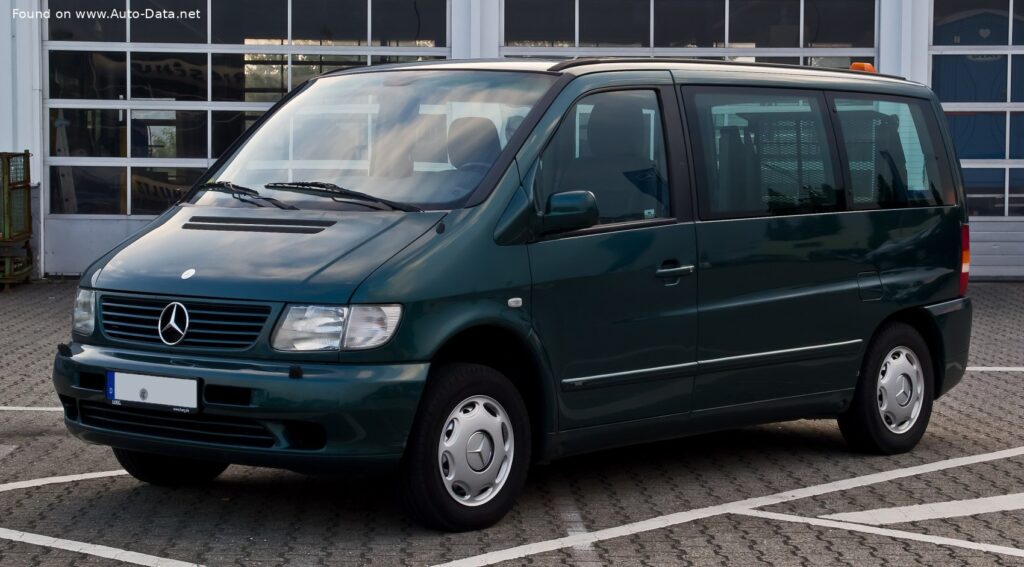
The Mercedes-Benz Vito (W638) V 230 (143 Hp) Manual 4-speed represents a pivotal moment in the evolution of light commercial vehicles from the esteemed German manufacturer. Launched in 1996, this generation, internally designated W638, marked a significant departure for Mercedes-Benz’s van offerings, introducing a front-wheel-drive architecture aimed at maximizing interior space and versatility. Primarily targeting the European market, where it quickly established itself as a popular choice for both commercial enterprises and private individuals seeking a spacious multi-purpose vehicle, the Vito (W638) offered a compelling blend of practicality, robust engineering, and the brand’s renowned quality. The V 230 variant, with its potent gasoline engine and manual transmission, was positioned as a capable workhorse, adaptable for a range of uses from cargo transport to a comfortable seven-seat passenger shuttle.
Overview of the Mercedes-Benz Vito (W638) V 230 (143 Hp) Manual 4-speed
The Mercedes-Benz Vito (W638) was a groundbreaking model for the company, signifying a strategic shift in its approach to the compact and mid-size van segment. Produced from 1996 to 1999, the V 230 (143 Hp) Manual 4-speed model was a key player within this generation. Unlike its predecessor, the MB100, which was a rear-wheel-drive model, the W638 adopted a transverse engine layout and front-wheel drive. This engineering decision provided a lower load floor, enhancing accessibility for cargo and passengers, and optimizing the interior volume – a critical consideration for vehicles in this class. The van’s design emphasized functionality and durability, characteristics essential for its intended role in demanding commercial environments, while also offering a level of refinement that made it appealing as a family vehicle or executive shuttle.
In its primary European markets, the Vito (W638) quickly gained a reputation for its spacious interior and flexible seating configurations. The V 230, specifically, was appreciated for its gasoline engine, offering a smoother and quieter operation compared to the diesel alternatives often favored for heavy-duty commercial use. This made the V 230 particularly suitable for applications where passenger comfort and reduced noise levels were paramount, such as airport shuttles, taxi services, or private transport. The vehicle’s robust construction and the availability of essential safety features, even in the late 1990s, underscored Mercedes-Benz’s commitment to quality across its entire product range, from luxury sedans to utilitarian vans.
Powertrain and Performance
At the heart of the Mercedes-Benz Vito (W638) V 230 (143 Hp) Manual 4-speed lies a robust 2.3-liter (2295 cm3 or 140.05 cu. in.) inline-four petrol engine, internally designated M 111 E 23 / 111.978. This naturally aspirated unit was a well-regarded powerplant within the Mercedes-Benz lineup, known for its reliability and smooth power delivery. Featuring a Double Overhead Camshaft (DOHC) valvetrain with four valves per cylinder, the engine was designed for efficient combustion and respectable performance for a vehicle of its size and purpose. Fuel delivery was managed by a multi-port manifold injection system, ensuring precise fuel metering and contributing to the engine’s overall efficiency and responsiveness.
The engine generates a peak power output of 143 HP at 5000 rpm, providing ample thrust for urban and highway driving, even when laden with passengers or cargo. Torque is equally impressive for its class, reaching 154.89 lb.-ft. at 4000 rpm. This healthy torque figure is crucial for a commercial vehicle, facilitating strong acceleration from a standstill and confident overtaking maneuvers. The power is transmitted to the front wheels via a durable 4-speed manual transmission. While modern vans typically feature more gears, this 4-speed unit was a common and reliable choice for commercial applications of its era, prioritizing robustness and ease of maintenance over ultimate gear count. The front-wheel-drive architecture, as mentioned, aids in maximizing interior space and improving traction in various conditions.
In terms of outright performance, the Vito (W638) V 230 delivers a respectable showing. It can accelerate from 0 to 60 mph in approximately 12.9 seconds, with a top speed reaching 106.25 mph (171 km/h). These figures are commendable for a vehicle designed primarily for utility and comfort, demonstrating that it was perfectly capable of keeping pace with traffic on European highways. Fuel economy, while not a primary selling point for a gasoline-powered van of this vintage, was reasonable for its time. The combined fuel consumption is rated at 20.1 US mpg (11.7 l/100 km), with urban driving yielding 15.1 US mpg (15.6 l/100 km) and extra-urban driving achieving 24.8 US mpg (9.5 l/100 km). These figures reflect the vehicle’s sturdy build and the demands placed upon a multi-purpose van, balancing performance with operational costs. The engine’s oil capacity is 7.93 US quarts, and the cooling system holds 9.19 US quarts, indicating robust thermal management for sustained operation.
Design, Utility, and Features
The design of the Mercedes-Benz Vito (W638) V 230 (143 Hp) Manual 4-speed is inherently functional, prioritizing interior volume and ease of access. As a van body type, it features five doors, including large sliding side doors for convenient passenger or cargo loading, and typically seating for seven occupants. Its exterior dimensions – a length of 183.43 inches, a width of 74.02 inches, and a height of 72.6 inches – contribute to its substantial road presence while ensuring maneuverability in urban settings. The generous 118.11-inch wheelbase provides a stable ride and contributes significantly to the vehicle’s interior space, allowing for versatile configurations.
The W638 generation was designed with practicality in mind. The front-wheel-drive layout allowed for a flat floor throughout the cabin, which was a significant advantage for both passenger comfort and cargo loading. With a kerb weight of 4409.25 lbs and a maximum permissible weight of 5798.16 lbs, the Vito V 230 could handle a substantial maximum payload of 1388.91 lbs. This impressive load capacity underscored its utility as a commercial vehicle, capable of transporting significant goods or a full complement of passengers with their luggage. The 20.61 US gallon fuel tank capacity further enhanced its practicality, allowing for extended ranges between refueling stops, a crucial factor for commercial operators.
For its era, the Vito (W638) offered a commendable array of features focusing on safety and driving dynamics. The suspension system comprised an independent McPherson type at the front, offering a comfortable ride and precise steering, complemented by a trailing arm setup at the rear, designed to handle heavy loads effectively. Braking performance was assured by ventilated discs at the front and disc brakes at the rear, a capable setup for a vehicle of this size and weight. Crucially, the vehicle was equipped with an Anti-lock Braking System (ABS), a significant safety feature in the late 1990s that helped prevent wheel lock-up during emergency braking, enhancing driver control. Steering was managed by a hydraulic rack and pinion system, providing direct feedback and ease of maneuverability, particularly beneficial in tight urban environments. The vehicle rode on 195/70 R15 tires mounted on 6J x 15 wheel rims, offering a balanced combination of grip and ride comfort suitable for its intended applications.
Technical Specifications
| Brand | Mercedes-Benz |
| Model | Vito |
| Generation | Vito (W638) |
| Type (Engine) | V 230 (143 Hp) Manual 4-speed |
| Start of production | 1996 year |
| End of production | 1999 year |
| Powertrain Architecture | Internal Combustion engine |
| Body type | Van |
| Seats | 7 |
| Doors | 5 |
| Fuel consumption (economy) – urban | 15.6 l/100 km (15.1 US mpg) |
| Fuel consumption (economy) – extra urban | 9.5 l/100 km (24.8 US mpg) |
| Fuel consumption (economy) – combined | 11.7 l/100 km (20.1 US mpg) |
| Fuel Type | Petrol (Gasoline) |
| Acceleration 0 – 60 mph | 12.9 sec |
| Acceleration 0 – 100 km/h | 13.6 sec |
| Maximum speed | 171 km/h (106.25 mph) |
| Weight-to-power ratio | 14 kg/Hp, 71.5 Hp/tonne |
| Weight-to-torque ratio | 9.5 kg/Nm, 105 Nm/tonne |
| Power | 143 Hp @ 5000 rpm |
| Power per litre | 62.3 Hp/l |
| Torque | 210 Nm @ 4000 rpm (154.89 lb.-ft. @ 4000 rpm) |
| Engine layout | Front, Transverse |
| Engine Model/Code | M 111 E 23 / 111.978 |
| Engine displacement | 2295 cm3 (140.05 cu. in.) |
| Number of cylinders | 4 |
| Engine configuration | Inline |
| Cylinder Bore | 90.9 mm (3.58 in.) |
| Piston Stroke | 88.4 mm (3.48 in.) |
| Compression ratio | 8.8:1 |
| Number of valves per cylinder | 4 |
| Fuel injection system | Multi-port manifold injection |
| Engine aspiration | Naturally aspirated engine |
| Valvetrain | DOHC |
| Engine oil capacity | 7.5 l (7.93 US qt) |
| Coolant | 8.7 l (9.19 US qt) |
| Kerb Weight | 2000 kg (4409.25 lbs) |
| Max. weight | 2630 kg (5798.16 lbs) |
| Max load | 630 kg (1388.91 lbs) |
| Fuel tank capacity | 78 l (20.61 US gal) |
| Length | 4659 mm (183.43 in.) |
| Width | 1880 mm (74.02 in.) |
| Height | 1844 mm (72.6 in.) |
| Wheelbase | 3000 mm (118.11 in.) |
| Front track | 1620 mm (63.78 in.) |
| Rear (Back) track | 1630 mm (64.17 in.) |
| Drivetrain Architecture | Front wheel drive (Internal Combustion engine drives front wheels) |
| Drive wheel | Front wheel drive |
| Number of gears and type of gearbox | 4 gears, manual transmission |
| Front suspension | Independent type McPherson |
| Rear suspension | Trailing arm |
| Front brakes | Ventilated discs |
| Rear brakes | Disc |
| Assisting systems | ABS (Anti-lock braking system) |
| Steering type | Steering rack and pinion |
| Power steering | Hydraulic Steering |
| Tires size | Front: 195/70 R15, Rear: 195/70 R15 |
| Wheel rims size | Front: 6J x 15, Rear: 6J x 15 |