
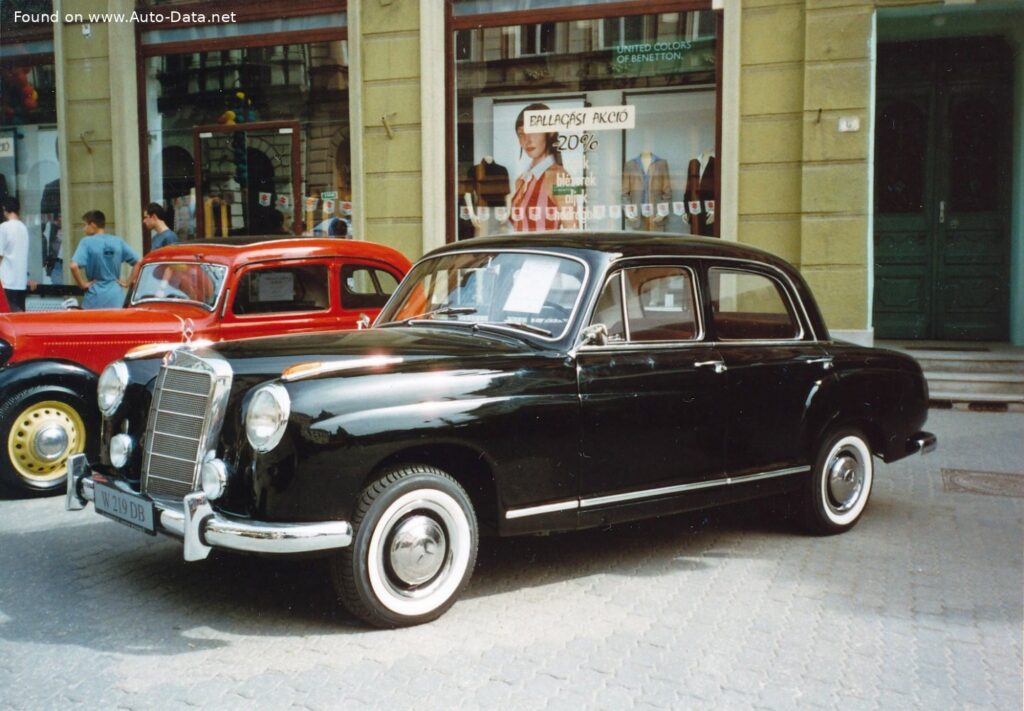
The Mercedes-Benz W105 Sedan 219 (85 Hp) represents a pivotal chapter in the illustrious history of the German automaker, embodying the brand’s commitment to quality, engineering prowess, and understated luxury in the post-war era. Produced for a relatively brief period from March 1956 to August 1957, the W105 series, affectionately known as the “Ponton” alongside its W120/W121 four-cylinder siblings, marked a significant departure from pre-war automotive design. The term “Ponton” refers to the car’s then-modern, slab-sided, and fully integrated bodywork, where the fenders were no longer separate appendages but rather seamlessly incorporated into the car’s overall envelope. This design philosophy was revolutionary for Mercedes-Benz, offering improved aerodynamics, greater interior space, and a more cohesive aesthetic compared to its predecessors. The W105 219 model specifically bridged the gap between the more economical four-cylinder Pontons and the larger, more luxurious six-cylinder W180 220 S/SE models, offering a compelling blend of performance, refinement, and a slightly more accessible price point than the top-tier offerings. It was predominantly sold in European and other international markets, cementing Mercedes-Benz’s reputation for engineering excellence globally.
Engine and Performance of the Mercedes-Benz W105 Sedan 219 (85 Hp)
At the heart of the Mercedes-Benz W105 Sedan 219 (85 Hp) lay a robust and well-regarded M 180 II / 180.921 inline six-cylinder engine. This powerplant, a derivative of Mercedes-Benz’s established M180 family, was a testament to the brand’s commitment to smooth power delivery and durability. With an engine displacement of 2.2 liters (2195 cm3 or 133.95 cubic inches), it was a naturally aspirated unit, fed by a carburetor system—a common and reliable fueling method for the era. The engine featured an overhead camshaft (SOHC) valvetrain with two valves per cylinder, a configuration that balanced efficiency with mechanical simplicity for dependable operation. It boasted a compression ratio of 7.6:1, suitable for the fuel grades available at the time.
The M 180 II engine generated a respectable 85 horsepower at 4800 revolutions per minute, providing ample motivation for the sedan. Torque output was equally impressive for its class, peaking at 115.8 pound-feet (157 Nm) at a relatively low 2400 rpm. This characteristic low-end torque ensured flexible driving dynamics, allowing the car to accelerate smoothly from a standstill and maintain momentum without constant downshifting. Power was efficiently transmitted to the rear wheels via a four-speed manual transmission, a standard and proven setup for Mercedes-Benz vehicles of this period. The drivetrain architecture, with the internal combustion engine positioned longitudinally at the front, driving the rear wheels, was classic for luxury sedans, contributing to balanced weight distribution and a predictable handling feel.
In terms of outright performance, the Mercedes-Benz W105 Sedan 219 (85 Hp) was not a sports car, but its capabilities were certainly competitive and comfortable for its time. It could accelerate from 0 to 60 miles per hour in approximately 16.2 seconds, with a top speed reaching 91.96 mph (148 km/h). While these figures may seem modest by today’s standards, they represented a strong blend of cruising ability and acceleration for a family sedan in the mid-1950s. Fuel economy was also a practical consideration, with the car achieving a combined average of around 21 US miles per gallon (11.2 liters per 100 km), which was a respectable figure given the engine’s size and the vehicle’s weight. The weight-to-power ratio of 14.8 kg per horsepower (67.5 horsepower per tonne) highlighted its robust construction and solid road presence, emphasizing reliability and comfort over outright speed.
Design and Features of the W105 Ponton Sedan
The design of the Mercedes-Benz W105 Sedan, part of the iconic “Ponton” series, was a landmark for the brand. Its most distinctive feature was the groundbreaking “Ponton” body style, which fully integrated the fenders, bonnet, and trunk into a single, flowing envelope. This modern, unibody construction not only provided a more contemporary aesthetic but also offered significant advantages in terms of structural rigidity, interior space, and manufacturing efficiency compared to older, body-on-frame designs with separate fenders. The W105 219 was a classic four-door sedan, designed to comfortably accommodate five occupants, making it an ideal choice for discerning families and business professionals. Its dimensions, with a length of 183.07 inches, a width of 68.5 inches, and a height of 61.42 inches, gave it a substantial yet elegant road presence. The generous 108.27-inch wheelbase contributed significantly to both interior roominess and ride comfort.
Inside, the W105 Ponton series upheld Mercedes-Benz’s reputation for quality and craftsmanship. While specific luxury features might have been understated compared to modern vehicles, the emphasis was on durable materials, ergonomic design, and a refined driving environment. The seating was designed for long-distance comfort, and the cabin was appointed with high-quality fabrics or leather, depending on specification. The dashboard layout was functional and clear, with essential instrumentation providing the driver with all necessary information. Despite its classic status, the W105 incorporated advanced engineering for its time, including a sophisticated suspension system. The front featured a double wishbone setup with a transverse stabilizer, while the rear utilized a trailing arm design. This combination provided a remarkably smooth and controlled ride, absorbing road imperfections effectively and contributing to the car’s reputation for superior handling and comfort on varied road surfaces.
Braking duties were handled by drum brakes on all four wheels, which was the prevalent technology for vehicles of this class and era. While not offering the fade resistance of later disc brake systems, these drum brakes provided reliable stopping power for the vehicle’s performance capabilities. Steering was managed by a cone worm with recirculation balls system, offering a precise and predictable feel, characteristic of Mercedes-Benz engineering. The vehicle’s kerb weight of 2777.82 pounds (1260 kg) underscored its solid construction, contributing to a feeling of security and stability on the road. With a maximum load capacity of 1025.15 pounds (465 kg), the W105 was practical for carrying passengers and luggage, further enhancing its appeal as a versatile and dependable luxury sedan. Its enduring design and robust engineering have cemented its place as a cherished classic, celebrated for its historical significance and timeless appeal.
Technical Specifications
| Brand | Mercedes-Benz |
| Model | Ponton |
| Generation | W105 Sedan |
| Type (Engine) | 219 (85 Hp) |
| Start of production | March, 1956 year |
| End of production | August, 1957 year |
| Powertrain Architecture | Internal Combustion engine |
| Body type | Sedan |
| Seats | 5 |
| Doors | 4 |
| Fuel consumption (combined) | 21 US mpg (11.2 l/100 km) |
| Fuel Type | Petrol (Gasoline) |
| Acceleration 0 – 60 mph | 16.2 sec |
| Maximum speed | 91.96 mph (148 km/h) |
| Weight-to-power ratio | 14.8 kg/Hp |
| Weight-to-torque ratio | 8 kg/Nm |
| Power | 85 Hp @ 4800 rpm |
| Power per liter | 38.7 Hp/l |
| Torque | 115.8 lb.-ft. @ 2400 rpm (157 Nm) |
| Engine layout | Front, Longitudinal |
| Engine Model/Code | M 180 II / 180.921 |
| Engine displacement | 2.2 liters (2195 cm3 / 133.95 cu. in.) |
| Number of cylinders | 6 |
| Engine configuration | Inline |
| Cylinder Bore | 3.15 in. (80 mm) |
| Piston Stroke | 2.87 in. (72.8 mm) |
| Compression ratio | 7.6:1 |
| Number of valves per cylinder | 2 |
| Fuel injection system | Carburettor |
| Engine aspiration | Naturally aspirated engine |
| Valvetrain | SOHC |
| Kerb Weight | 2777.82 lbs. (1260 kg) |
| Max. weight | 3802.97 lbs. (1725 kg) |
| Max load | 1025.15 lbs. (465 kg) |
| Fuel tank capacity | 14.79 US gal (56 l) |
| Length | 183.07 in. (4650 mm) |
| Width | 68.5 in. (1740 mm) |
| Height | 61.42 in. (1560 mm) |
| Wheelbase | 108.27 in. (2750 mm) |
| Front track | 56.3 in. (1430 mm) |
| Rear (Back) track | 57.87 in. (1470 mm) |
| Drivetrain Architecture | Internal combustion engine drives rear wheels |
| Drive wheel | Rear wheel drive |
| Number of gears and type of gearbox | 4 gears, manual transmission |
| Front suspension | Double wishbone, Transverse stabilizer |
| Rear suspension | Trailing arm |
| Front brakes | Drum |
| Rear brakes | Drum |
| Steering type | Cone worm with recirculation balls |
