
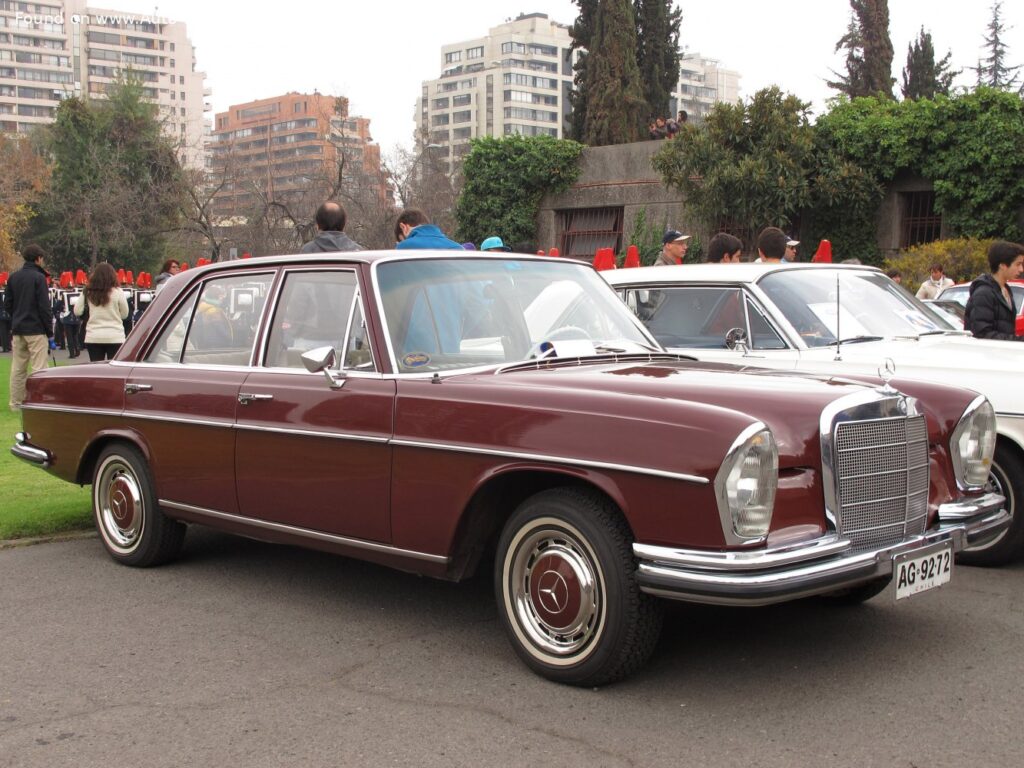
The Mercedes-Benz W108 250 S (130 Hp) stands as a quintessential representation of luxury, engineering prowess, and understated elegance from the mid-1960s. Introduced in July 1965, this sedan was part of the W108/W109 series, which succeeded the revered “Fintail” models, marking a significant evolution in Mercedes-Benz’s design language and technological sophistication. The W108 generation, produced until March 1969, was a flagship offering, aiming to solidify the brand’s reputation for building robust, comfortable, and high-performance vehicles for discerning customers worldwide. The 250 S variant, specifically, provided a compelling blend of power and refinement, positioning it as a premium choice for executives and families seeking an elevated driving experience. Its classic lines and well-appointed interior quickly established it as a benchmark in the luxury sedan segment, a status it maintains among classic car enthusiasts today.
The Legacy of the Mercedes-Benz W108 250 S (130 Hp)
The W108 series was a pivotal moment for Mercedes-Benz, bridging the gap between the more ornate designs of the late 1950s and early 1960s and the cleaner, more functional aesthetics that would define subsequent generations. The 250 S, with its M 108 I / 108.920 engine, was at the forefront of this transition, embodying the brand’s commitment to continuous innovation. While primarily targeting European and North American markets, its universal appeal stemmed from its blend of sophisticated engineering and timeless design. This model cemented Mercedes-Benz’s position as a leader in automotive luxury, offering a driving experience that was both engaging and supremely comfortable. Its enduring appeal lies not just in its aesthetics, but also in the meticulous build quality and mechanical integrity that allowed many examples to survive and thrive for decades, becoming coveted collector’s items. The W108 generation is often celebrated for its “stack headlight” design in some markets and its spacious, airy cabin, which provided excellent visibility and a sense of command over the road.
Engineering and Performance of the W108 250 S
At the heart of the Mercedes-Benz W108 250 S (130 Hp) was a robust 2.5-liter (2496 cm3 or 152.32 cu. in.) inline six-cylinder engine, designated M 108 I / 108.920. This naturally aspirated gasoline powerplant was configured longitudinally at the front of the vehicle, driving the rear wheels, a classic setup for luxury sedans of the era. With a bore of 3.23 inches (82 mm) and a piston stroke of 3.1 inches (78.8 mm), the engine featured a single overhead camshaft (SOHC) valvetrain with two valves per cylinder, a sophisticated arrangement for its time that prioritized smooth operation and durability. Fuel delivery was managed by a carburetor system, typical for the mid-1960s, contributing to its characteristic engine note and operational feel, which enthusiasts often describe as refined and melodious.
This engine generated a respectable 130 horsepower at 5400 rpm, translating to a power-per-liter output of 52.1 horsepower. Torque peaked at 143.09 lb.-ft. (194 Nm) at 4000 rpm, providing ample pulling power for a vehicle of its stature. Paired with a standard 4-speed manual transmission, the 250 S offered a surprisingly sprightly performance for a luxury sedan, capable of accelerating from 0 to 60 mph in a calculated 12.2 seconds (0-100 km/h in 12.8 seconds). Its maximum speed of 111.85 mph (180 km/h) was quite impressive, allowing for comfortable cruising on newly developing highway networks, a testament to its autobahn-bred engineering. The vehicle’s weight-to-power ratio of 11.1 kg/Hp (90.3 Hp/tonne) and weight-to-torque ratio of 7.4 kg/Nm (134.7 Nm/tonne) underscored its balanced engineering, providing a sense of solidity and controlled power delivery. Fuel consumption, while not a primary concern for luxury buyers of the era, was a combined 20.1 US mpg (11.7 l/100 km), which was competitive for a large six-cylinder sedan of its vintage.
Design, Features, and Enduring Appeal
The Mercedes-Benz W108 250 S (130 Hp) presented a distinctive and elegant sedan body type, characterized by its clean, upright styling and generous proportions. Measuring 192.91 inches (4900 mm) in length, 71.26 inches (1810 mm) in width, and 56.69 inches (1440 mm) in height, with a substantial 108.27-inch (2750 mm) wheelbase, the W108 exuded an imposing yet graceful presence. The design, often credited to Paul Bracq, moved away from the “Fintail” era’s flourishes towards a more timeless and restrained aesthetic, which has aged remarkably well. Its four-door, five-seat configuration provided ample space and comfort for occupants, making it an ideal vehicle for long journeys or executive transport, offering a blend of formality and practicality.
Beyond its visual appeal, the W108 incorporated advanced features for its time, particularly in its chassis and braking systems. The front suspension utilized a double wishbone setup, while the rear featured a sophisticated hydro-pneumatic element combined with trailing arms, contributing to the car’s renowned smooth ride and composed handling. This advanced suspension system was a significant factor in its luxury appeal, effectively isolating occupants from road imperfections and providing a stable platform even at higher speeds. Braking performance was equally forward-thinking, with disc brakes fitted on both the front and rear wheels—a notable safety feature when many competitors still relied on drum brakes, especially at the rear, demonstrating Mercedes-Benz’s commitment to safety innovation. The steering system employed a cone worm with recirculating balls, offering precise control and a comfortable feel, reducing driver fatigue on extended trips. Standard wheel rims were sized at 6J x 14 inches, complementing the car’s overall stance and contributing to its refined ride quality. The 21.66 US gallon (82-liter) fuel tank capacity ensured a considerable cruising range, further enhancing its suitability for long-distance travel. With a curb weight of 3174.66 lbs (1440 kg) and a maximum permissible weight of 4276.97 lbs (1940 kg), allowing for a max load of 1102.31 lbs (500 kg), the W108 was built with a robustness that spoke to its premium aspirations and enduring quality.
