
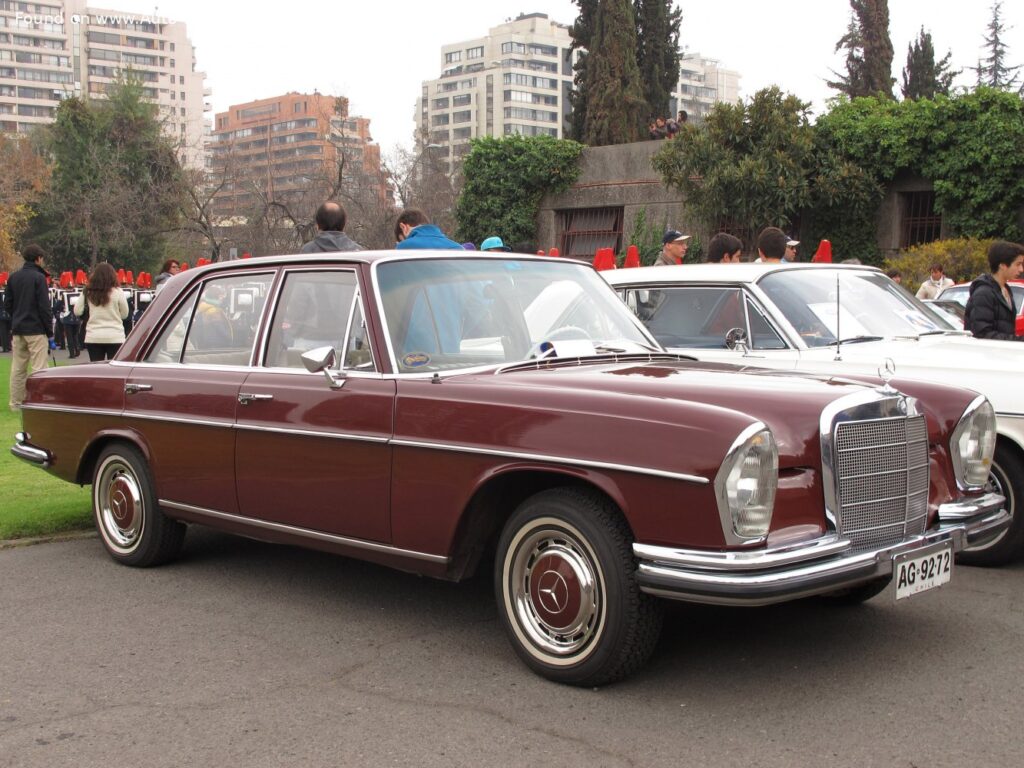
The Mercedes-Benz W108 250 S (130 Hp) Automatic represents a pivotal chapter in the storied history of the German luxury automaker, embodying a refined blend of elegance, advanced engineering, and robust performance characteristic of the mid-1960s. Launched in July 1965 as part of the W108/W109 “New Generation” series, this executive sedan marked a significant aesthetic and technical evolution from its “Fintail” predecessors. Designed to appeal to a discerning global clientele, the W108 series quickly cemented Mercedes-Benz’s reputation for building durable, comfortable, and prestigious vehicles. While primarily targeted at the European market, its influence and desirability spread worldwide, offering a sophisticated alternative in the burgeoning luxury segment. The 250 S variant, in particular, provided a compelling entry point into the W108 lineup, balancing respectable performance with the unparalleled build quality and passenger comfort that became synonymous with the Mercedes-Benz brand, especially when paired with its smooth automatic transmission.
The Mercedes-Benz W108 Legacy: A Classic of Engineering and Design
The W108 generation, produced from 1965 to 1969, emerged during a transformative period for automotive design and technology. Its styling, penned by the legendary Paul Bracq, moved away from the more flamboyant lines of the Fintail models (W111/W112) towards a cleaner, more rectilinear aesthetic. This timeless design ethos emphasized understated luxury and a commanding road presence, traits that would define Mercedes-Benz sedans for decades to come. The 250 S, with its four-door sedan body and capacity for five occupants, was engineered not just for comfort but also for durability and safety, aspects that were increasingly gaining importance in the automotive industry. Its construction reflected Mercedes-Benz’s commitment to quality, utilizing robust materials and meticulous assembly techniques that ensured a long service life, contributing to its enduring appeal as a classic car today. The W108 platform was also praised for its excellent ride quality, a hallmark of Mercedes-Benz, achieved through a sophisticated suspension setup that was advanced for its time.
Powertrain and Performance Characteristics
At the heart of the Mercedes-Benz W108 250 S (130 Hp) Automatic lies the M 108 I / 108.920 engine, a naturally aspirated 2.5-liter (2496 cm3 or 152.32 cu. in.) inline-six gasoline engine. This powerplant, configured with a Single Overhead Camshaft (SOHC) valvetrain and a carburettor fuel injection system, delivered a respectable 130 horsepower at 5400 rpm. Torque output stood at 143.09 lb.-ft. (194 Nm) at 4000 rpm, providing ample pulling power for a luxury sedan of its era. The engine’s inline-six configuration was renowned for its inherent balance and smoothness, contributing significantly to the refined driving experience expected from a Mercedes-Benz. Power was efficiently transmitted to the rear wheels via a 4-speed automatic transmission, a popular choice among luxury car buyers for its ease of use and seamless gear changes, enhancing the car’s relaxed cruising capabilities.
Performance figures for the 250 S were competitive for its class in the mid-1960s. It could accelerate from 0 to 60 mph in a brisk 12.3 seconds, with a 0-100 km/h time of 12.9 seconds. Its maximum speed was recorded at 108.74 mph (175 km/h). While these figures may seem modest by modern standards, they represented a strong blend of performance and luxury for the period, allowing for comfortable high-speed cruising on the newly developing autobahns and highways. Fuel economy, a less critical factor in the 1960s than today, was rated at a combined 20.1 US mpg (11.7 l/100 km), which was typical for a large, six-cylinder luxury vehicle of its time. The engine’s design, with an 82 mm bore and 78.8 mm piston stroke, along with a 9:1 compression ratio, underscored Mercedes-Benz’s engineering prowess in creating durable and efficient power units. With an engine oil capacity of 5.5 US quarts and a coolant capacity of 12.05 US quarts, the M108 engine was designed for robust operation and longevity.
Design, Engineering, and Interior Appointments
The exterior design of the Mercedes-Benz W108 250 S was a masterclass in understated elegance. Its proportions were stately, with a length of 192.91 inches, a width of 71.26 inches, and a height of 56.69 inches. The generous 108.27-inch wheelbase contributed significantly to both its spacious interior and its composed ride quality. The wide front (58.35 in) and rear (58.46 in) tracks further enhanced stability and handling. The car’s visual appeal was characterized by its expansive glass area, upright grille, and large, clear headlamps, creating an imposing yet sophisticated presence on the road. The body type was a classic sedan, featuring four doors and a comfortable five-seat configuration, designed for long-distance travel in utmost comfort.
Beneath its elegant skin, the W108 250 S featured advanced engineering that prioritized ride comfort, handling, and safety. The front suspension utilized a double wishbone setup, providing precise wheel control and a smooth ride. At the rear, a sophisticated hydro-pneumatic element combined with trailing arms offered a level of ride comfort and self-leveling capability that was truly cutting-edge for the era, particularly adept at absorbing road imperfections and maintaining composure under varying loads. Braking performance was handled by disc brakes on both the front and rear wheels, a significant safety advantage over many contemporaries that still relied on drum brakes, offering superior stopping power and fade resistance. Steering was managed by a cone worm with recirculation balls system, providing a direct yet comfortable feel. The vehicle rode on 6J x 14 wheel rims, complementing its classic aesthetic. With a kerb weight of 3174.66 lbs. (1440 kg) and a maximum permissible weight of 4276.97 lbs. (1940 kg), the W108 was a substantial machine, built to withstand the rigors of extensive use while offering a maximum load capacity of 1102.31 lbs. The 21.66 US gallon (82 liter) fuel tank ensured a considerable cruising range, making it well-suited for grand touring. The W108 250 S remains a beloved classic, cherished for its timeless design, robust engineering, and the enduring quality that defines the Mercedes-Benz marque.
Technical Specifications: Mercedes-Benz W108 250 S (130 Hp) Automatic
| Brand | Mercedes-Benz |
| Model | W108 |
| Generation | W108 |
| Type (Engine) | 250 S (130 Hp) Automatic |
| Start of production | July, 1965 year |
| End of production | March, 1969 year |
| Powertrain Architecture | Internal Combustion engine |
| Body type | Sedan |
| Seats | 5 |
| Doors | 4 |
| Fuel consumption (economy) – combined | 20.1 US mpg (11.7 l/100 km) |
| Fuel Type | Petrol (Gasoline) |
| Acceleration 0 – 60 mph | 12.3 sec |
| Acceleration 0 – 100 km/h | 12.9 sec |
| Maximum speed | 108.74 mph (175 km/h) |
| Weight-to-power ratio | 11.1 kg/Hp |
| Weight-to-torque ratio | 7.4 kg/Nm |
| Power | 130 Hp @ 5400 rpm. |
| Power per litre | 52.1 Hp/l |
| Torque | 143.09 lb.-ft. @ 4000 rpm. (194 Nm) |
| Engine layout | Front, Longitudinal |
| Engine Model/Code | M 108 I / 108.920 |
| Engine displacement | 2.5 l (2496 cm3 / 152.32 cu. in.) |
| Number of cylinders | 6 |
| Engine configuration | Inline |
| Cylinder Bore | 3.23 in. (82 mm) |
| Piston Stroke | 3.1 in. (78.8 mm) |
| Compression ratio | 9:1 |
| Number of valves per cylinder | 2 |
| Fuel injection system | Carburettor |
| Engine aspiration | Naturally aspirated engine |
| Valvetrain | SOHC |
| Engine oil capacity | 5.81 US qt (5.5 l) |
| Coolant | 12.05 US qt (11.4 l) |
| Kerb Weight | 3174.66 lbs. (1440 kg) |
| Max. weight | 4276.97 lbs. (1940 kg) |
| Max load | 1102.31 lbs. (500 kg) |
| Fuel tank capacity | 21.66 US gal (82 l) |
| Length | 192.91 in. (4900 mm) |
| Width | 71.26 in. (1810 mm) |
| Height | 56.69 in. (1440 mm) |
| Wheelbase | 108.27 in. (2750 mm) |
| Front track | 58.35 in. (1482 mm) |
| Rear (Back) track | 58.46 in. (1485 mm) |
| Drivetrain Architecture | The Internal combustion engine (ICE) drives the rear wheels of the vehicle. |
| Drive wheel | Rear wheel drive |
| Number of gears and type of gearbox | 4 gears, automatic transmission |
| Front suspension | Double wishbone |
| Rear suspension | Hydro-pneumatic element, Trailing arm |
| Front brakes | Disc |
| Rear brakes | Disc |
| Steering type | Cone worm with recirculation balls |
| Wheel rims size | 6J x 14 |
