
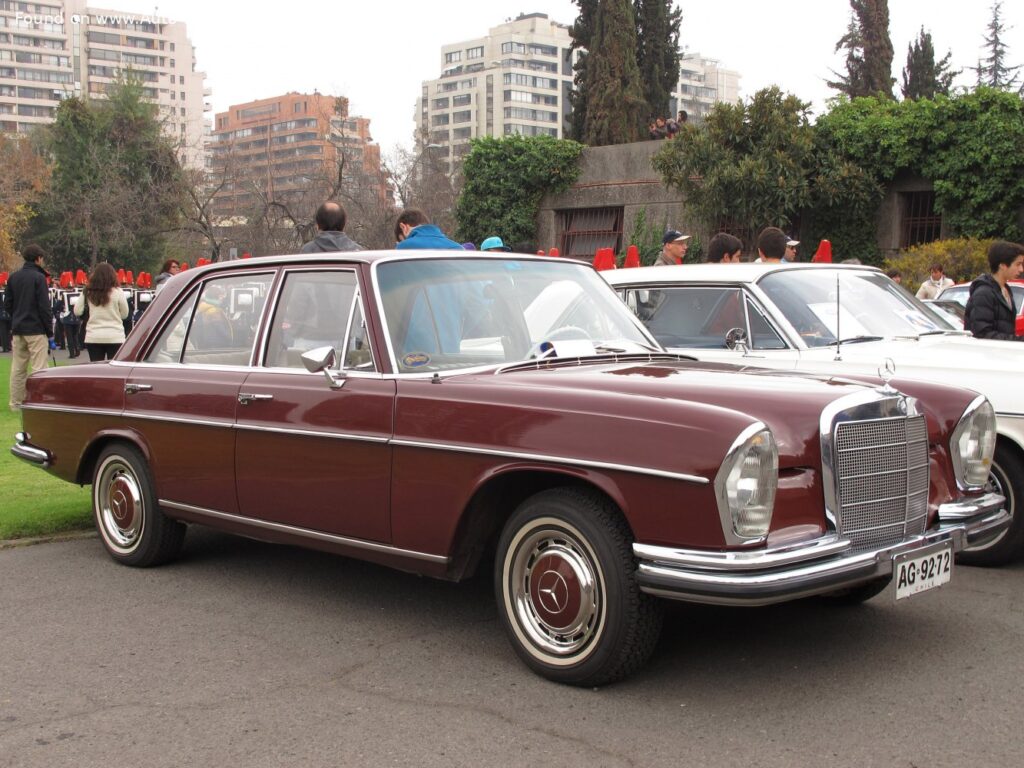
The Mercedes-Benz W108 280 S represents a pivotal era for the German luxury automaker, embodying a blend of classic elegance and robust engineering that defined premium sedans of the late 1960s and early 1970s. Launched in November 1967, the W108 generation built upon the success of its “fintail” predecessors (W111/W112) by refining their styling into a more understated and timeless aesthetic, shedding the prominent tailfins for a cleaner, more horizontal design. This particular variant, the 280 S, was a staple of the lineup, positioned as a sophisticated, comfortable, and capable four-door, five-seat sedan designed for discerning buyers seeking a blend of performance and luxury. While not exclusively a U.S. market model, its engineering prowess and design principles resonated globally, solidifying Mercedes-Benz’s reputation for quality and durability. The W108 series, including the {original_title}, was a significant contributor to the brand’s image as a producer of executive-class vehicles, offering a compelling package of ride comfort, safety, and mechanical refinement.
Engineering and Performance of the Mercedes-Benz W108 280 S
At the heart of the Mercedes-Benz W108 280 S was its formidable M 130 V 28 / 130.920 inline-six engine, a powerplant renowned for its smooth operation and reliability. This naturally aspirated, front-longitudinal engine featured a single overhead camshaft (SOHC) valvetrain and a carbureted fuel injection system, typical of the era’s automotive technology. With an engine displacement of 2778 cubic centimeters, or approximately 169.52 cubic inches, it delivered a respectable 140 horsepower at 5200 revolutions per minute. This output translated to a power per liter ratio of 50.4 Hp/l, a solid figure for a luxury sedan of its time. Torque was equally impressive, peaking at 224 Newton-meters (165.21 lb.-ft.) at 3600 rpm, providing ample low-end grunt for effortless cruising and confident acceleration.
The performance metrics of the 280 S were well-suited to its luxury touring intentions. It could accelerate from 0 to 60 miles per hour in a brisk 11.9 seconds, a competitive time for a large sedan weighing 3240.8 pounds (1470 kg) during its production run. The top speed was rated at 114.95 miles per hour (185 km/h), allowing for comfortable and sustained high-speed travel on the nascent European autobahns and American interstates. Fuel economy, while not a primary concern for luxury car buyers of the period, was a combined 19.1 US miles per gallon (12.3 l/100 km), which was reasonable given its engine size and the technology available. The engine featured a compression ratio of 9:1, contributing to its efficient combustion and power delivery. With a six-cylinder inline configuration and two valves per cylinder, the engine was a testament to Mercedes-Benz’s commitment to balanced performance and longevity. The engine oil capacity was 6 liters (6.34 US quarts), and the cooling system held 10.8 liters (11.41 US quarts), indicating a robust design for thermal management.
Design and Features
The W108 generation marked a significant evolutionary step in Mercedes-Benz design, moving away from the more flamboyant “fintail” styling towards a more restrained, elegant, and timeless aesthetic that would influence the brand’s design language for decades. The 280 S, as a four-door sedan, exuded understated luxury with its clean lines, expansive glasshouse, and a dignified presence. Its dimensions—192.91 inches (4900 mm) in length, 71.26 inches (1810 mm) in width, and 56.69 inches (1440 mm) in height—provided a spacious and comfortable cabin for five occupants, a hallmark of Mercedes-Benz sedans. The long wheelbase of 108.27 inches (2750 mm) contributed significantly to its composed ride quality and interior room.
Beyond its aesthetic appeal, the W108 280 S incorporated advanced mechanical features for its time, enhancing both safety and driving dynamics. The drivetrain architecture featured an internal combustion engine driving the rear wheels, a classic setup for luxury vehicles emphasizing balanced weight distribution and traditional handling characteristics. Power was transmitted through a 4-speed manual transmission, offering direct driver engagement. The suspension system was particularly noteworthy: a double wishbone setup at the front provided precise steering and excellent road holding, while the rear suspension utilized a sophisticated combination of hydro-pneumatic elements and trailing arms. This innovative rear suspension design was instrumental in delivering the W108’s renowned smooth and isolated ride, effectively absorbing road imperfections and maintaining stability. Braking performance was equally advanced, with disc brakes employed on both the front and rear axles, a feature that was not universal across all vehicles in this class during the late 1960s, providing superior stopping power and fade resistance. Steering was managed by a cone worm with recirculation balls system, offering a precise yet comfortable feel, fitting for a luxury sedan. The vehicle rode on 6J x 14 wheel rims, ensuring a classic stance and adequate tire contact for its performance capabilities.
The W108 280 S, with a kerb weight of 3240.8 pounds (1470 kg) and a maximum gross weight of 4343.11 pounds (1970 kg), offered a substantial and secure feeling on the road. Its maximum load capacity was 1102.31 pounds (500 kg), demonstrating its utility as a practical luxury vehicle. The fuel tank capacity of 21.66 US gallons (82 liters) provided a generous cruising range, allowing for extended journeys without frequent refueling stops, reinforcing its role as a grand touring sedan. The meticulous attention to detail in its engineering, from the robust chassis to the refined powertrain and advanced suspension, cemented the W108’s reputation as a benchmark for luxury and durability in its segment, ensuring its enduring appeal as a classic Mercedes-Benz.
Technical Specifications
| Brand | Mercedes-Benz |
| Model | W108 |
| Generation | W108 |
| Type (Engine) | 280 S (140 Hp) |
| Start of production | November, 1967 year |
| End of production | September, 1972 year |
| Powertrain Architecture | Internal Combustion engine |
| Body type | Sedan |
| Seats | 5 |
| Doors | 4 |
| Fuel consumption (economy) – combined | 12.3 l/100 km (19.1 US mpg) |
| Fuel Type | Petrol (Gasoline) |
| Acceleration 0 – 100 km/h | 12.5 sec |
| Acceleration 0 – 62 mph | 12.5 sec |
| Acceleration 0 – 60 mph (Calculated) | 11.9 sec |
| Maximum speed | 185 km/h (114.95 mph) |
| Weight-to-power ratio | 10.5 kg/Hp (95.2 Hp/tonne) |
| Weight-to-torque ratio | 6.6 kg/Nm (152.4 Nm/tonne) |
| Power | 140 Hp @ 5200 rpm. |
| Power per liter | 50.4 Hp/l |
| Torque | 224 Nm @ 3600 rpm (165.21 lb.-ft. @ 3600 rpm) |
| Engine layout | Front, Longitudinal |
| Engine Model/Code | M 130 V 28 / 130.920 |
| Engine displacement | 2778 cm3 (169.52 cu. in.) |
| Number of cylinders | 6 |
| Engine configuration | Inline |
| Cylinder Bore | 86.51 mm (3.41 in.) |
| Piston Stroke | 78.8 mm (3.1 in.) |
| Compression ratio | 9:1 |
| Number of valves per cylinder | 2 |
| Fuel injection system | Carburettor |
| Engine aspiration | Naturally aspirated engine |
| Valvetrain | SOHC |
| Engine oil capacity | 6 l (6.34 US qt) |
| Coolant | 10.8 l (11.41 US qt) |
| Kerb Weight | 1470 kg (3240.8 lbs.) |
| Max. weight | 1970 kg (4343.11 lbs.) |
| Max load | 500 kg (1102.31 lbs.) |
| Fuel tank capacity | 82 l (21.66 US gal) |
| Length | 4900 mm (192.91 in.) |
| Width | 1810 mm (71.26 in.) |
| Height | 1440 mm (56.69 in.) |
| Wheelbase | 2750 mm (108.27 in.) |
| Front track | 1482 mm (58.35 in.) |
| Rear (Back) track | 1485 mm (58.46 in.) |
| Drivetrain Architecture | The Internal combustion engine (ICE) drives the rear wheels of the vehicle. |
| Drive wheel | Rear wheel drive |
| Number of gears and type of gearbox | 4 gears, manual transmission |
| Front suspension | Double wishbone |
| Rear suspension | Hydro-pneumatic element, Trailing arm |
| Front brakes | Disc |
| Rear brakes | Disc |
| Steering type | Cone worm with recirculation balls |
| Wheel rims size | 6J x 14 |
