
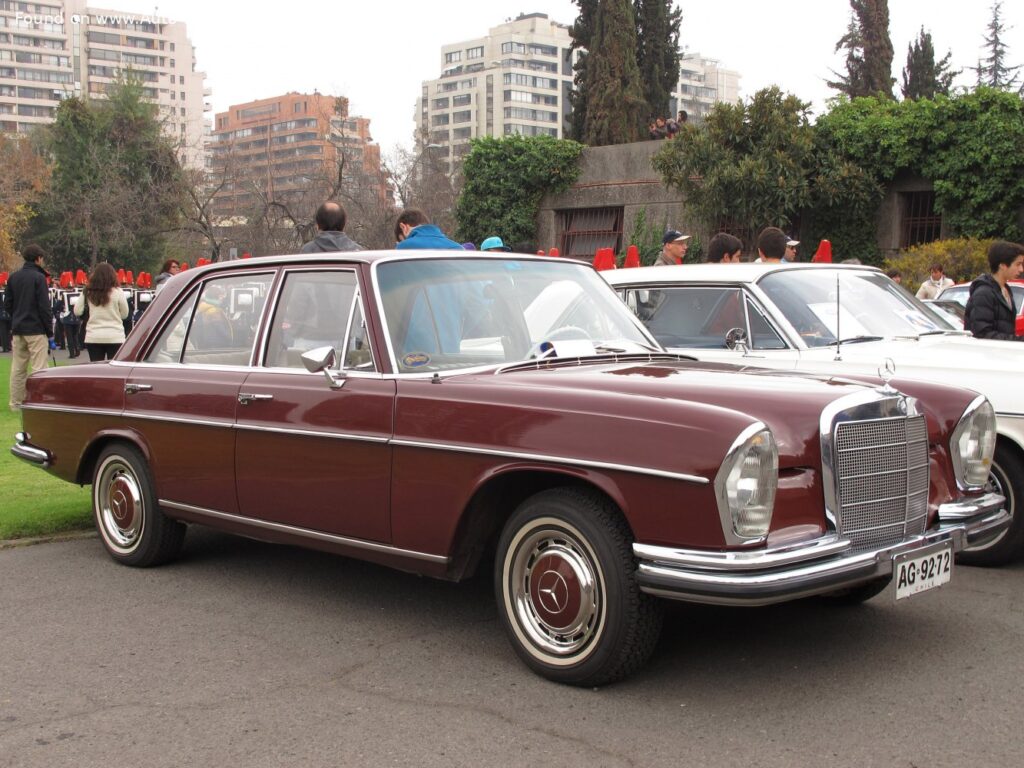
The Mercedes-Benz W108 series represents a pinnacle of luxury and engineering from the late 1960s and early 1970s, embodying the brand’s commitment to quality, comfort, and sophisticated design. This generation of S-Class sedans, produced from November 1967 to September 1972, succeeded the W111 and W112 “Fintail” models, evolving their stately presence into a more modern, yet still undeniably classic, aesthetic. Among its distinguished variants, the Mercedes-Benz W108 280 S (140 Hp) Automatic stands out as a particularly well-balanced offering, combining a potent inline-six engine with the smooth operation of an automatic transmission. This model catered to discerning buyers who sought understated elegance, robust performance, and the unparalleled build quality that became synonymous with Mercedes-Benz during this golden era. Its role in the luxury sedan market was to set a benchmark, providing a refined driving experience and a spacious, comfortable cabin for five occupants, solidifying its place as a cherished classic today.
Engineering Excellence: The Powertrain of the Mercedes-Benz W108 280 S (140 Hp) Automatic
At the heart of the Mercedes-Benz W108 280 S (140 Hp) Automatic lies a meticulously engineered M 130 V 28 / 130.920 inline-six engine, a powerplant renowned for its smoothness and durability. This naturally aspirated gasoline engine boasts a displacement of 2778 cubic centimeters, or approximately 169.52 cubic inches. Its configuration features an inline layout with six cylinders, each with a bore of 3.41 inches and a piston stroke of 3.1 inches, resulting in a healthy compression ratio of 9:1. The engine’s valvetrain utilizes a Single Overhead Camshaft (SOHC) design, with two valves per cylinder, a common and reliable setup for its time. Fuel delivery was managed by a carburetion system, a testament to the era’s technology before widespread electronic fuel injection became standard.
This sophisticated engine generates a robust 140 horsepower at 5200 revolutions per minute, delivering a power-per-liter output of 50.4 Hp/l. Torque figures are equally impressive for the period, peaking at 165.21 lb.-ft. at 3600 rpm. These figures translate into a commendable performance for a luxury sedan weighing 3240.8 pounds (kerb weight). The power-to-weight ratio stands at 10.5 kg/Hp, or 95.2 Hp per tonne, while the torque-to-weight ratio is 6.6 kg/Nm, or 152.4 Nm per tonne, indicating a well-matched engine and chassis. Power is transmitted to the rear wheels through a smooth-shifting 4-speed automatic transmission, a desirable feature for the luxury segment, emphasizing comfort and ease of driving over outright sporting performance. This rear-wheel-drive architecture, with the engine mounted longitudinally in the front, provided balanced handling dynamics.
In terms of performance, the 280 S was capable of accelerating from 0 to 60 miles per hour in a respectable 11.9 seconds, with a top speed of 111.85 mph. While these figures might seem modest by modern standards, they were competitive for a luxury sedan of its vintage, offering effortless cruising capabilities on the newly developing highway networks. Fuel economy, an emerging concern even in the late 1960s, was rated at a combined 19.1 US mpg, which was a reasonable figure for a large, six-cylinder luxury car using a carbureted engine. The engine required 6.34 US quarts of oil and had a coolant capacity of 11.41 US quarts, reflecting its robust engineering designed for longevity and reliability.
Design and Features: The Enduring Appeal of the W108 Sedan
The Mercedes-Benz W108 series, and specifically the 280 S, is celebrated for its timeless and elegant design. As a four-door sedan with seating for five, its proportions exude a sense of understated luxury and solidity. The exterior dimensions—192.91 inches in length, 71.26 inches in width, and 56.69 inches in height—contribute to its commanding road presence. A generous wheelbase of 108.27 inches provided ample interior space and contributed to the car’s stable ride quality, while front and rear tracks of 58.35 inches and 58.46 inches, respectively, ensured a planted stance.
Beyond its aesthetic appeal, the W108 was engineered with an emphasis on occupant comfort and advanced mechanical features for its time. The suspension system was particularly noteworthy: the front utilized a double wishbone setup, providing precise steering and excellent road holding. The rear suspension, a more innovative design for the period, featured a combination of hydro-pneumatic elements and trailing arms. This sophisticated arrangement aimed to deliver superior ride comfort by allowing the suspension to adapt to varying road conditions and loads, a hallmark of Mercedes-Benz’s dedication to ride quality.
Braking performance was handled by disc brakes on both the front and rear wheels, a significant safety feature for the era that provided superior stopping power and fade resistance compared to drum brakes. The steering system was a cone worm with recirculation balls type, offering a precise and predictable feel. The car rode on 6J x 14-inch wheel rims, which were typically fitted with bias-ply or early radial tires, contributing to its smooth ride. With a maximum load capacity of 1102.31 pounds and a generous fuel tank capacity of 21.66 US gallons, the W108 280 S was well-suited for long-distance touring, offering both practicality and luxury.
Technical Specifications
| Brand | Mercedes-Benz |
| Model | W108 |
| Generation | W108 |
| Type (Engine) | 280 S (140 Hp) Automatic |
| Start of production | November, 1967 year |
| End of production | September, 1972 year |
| Powertrain Architecture | Internal Combustion engine |
| Body type | Sedan |
| Seats | 5 |
| Doors | 4 |
| Fuel consumption (economy) – combined | 19.1 US mpg (12.3 l/100 km) |
| Fuel Type | Gasoline |
| Acceleration 0 – 60 mph | 11.9 sec |
| Maximum speed | 111.85 mph (180 km/h) |
| Weight-to-power ratio | 10.5 kg/Hp |
| Weight-to-torque ratio | 6.6 kg/Nm |
| Power | 140 Hp @ 5200 rpm |
| Power per litre | 50.4 Hp/l |
| Torque | 165.21 lb.-ft. @ 3600 rpm (224 Nm) |
| Engine layout | Front, Longitudinal |
| Engine Model/Code | M 130 V 28 / 130.920 |
| Engine displacement | 169.52 cu. in. (2778 cm3) |
| Number of cylinders | 6 |
| Engine configuration | Inline |
| Cylinder Bore | 3.41 in. (86.51 mm) |
| Piston Stroke | 3.1 in. (78.8 mm) |
| Compression ratio | 9:1 |
| Number of valves per cylinder | 2 |
| Fuel injection system | Carburettor |
| Engine aspiration | Naturally aspirated engine |
| Valvetrain | SOHC |
| Engine oil capacity | 6.34 US qt (6 l) |
| Coolant | 11.41 US qt (10.8 l) |
| Kerb Weight | 3240.8 lbs. (1470 kg) |
| Max. weight | 4343.11 lbs. (1970 kg) |
| Max load | 1102.31 lbs. (500 kg) |
| Fuel tank capacity | 21.66 US gal (82 l) |
| Length | 192.91 in. (4900 mm) |
| Width | 71.26 in. (1810 mm) |
| Height | 56.69 in. (1440 mm) |
| Wheelbase | 108.27 in. (2750 mm) |
| Front track | 58.35 in. (1482 mm) |
| Rear (Back) track | 58.46 in. (1485 mm) |
| Drivetrain Architecture | The Internal combustion engine (ICE) drives the rear wheels of the vehicle. |
| Drive wheel | Rear wheel drive |
| Number of gears and type of gearbox | 4 gears, automatic transmission |
| Front suspension | Double wishbone |
| Rear suspension | Hydro-pneumatic element, Trailing arm |
| Front brakes | Disc |
| Rear brakes | Disc |
| Steering type | Cone worm with recirculation balls |
| Wheel rims size | 6J x 14 |
