
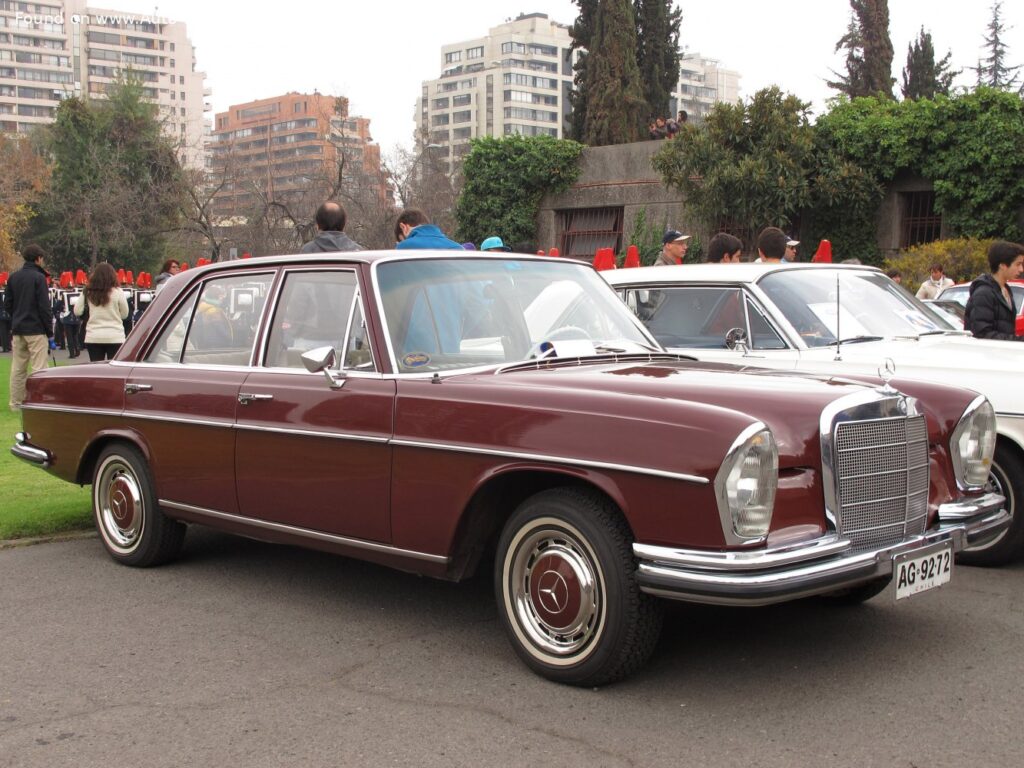
The Mercedes-Benz W108 280 SE represents a pinnacle of luxury and engineering from the late 1960s and early 1970s, embodying the brand’s reputation for robust build quality, elegant design, and refined performance. As a key model within the W108 generation, which succeeded the iconic “Fintail” series, the 280 SE was launched in November 1967 and remained in production until September 1972. This full-size luxury sedan was primarily targeted at discerning buyers in Europe and other global markets who sought a blend of comfort, prestige, and advanced mechanical sophistication for its era. The W108 series, and particularly the Mercedes-Benz W108 280 SE, became a benchmark for executive sedans, setting standards that influenced automotive design and engineering for decades to come, solidifying Mercedes-Benz’s position as a leader in the premium segment. Its enduring appeal today as a classic car is a testament to its timeless design and engineering integrity.
Engine and Performance: The Heart of the Mercedes-Benz W108 280 SE
At the core of the Mercedes-Benz W108 280 SE’s appeal was its meticulously engineered M 130 E 28 inline-six engine, a powerplant renowned for its smooth operation and reliability. This naturally aspirated, 2.8-liter (2778 cm³ or 169.52 cu. in.) unit featured a Single Overhead Camshaft (SOHC) valvetrain and, notably for its time, a multi-port manifold fuel injection system. This advanced fuel delivery method, rather than a carburetor, contributed significantly to the engine’s efficiency, responsiveness, and consistent power delivery, a hallmark of Mercedes-Benz engineering in an era when many competitors still relied on less sophisticated systems.
The M 130 E 28 engine produced a respectable 160 horsepower at 5500 rpm, translating to a power-per-liter output of 57.6 HP/l. Torque figures were equally impressive for a luxury sedan of its vintage, peaking at 240 Nm (177.01 lb.-ft.) at 4250 rpm. This robust torque curve ensured effortless acceleration and comfortable cruising at highway speeds. Power was delivered to the rear wheels via a standard 4-speed manual transmission, offering an engaging driving experience that was both smooth and precise, a characteristic highly valued by drivers of the period. The powertrain architecture, with the internal combustion engine mounted longitudinally at the front, driving the rear wheels, provided a balanced weight distribution and predictable handling dynamics.
In terms of outright performance, the Mercedes-Benz W108 280 SE was capable of accelerating from 0 to 60 mph in approximately 10 seconds (0-100 km/h in 10.5 seconds), a commendable figure for a substantial luxury sedan weighing 3295.91 lbs. (1495 kg) curb weight. Its top speed was rated at 118.06 mph (190 km/h), allowing it to comfortably keep pace with, and often surpass, much of the traffic of its time. Fuel economy, while not a primary concern for luxury car buyers in the late 1960s, was reasonable for the segment and engine size, averaging around 19.1 US mpg (12.3 l/100 km) in combined driving conditions. The engine’s generous 6-liter oil capacity and 10.8-liter coolant capacity underscored its design for durability and sustained performance.
Design and Features: Timeless Elegance and Engineering Prowess
The design of the Mercedes-Benz W108 280 SE is an enduring example of automotive elegance, characterized by its clean lines, expansive glasshouse, and stately proportions. As a four-door sedan with seating for five, it offered ample space and comfort, distinguishing it as a true executive class vehicle. The W108 generation marked a departure from the more pronounced “fintails” of its predecessors, adopting a more understated and timeless aesthetic that influenced Mercedes-Benz styling for years to come. Its overall length of 192.91 inches (4900 mm) and width of 71.26 inches (1810 mm) gave it a commanding road presence, while the 108.27-inch (2750 mm) wheelbase contributed to its stable ride and spacious interior.
Beyond its aesthetic appeal, the W108 280 SE incorporated several advanced features for its time, focusing on safety, comfort, and driving dynamics. The suspension system, for instance, was sophisticated, featuring a double wishbone setup at the front and a unique hydro-pneumatic element combined with a trailing arm design at the rear. This combination provided an exceptionally smooth and controlled ride, absorbing road imperfections with remarkable composure, a key attribute for a luxury vehicle. Braking performance was equally advanced, with disc brakes fitted on both the front and rear wheels, offering superior stopping power and fade resistance compared to the drum brakes still prevalent on many contemporary vehicles.
The steering system, a cone worm with recirculation balls, provided precise control and a good sense of road feel, contributing to the car’s confident handling. The vehicle rode on 6J x 14 wheel rims, shod with tires that were designed to complement the car’s refined suspension. Inside, while specific features are not detailed in the raw data, Mercedes-Benz W108 models were known for their high-quality materials, meticulous craftsmanship, and ergonomic layouts. Standard features would have included comfortable seating, a well-appointed dashboard with clear instrumentation, and potentially options like power windows or air conditioning, depending on the market and specific trim. The substantial 82-liter (21.66 US gal) fuel tank capacity ensured a long cruising range, further enhancing its suitability for extended journeys. The maximum load capacity of 1102.31 lbs. (500 kg) underscored its robust construction and utility, allowing it to comfortably carry passengers and luggage.
Technical Specifications: Mercedes-Benz W108 280 SE (160 Hp)
| General Information | |
| Brand | Mercedes-Benz |
| Model | W108 |
| Generation | W108 |
| Type (Engine) | 280 SE (160 Hp) |
| Start of production | November, 1967 |
| End of production | September, 1972 |
| Powertrain Architecture | Internal Combustion engine |
| Body type | Sedan |
| Seats | 5 |
| Doors | 4 |
| Performance Specs | |
| Fuel consumption (combined) | 19.1 US mpg (12.3 l/100 km) |
| Fuel Type | Petrol (Gasoline) |
| Acceleration 0 – 60 mph | 10 sec |
| Acceleration 0 – 100 km/h | 10.5 sec |
| Maximum speed | 118.06 mph (190 km/h) |
| Weight-to-power ratio | 9.3 kg/Hp, 107 Hp/tonne |
| Weight-to-torque ratio | 6.2 kg/Nm, 160.5 Nm/tonne |
| Engine Specs | |
| Power | 160 Hp @ 5500 rpm. |
| Power per liter | 57.6 Hp/l |
| Torque | 240 Nm @ 4250 rpm (177.01 lb.-ft. @ 4250 rpm) |
| Engine layout | Front, Longitudinal |
| Engine Model/Code | M 130 E 28 / 130.980 |
| Engine displacement | 2778 cm³ (169.52 cu. in.) |
| Number of cylinders | 6 |
| Engine configuration | Inline |
| Cylinder Bore | 86.5 mm (3.41 in.) |
| Piston Stroke | 78.8 mm (3.1 in.) |
| Compression ratio | 9.5:1 |
| Number of valves per cylinder | 2 |
| Fuel injection system | Multi-port manifold injection |
| Engine aspiration | Naturally aspirated engine |
| Valvetrain | SOHC |
| Engine oil capacity | 6 l (6.34 US qt) |
| Coolant | 10.8 l (11.41 US qt) |
| Space, Volume and Weights | |
| Kerb Weight (Curb Weight) | 1495 kg (3295.91 lbs) |
| Max. weight | 1995 kg (4398.22 lbs) |
| Max load | 500 kg (1102.31 lbs) |
| Fuel tank capacity | 82 l (21.66 US gal) |
| Dimensions | |
| Length | 4900 mm (192.91 in.) |
| Width | 1810 mm (71.26 in.) |
| Height | 1440 mm (56.69 in.) |
| Wheelbase | 2750 mm (108.27 in.) |
| Front track | 1482 mm (58.35 in.) |
| Rear (Back) track | 1485 mm (58.46 in.) |
| Drivetrain, Brakes and Suspension Specs | |
| Drivetrain Architecture | The Internal combustion engine (ICE) drives the rear wheels of the vehicle. |
| Drive wheel | Rear wheel drive |
| Number of gears and type of gearbox | 4 gears, manual transmission |
| Front suspension | Double wishbone |
| Rear suspension | Hydro-pneumatic element, Trailing arm |
| Front brakes | Disc |
| Rear brakes | Disc |
| Steering type | Cone worm with recirculation balls |
| Wheel rims size | 6J x 14 |
