
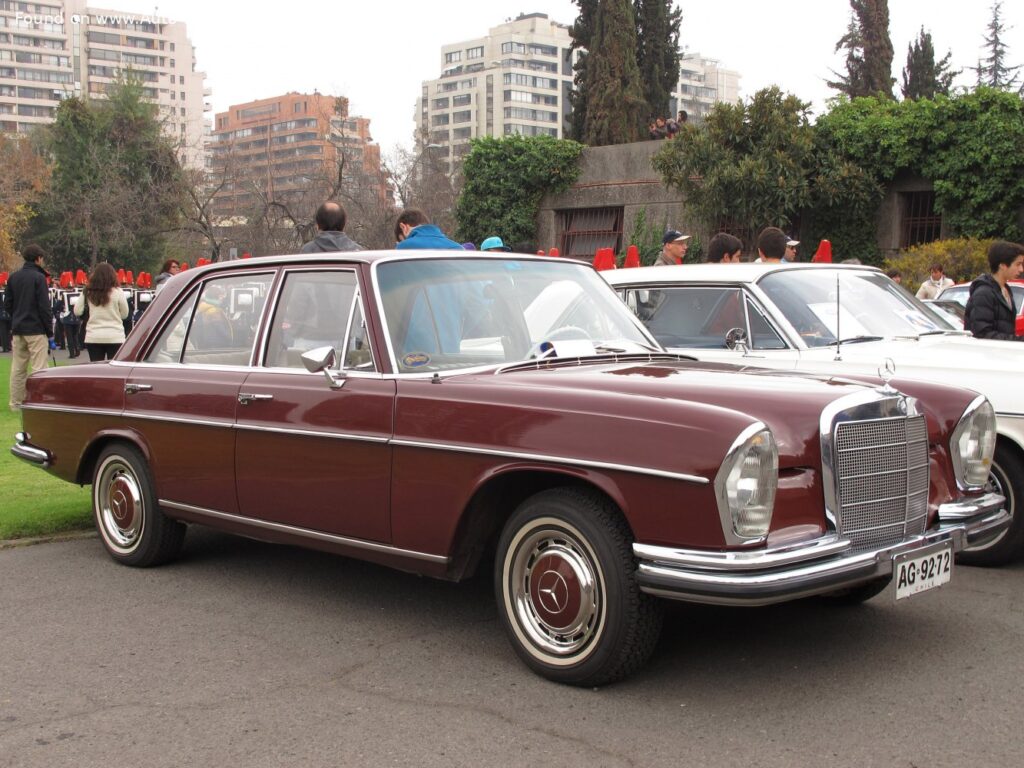
The Mercedes-Benz W108 series, produced from 1965 to 1972, stands as a quintessential representation of luxury, engineering prowess, and understated elegance from the Stuttgart marque during its era. As the successor to the iconic “Fintail” sedans, the W108 ushered in a more modern, clean design aesthetic that would influence Mercedes-Benz styling for decades. Among its various iterations, the Mercedes-Benz W108 280 SE 3.5 V8 (200 Hp), produced from July 1970 to September 1972, represents a significant milestone, marking the introduction of Mercedes-Benz’s first modern V8 engine in a volume production sedan. This particular model combined the W108’s refined chassis with a powerful, smooth V8, offering a driving experience that was both sophisticated and remarkably capable for its time, cementing its status as a highly sought-after classic among enthusiasts and collectors today.
Engine & Performance: The Power of the Mercedes-Benz W108 280 SE 3.5 V8 (200 Hp)
At the heart of the 280 SE 3.5 V8 beats the M 116 E 35 engine, a naturally aspirated V-engine with a displacement of 3,499 cubic centimeters (213.52 cubic inches). This sophisticated eight-cylinder unit, configured in a V-layout, was a technological tour de force for Mercedes-Benz. It featured a single overhead camshaft (SOHC) valvetrain with two valves per cylinder, a setup that prioritized smooth operation and robust reliability. Fuel delivery was handled by a multi-port manifold injection system, an advanced feature for the early 1970s that ensured precise fuel metering and contributed to both performance and efficiency.
The M 116 engine generated a formidable 200 horsepower at 5,800 revolutions per minute, translating to a power-per-liter output of 57.2 Hp/l. Torque figures were equally impressive, peaking at 286 Newton-meters (210.94 lb.-ft.) at a relatively accessible 4,000 rpm. This combination of power and torque, delivered through a front-longitudinal engine layout and a four-speed manual transmission driving the rear wheels, provided the substantial sedan with surprising athleticism. The 280 SE 3.5 V8 could accelerate from 0 to 60 mph in a brisk 8.6 seconds (0-100 km/h in 9 seconds) and reach a top speed of 130.49 mph (210 km/h). These performance metrics placed it firmly among the fastest luxury sedans of its era, offering a blend of high-speed cruising capability and effortless power delivery.
Despite its luxurious nature and powerful engine, fuel consumption, while not a primary concern for buyers in the early 1970s, was rated at 13 liters per 100 kilometers, which translates to approximately 18.1 US miles per gallon in combined driving conditions. The engine’s robust construction and generous 7.5-liter (7.93 US quarts) oil capacity, along with a 13.2-liter (13.95 US quarts) coolant system, ensured durability and efficient thermal management, crucial for a high-performance luxury vehicle designed for extended journeys. The weight-to-power ratio of 7.8 kg/Hp (129 Hp/tonne) and a weight-to-torque ratio of 5.4 kg/Nm (184.5 Nm/tonne) underscore the car’s substantial yet well-balanced engineering.
Design & Features: Timeless Elegance and Period Luxury
The Mercedes-Benz W108 series, including the 280 SE 3.5 V8, is celebrated for its timeless and elegant design, a departure from the more ornate “fintail” styling of its predecessor. Penned by Paul Bracq, the W108 featured clean lines, a wider and lower stance, and a distinctive vertical grille that exuded sophistication without being ostentatious. As a four-door sedan with seating for five, it perfectly embodied the luxury segment, providing ample space and comfort for all occupants. Its dimensions were substantial, measuring 192.91 inches in length, 71.26 inches in width, and 56.69 inches in height, with a generous wheelbase of 108.27 inches, contributing to its stable ride and commanding road presence.
Inside, the W108 upheld Mercedes-Benz’s reputation for impeccable craftsmanship and high-quality materials. While specific interior features varied with individual orders, standard appointments would typically include genuine wood trim, comfortable leather or velour upholstery, and a thoughtfully designed dashboard with clear instrumentation. For its time, luxury amenities might have encompassed power steering, which on the 280 SE 3.5 V8 was a hydraulic system utilizing a cone worm with recirculation balls, making maneuvering the large sedan remarkably easy. The vehicle’s kerb weight of 3,417.17 pounds (1,550 kg) and a maximum permissible weight of 4,530.5 pounds (2,055 kg) speak to its solid construction and capacity for carrying passengers and luggage, aided by an 82-liter (21.66 US gallons) fuel tank for extended touring range.
In terms of chassis and safety, the W108 was advanced for its era. It featured an independent suspension system, with a double wishbone setup at the front and a sophisticated hydro-pneumatic element combined with a trailing arm at the rear. This arrangement provided an exceptional balance of ride comfort and handling stability, a hallmark of Mercedes-Benz engineering. Braking performance was assured by disc brakes at both the front and rear, offering superior stopping power and fade resistance compared to drum brakes common on many contemporaries. The wheel rims, sized 6J x 14, were designed to complement the car’s sturdy construction and elegant aesthetics, further enhancing its classic appeal.
Technical Specifications
| Brand | Mercedes-Benz |
| Model | W108 |
| Generation | W108 |
| Type (Engine) | 280 SE 3.5 V8 (200 Hp) |
| Start of production | July, 1970 year |
| End of production | September, 1972 year |
| Powertrain Architecture | Internal Combustion engine |
| Body type | Sedan |
| Seats | 5 |
| Doors | 4 |
| Fuel consumption (economy) – combined | 18.1 US mpg (13 l/100 km) |
| Fuel Type | Petrol (Gasoline) |
| Acceleration 0 – 60 mph | 8.6 sec |
| Acceleration 0 – 100 km/h | 9 sec |
| Maximum speed | 130.49 mph (210 km/h) |
| Weight-to-power ratio | 7.8 kg/Hp, 129 Hp/tonne |
| Weight-to-torque ratio | 5.4 kg/Nm, 184.5 Nm/tonne |
| Power | 200 Hp @ 5800 rpm. |
| Power per litre | 57.2 Hp/l |
| Torque | 210.94 lb.-ft. @ 4000 rpm. (286 Nm) |
| Engine layout | Front, Longitudinal |
| Engine Model/Code | M 116 E 35 / 116.980 |
| Engine displacement | 3.5 l (3499 cm3, 213.52 cu. in.) |
| Number of cylinders | 8 |
| Engine configuration | V-engine |
| Cylinder Bore | 3.62 in. (92 mm) |
| Piston Stroke | 2.59 in. (65.8 mm) |
| Compression ratio | 9.5:1 |
| Number of valves per cylinder | 2 |
| Fuel injection system | Multi-port manifold injection |
| Engine aspiration | Naturally aspirated engine |
| Valvetrain | SOHC |
| Engine oil capacity | 7.93 US qt (7.5 l) |
| Coolant | 13.95 US qt (13.2 l) |
| Kerb Weight | 3417.17 lbs. (1550 kg) |
| Max. weight | 4530.5 lbs. (2055 kg) |
| Max load | 1113.33 lbs. (505 kg) |
| Fuel tank capacity | 21.66 US gal (82 l) |
| Length | 192.91 in. (4900 mm) |
| Width | 71.26 in. (1810 mm) |
| Height | 56.69 in. (1440 mm) |
| Wheelbase | 108.27 in. (2750 mm) |
| Front track | 58.35 in. (1482 mm) |
| Rear (Back) track | 58.46 in. (1485 mm) |
| Drivetrain Architecture | The Internal combustion engine (ICE) drives the rear wheels of the vehicle. |
| Drive wheel | Rear wheel drive |
| Number of gears and type of gearbox | 4 gears, manual transmission |
| Front suspension | Double wishbone |
| Rear suspension | Hydro-pneumatic element, Trailing arm |
| Front brakes | Disc |
| Rear brakes | Disc |
| Steering type | Cone worm with recirculation balls |
| Power steering | Hydraulic Steering |
| Wheel rims size | 6J x 14 |
