
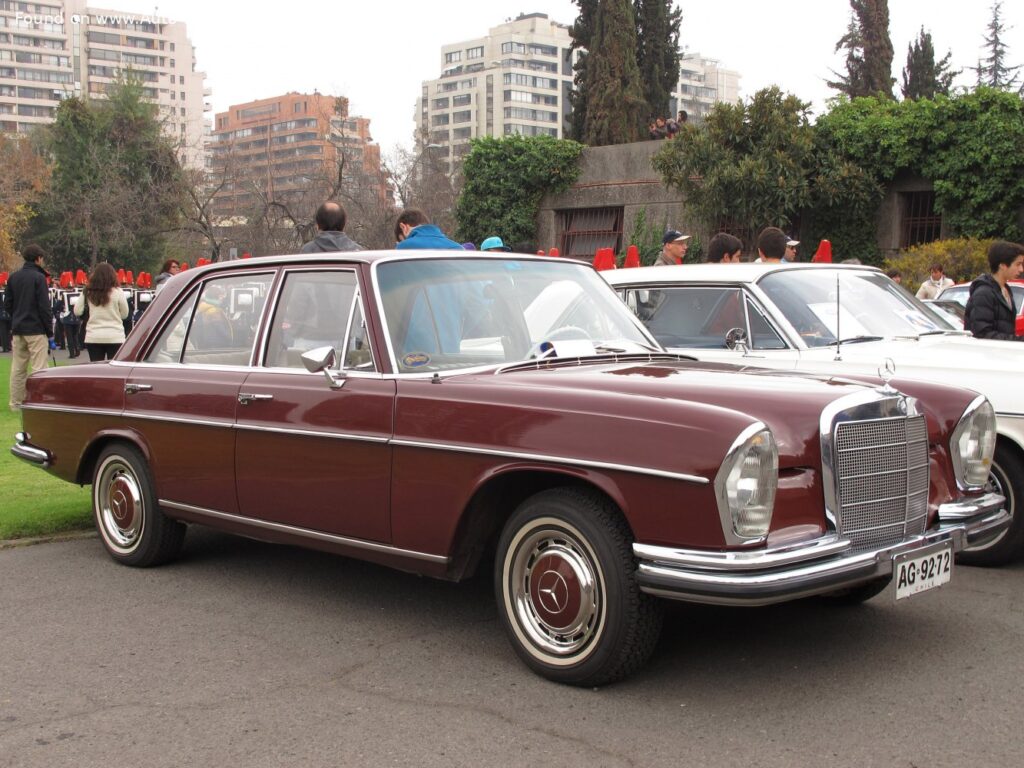
The Mercedes-Benz W108 series represents a pivotal chapter in the history of luxury sedans, embodying a blend of refined elegance, robust engineering, and sophisticated performance that defined premium motoring in the mid-1960s. Introduced in August 1965, the W108 generation succeeded the “Fintail” W111/W112 models, moving towards a cleaner, more timeless design aesthetic. Among its distinguished variants, the Mercedes-Benz W108 300 SEb (170 Hp) Automatic stood out as a particularly desirable model, combining a powerful inline-six engine with a smooth automatic transmission, catering to discerning buyers who sought both prestige and comfort. This vehicle was not merely a mode of transport; it was a statement of success and a testament to Mercedes-Benz’s unwavering commitment to quality and innovation during a transformative era for the automotive industry.
The Mercedes-Benz W108 Legacy: A Classic of Engineering and Style
The W108 series, produced from 1965 to 1972, marked a significant evolution in Mercedes-Benz’s design language, moving away from the more flamboyant styling cues of the late 1950s and early 1960s. Penned by Paul Bracq, the W108’s design was characterized by its clean lines, expansive glasshouse, and a dignified, understated elegance that would influence Mercedes-Benz vehicles for decades. The “b” designation in 300 SEb signified a return to coil spring suspension, distinguishing it from earlier “300 SE” models that featured more complex, and sometimes problematic, air suspension systems. This change underscored a philosophy of practical luxury, prioritizing reliability and ease of maintenance without compromising the exceptional ride quality expected from a Mercedes-Benz.
Positioned at the upper echelon of the Mercedes-Benz range, the W108 offered a spacious and opulent cabin, making it a favorite among executives, dignitaries, and affluent families across Europe and North America. Its reputation for durability and advanced engineering for its time cemented its status as a benchmark for luxury sedans. The 300 SEb variant, in particular, benefited from a larger, more powerful engine than its siblings, providing a level of performance commensurate with its premium standing. The vehicle’s enduring appeal as a classic car today is a testament to its original design integrity and the meticulous German engineering that went into every component.
Powertrain and Performance of the Mercedes-Benz W108 300 SEb (170 Hp) Automatic
At the heart of the Mercedes-Benz W108 300 SEb (170 Hp) Automatic lay a robust and sophisticated 3.0-liter (2996 cm3 or 182.83 cubic inches) inline-six engine, specifically the M 189 VIII / 189.989 model. This naturally aspirated unit featured a Single Overhead Camshaft (SOHC) valvetrain with two valves per cylinder, a configuration known for its smooth operation and durability. A significant technological advancement for its time was the multi-port manifold injection system, which provided precise fuel delivery, contributing to both power output and efficiency. This was a sophisticated setup at a time when many competitors still relied on carburetors, highlighting Mercedes-Benz’s commitment to cutting-edge engine technology.
The engine produced a healthy 170 horsepower at 5400 rpm and an impressive 183.65 lb.-ft. of torque at 4000 rpm. These figures were substantial for a luxury sedan of the mid-1960s, allowing the 300 SEb to deliver a refined yet spirited driving experience. Paired with a smooth 4-speed automatic transmission, power was reliably sent to the rear wheels, providing a balanced and predictable handling characteristic. The acceleration from 0 to 60 mph was achieved in a respectable 10.6 seconds, while the top speed reached 114.95 mph. While these numbers may seem modest by today’s standards, they positioned the 300 SEb among the faster and more capable luxury cars of its era, capable of comfortable high-speed cruising on the nascent autobahn network in Germany and interstate highways in the US.
Fuel economy for the 300 SEb was rated at 18.8 US mpg combined, a respectable figure given the vehicle’s size, weight (3439.21 lbs. curb weight), and the technological limitations of the time. The 21.66 US gallon fuel tank capacity ensured a considerable range between fill-ups, making it suitable for long-distance touring. The engine’s layout, front and longitudinal, contributed to the car’s balanced weight distribution and characteristic Mercedes-Benz driving feel, emphasizing stability and control.
Design, Engineering, and Interior Features
The design of the Mercedes-Benz W108 300 SEb (170 Hp) Automatic was a masterclass in understated elegance. As a four-door sedan with seating for five, its dimensions were generous, measuring 192.91 inches in length, 71.26 inches in width, and 56.69 inches in height. The substantial 108.27-inch wheelbase contributed significantly to its stately presence and provided ample interior space for passengers. The clean, unadorned bodywork, with its distinct upright grille and large, functional headlights, projected an image of timeless sophistication rather than fleeting fashion.
Beyond its aesthetics, the W108 was engineered for comfort, safety, and durability. The suspension system, a highlight for its era, featured a double wishbone setup at the front, providing precise steering and excellent road holding. The rear suspension utilized a sophisticated hydro-pneumatic element combined with trailing arms. This innovative system, though simpler than the earlier air suspension, still offered an exceptionally smooth and compliant ride, effectively isolating occupants from road imperfections – a hallmark of Mercedes-Benz luxury. Stopping power was provided by disc brakes on both the front and rear wheels, which was an advanced safety feature in the mid-1960s, offering superior fade resistance and stopping performance compared to drum brakes prevalent on many contemporary vehicles.
Steering was managed by a cone worm with recirculation balls system, augmented by hydraulic power steering. This setup provided light and effortless steering at low speeds for easy maneuvering, while maintaining a reassuring feel at higher velocities. The interior of the 300 SEb was crafted with meticulous attention to detail and high-quality materials. Although specific trim details are not provided, Mercedes-Benz of this era was renowned for its use of fine wood veneers, supple leather or high-grade upholstery, and robust chrome accents. The cabin was designed for ergonomic efficiency and passenger comfort, with clear instrumentation and intuitive controls, reflecting a focus on driver and passenger well-being that was ahead of its time. Safety considerations, while not as comprehensive as modern vehicles, included a rigid passenger cell and thoughtful interior design to minimize injury in the event of a collision, reflecting Mercedes-Benz’s early commitment to passive safety.
Technical Specifications: Mercedes-Benz W108 300 SEb (170 Hp) Automatic
Below are the detailed technical specifications for the Mercedes-Benz W108 300 SEb (170 Hp) Automatic model, produced from August 1965 to December 1967.
| Brand | Mercedes-Benz |
| Model | W108 |
| Generation | W108 |
| Type (Engine) | 300 SEb (170 Hp) Automatic |
| Start of production | August, 1965 year |
| End of production | December, 1967 year |
| Powertrain Architecture | Internal Combustion engine |
| Body type | Sedan |
| Seats | 5 |
| Doors | 4 |
| Fuel consumption (economy) – combined | 18.8 US mpg (12.5 l/100 km) |
| Fuel Type | Petrol (Gasoline) |
| Acceleration 0 – 60 mph | 10.6 sec |
| Acceleration 0 – 100 km/h | 11.2 sec |
| Maximum speed | 114.95 mph (185 km/h) |
| Weight-to-power ratio | 9.2 kg/Hp, 109 Hp/tonne |
| Weight-to-torque ratio | 6.3 kg/Nm, 159.6 Nm/tonne |
| Power | 170 Hp @ 5400 rpm |
| Power per liter | 56.7 Hp/l |
| Torque | 183.65 lb.-ft. @ 4000 rpm (249 Nm @ 4000 rpm) |
| Engine layout | Front, Longitudinal |
| Engine Model/Code | M 189 VIII / 189.989 |
| Engine displacement | 3.0 l (2996 cm3 / 182.83 cu. in.) |
| Number of cylinders | 6 |
| Engine configuration | Inline |
| Cylinder Bore | 3.35 in. (85 mm) |
| Piston Stroke | 3.46 in. (88 mm) |
| Compression ratio | 8.8:1 |
| Number of valves per cylinder | 2 |
| Fuel injection system | Multi-port manifold injection |
| Engine aspiration | Naturally aspirated engine |
| Valvetrain | SOHC |
| Kerb Weight | 3439.21 lbs. (1560 kg) |
| Max. weight | 4541.52 lbs. (2060 kg) |
| Max load | 1102.31 lbs. (500 kg) |
| Fuel tank capacity | 21.66 US gal (82 l) |
| Length | 192.91 in. (4900 mm) |
| Width | 71.26 in. (1810 mm) |
| Height | 56.69 in. (1440 mm) |
| Wheelbase | 108.27 in. (2750 mm) |
| Front track | 58.35 in. (1482 mm) |
| Rear (Back) track | 58.46 in. (1485 mm) |
| Drivetrain Architecture | Internal combustion engine (ICE) drives the rear wheels |
| Drive wheel | Rear wheel drive |
| Number of gears and type of gearbox | 4 gears, automatic transmission |
| Front suspension | Double wishbone |
| Rear suspension | Hydro-pneumatic element, Trailing arm |
| Front brakes | Disc |
| Rear brakes | Disc |
| Steering type | Cone worm with recirculation balls |
| Power steering | Hydraulic Steering |
| Wheel rims size | 6J x 14 |
