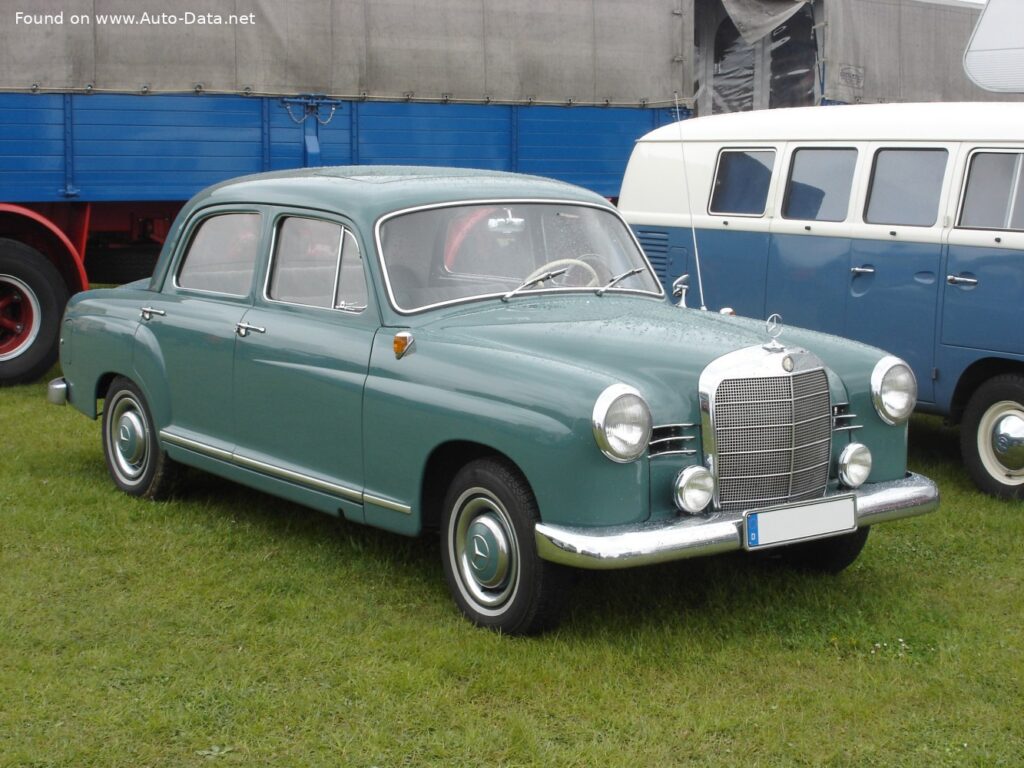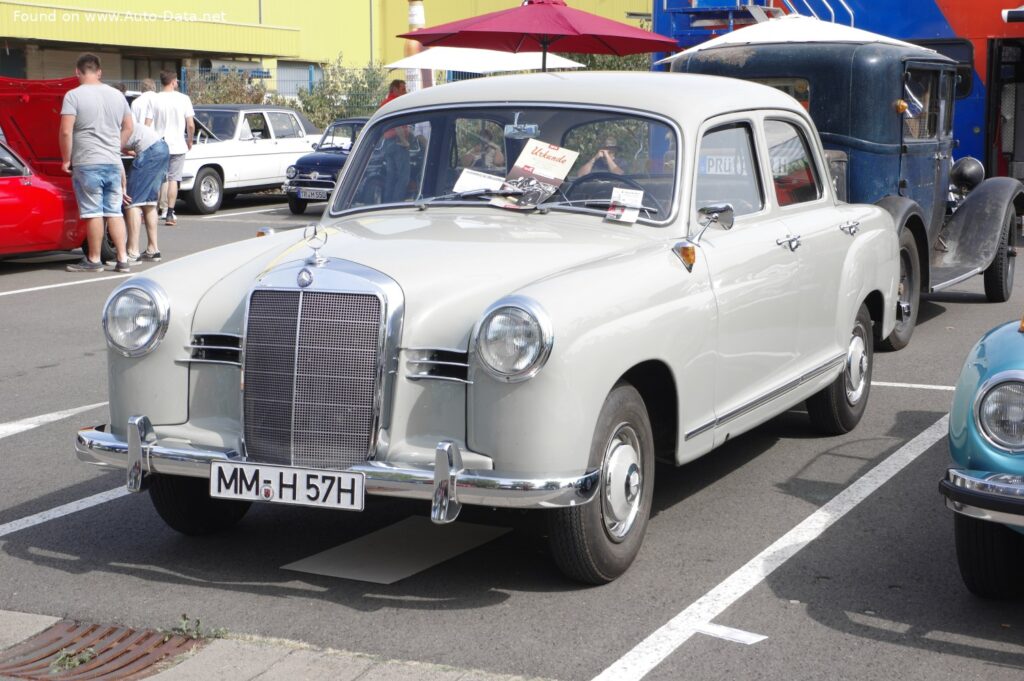
The Mercedes-Benz W120 Sedan, often referred to as the “Ponton” (meaning “pontoon” in German due to its rounded styling), represents a pivotal moment in post-war German automotive history. Produced from July 1953 to June 1957, the W120 was Mercedes-Benz’s first model to feature a monocoque body construction, a significant departure from the traditional body-on-frame designs of the era. The 180 model, powered by a 1.8-liter engine producing 52 horsepower, served as the entry point to the Mercedes-Benz lineup and was instrumental in democratizing the brand, making it accessible to a wider segment of the population. While not initially a major export to the United States, the Ponton established key design and engineering principles that would define Mercedes-Benz for decades to come.
The Mercedes-Benz W120 Sedan 180: A Post-War Icon
The W120 series was designed to replace the aging Mercedes-Benz 170 series. The Ponton’s design philosophy centered around providing comfortable, reliable transportation for the growing middle class in a recovering Germany. Its unibody construction offered increased rigidity and reduced weight compared to previous models, contributing to improved handling and fuel efficiency. The 180 model, with its relatively modest power output, was geared towards practicality and economy, making it a popular choice for families and everyday commuting.
Engine & Performance
The heart of the W120 180 is a 1,767 cc (107.83 cubic inches) inline-four cylinder engine, designated the M 136 VII / 136.925. This naturally aspirated engine produces 52 horsepower at 4000 rpm and 112 Nm (82.61 lb-ft) of torque at 1800 rpm. While these figures may seem modest by modern standards, they were competitive for the time. The engine features an overhead valve (OHV) valvetrain with two valves per cylinder and utilizes a carburetor for fuel delivery. Power is delivered to the rear wheels via a four-speed manual transmission. Acceleration from 0 to 60 mph takes approximately 29.5 seconds, and the vehicle has a top speed of 125 km/h (77.67 mph). The engine’s power-to-weight ratio is 22.1 kg/Hp, and it delivers 29.4 Hp per liter of displacement.
Design & Features
The W120 Sedan’s design was a radical departure from the pre-war Mercedes-Benz aesthetic. The “Ponton” name derives from the car’s smooth, rounded body shape, reminiscent of a pontoon boat. The integrated fenders and flowing lines were a significant step towards modern automotive styling. The vehicle is a four-door sedan with seating for five passengers. The interior, while relatively spartan by today’s standards, was designed for comfort and practicality. Features included a spacious cabin, large windows for good visibility, and a relatively large trunk for the era. Safety features were limited by the standards of the 1950s, but the monocoque construction provided a degree of inherent crash protection. The car’s dimensions are 4460 mm (175.59 in) in length, 1740 mm (68.5 in) in width, and 1560 mm (61.42 in) in height, with a wheelbase of 2650 mm (104.33 in).
Technical Specifications
| Brand | Mercedes-Benz |
| Model | Ponton |
| Generation | W120 Sedan |
| Type (Engine) | 180 (52 Hp) |
| Start of production | July, 1953 |
| End of production | June, 1957 |
| Powertrain Architecture | Internal Combustion engine |
| Body type | Sedan |
| Seats | 5 |
| Doors | 4 |
| Fuel consumption (combined) | 8.7 l/100 km (27 US mpg, 32.5 UK mpg, 11.5 km/l) |
| Fuel Type | Petrol (Gasoline) |
| Acceleration 0 – 100 km/h | 31 sec |
| Acceleration 0 – 62 mph | 31 sec |
| Acceleration 0 – 60 mph | 29.5 sec |
| Maximum speed | 125 km/h (77.67 mph) |
| Weight-to-power ratio | 22.1 kg/Hp |
| Weight-to-torque ratio | 10.3 kg/Nm |
| Power | 52 Hp @ 4000 rpm |
| Power per litre | 29.4 Hp/l |
| Torque | 112 Nm @ 1800 rpm (82.61 lb.-ft. @ 1800 rpm) |
| Engine layout | Front, Longitudinal |
| Engine Model/Code | M 136 VII / 136.925 |
| Engine displacement | 1767 cm3 (107.83 cu. in.) |
| Number of cylinders | 4 |
| Engine configuration | Inline |
| Cylinder Bore | 75 mm (2.95 in.) |
| Piston Stroke | 100 mm (3.94 in.) |
| Compression ratio | 6.7:1 |
| Number of valves per cylinder | 2 |
| Fuel injection system | Carburettor |
| Engine aspiration | Naturally aspirated engine |
| Valvetrain | OHV |
| Engine oil capacity | 4 l (4.23 US qt | 3.52 UK qt) |
| Coolant | 9 l (9.51 US qt | 7.92 UK qt) |
| Kerb Weight | 1150 kg (2535.32 lbs.) |
| Max. weight | 1600 kg (3527.4 lbs.) |
| Max load | 450 kg (992.08 lbs.) |
| Fuel tank capacity | 56 l (14.79 US gal | 12.32 UK gal) |
| Length | 4460 mm (175.59 in.) |
| Width | 1740 mm (68.5 in.) |
| Height | 1560 mm (61.42 in.) |
| Wheelbase | 2650 mm (104.33 in.) |
| Front track | 1420 mm (55.91 in.) |
| Rear track | 1460 mm (57.48 in.) |
| Drivetrain Architecture | Rear wheel drive |
| Number of gears and type of gearbox | 4 gears, manual transmission |
| Front suspension | Double wishbone, Transverse stabilizer |
| Rear suspension | Trailing arm |
| Front brakes | Drum |
| Rear brakes | Drum |
| Steering type | Cone worm with recirculation balls |
The Mercedes-Benz W120 Sedan 180, while not a performance car, was a significant achievement in automotive engineering and design. Its introduction of unibody construction and its focus on practicality and comfort helped to establish Mercedes-Benz as a leading manufacturer of quality automobiles. The Ponton series laid the groundwork for the company’s future success and remains a cherished classic among automotive enthusiasts.