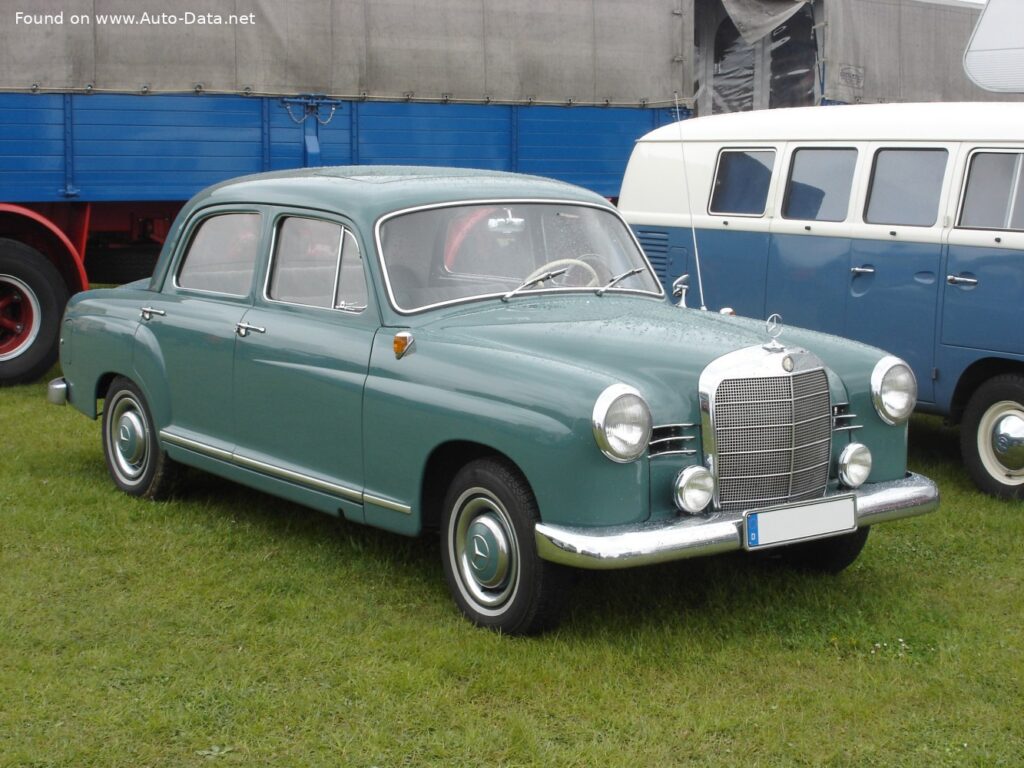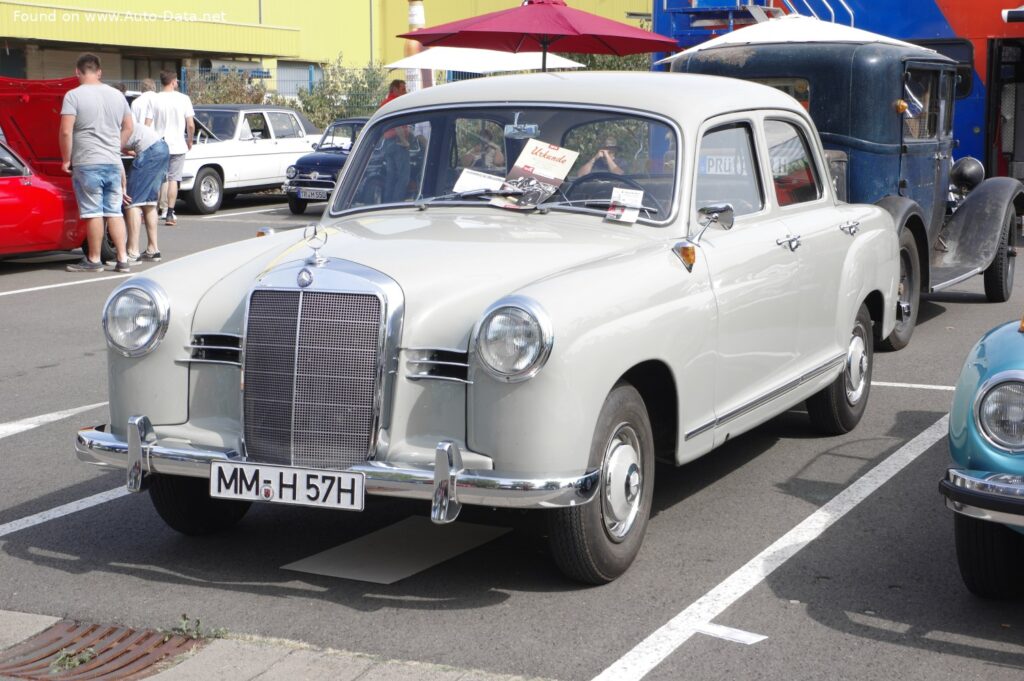
The Mercedes-Benz W120 Sedan, often referred to as the “Ponton” (meaning “pontoon” in German due to its rounded styling), represents a pivotal moment in post-war Mercedes-Benz history. Produced from 1956 to 1959, the W120 was the first Mercedes-Benz to feature a monocoque body construction, a significant departure from the traditional body-on-frame designs of the past. The 180 a model, powered by a 1.9-liter engine producing 65 horsepower, was a popular variant, offering a blend of affordability and the renowned Mercedes-Benz build quality. This vehicle marked a shift towards mass production for the brand, making Mercedes-Benz automobiles accessible to a wider segment of the market.
Mercedes-Benz W120 Sedan 180 a: A Post-War Icon
The W120 series was designed to replace the aging Mercedes-Benz 170 series and compete with contemporary vehicles from manufacturers like BMW and Opel. The “Ponton” styling, characterized by its flowing lines and integrated fenders, was a deliberate break from the more angular designs of the pre-war era. The 180 a, introduced in June 1957, was the entry-level model in the W120 range, offering a more economical option alongside the more powerful 180 D (diesel) and 190 models. While not a performance car by modern standards, the 180 a provided comfortable and reliable transportation for families and commuters.
Engine & Performance
The heart of the Mercedes-Benz W120 Sedan 180 a is its 1.9-liter (1897 cc) inline-four cylinder engine, designated the M121 B IV / 121.923. This naturally aspirated engine produced 65 horsepower at 4500 rpm and 127 Nm (93.67 lb.-ft.) of torque at 2200 rpm. The engine featured a single overhead camshaft (SOHC) valvetrain with two valves per cylinder and utilized a carburetor for fuel delivery. While the power output may seem modest today, it was sufficient for the vehicle’s weight and intended purpose. Acceleration from 0 to 100 km/h (0-62 mph) took approximately 21 seconds, and the car had a top speed of 135 km/h (83.89 mph). The engine’s power-to-weight ratio was 16.4 kg/Hp, and its power per liter was 34.3 Hp/l. The engine is longitudinally mounted at the front of the vehicle, driving the rear wheels through a four-speed manual transmission.
Design & Features
The W120 Sedan’s body style is a four-door, five-seat sedan. Its defining characteristic is its unibody construction, a significant advancement in automotive engineering at the time. This construction method resulted in a lighter and more rigid chassis compared to traditional body-on-frame designs, improving handling and safety. The exterior design, as mentioned, is characterized by its rounded “Ponton” shape, with integrated fenders and a relatively low roofline. Inside, the 180 a offered a comfortable, if spartan, interior. Features were relatively basic by modern standards, focusing on practicality and durability. The interior was typically trimmed with cloth upholstery, and the dashboard featured a simple instrument cluster. Safety features were limited by the standards of the era, but the monocoque construction provided a degree of inherent crash protection. The fuel tank capacity is 56 liters (14.79 US gal). The vehicle’s dimensions are 4485 mm (176.57 in) in length, 1740 mm (68.5 in) in width, and 1560 mm (61.42 in) in height, with a wheelbase of 2650 mm (104.33 in).
Technical Specifications
| Brand | Mercedes-Benz |
| Model | Ponton |
| Generation | W120 Sedan |
| Type (Engine) | 180 a (65 Hp) |
| Start of production | June, 1957 |
| End of production | July, 1959 |
| Powertrain Architecture | Internal Combustion engine |
| Body type | Sedan |
| Seats | 5 |
| Doors | 4 |
| Fuel consumption (combined) | 10.9 l/100 km |
| Fuel consumption (US mpg) | 21.6 US mpg |
| Fuel consumption (UK mpg) | 25.9 UK mpg |
| Fuel consumption (km/l) | 9.2 km/l |
| Fuel Type | Petrol (Gasoline) |
| Acceleration 0 – 100 km/h | 21 sec |
| Acceleration 0 – 62 mph | 21 sec |
| Acceleration 0 – 60 mph | 20 sec |
| Maximum speed | 135 km/h (83.89 mph) |
| Weight-to-power ratio | 16.4 kg/Hp |
| Weight-to-torque ratio | 8.4 kg/Nm |
| Power | 65 Hp @ 4500 rpm |
| Power per litre | 34.3 Hp/l |
| Torque | 127 Nm @ 2200 rpm (93.67 lb.-ft. @ 2200 rpm) |
| Engine layout | Front, Longitudinal |
| Engine Model/Code | M 121 B IV / 121.923 |
| Engine displacement | 1897 cm3 (115.76 cu. in.) |
| Number of cylinders | 4 |
| Engine configuration | Inline |
| Cylinder Bore | 85 mm (3.35 in.) |
| Piston Stroke | 83.6 mm (3.29 in.) |
| Compression ratio | 6.8:1 |
| Number of valves per cylinder | 2 |
| Fuel injection system | Carburettor |
| Engine aspiration | Naturally aspirated engine |
| Valvetrain | SOHC |
| Engine oil capacity | 4 l (4.23 US qt | 3.52 UK qt) |
| Coolant | 9 l (9.51 US qt | 7.92 UK qt) |
| Kerb Weight | 1065 kg (2347.92 lbs.) |
| Max. weight | 1615 kg (3560.47 lbs.) |
| Max load | 550 kg (1212.54 lbs.) |
| Fuel tank capacity | 56 l (14.79 US gal | 12.32 UK gal) |
| Length | 4485 mm (176.57 in.) |
| Width | 1740 mm (68.5 in.) |
| Height | 1560 mm (61.42 in.) |
| Wheelbase | 2650 mm (104.33 in.) |
| Front track | 1420 mm (55.91 in.) |
| Rear track | 1460 mm (57.48 in.) |
| Drivetrain Architecture | Rear wheel drive |
| Number of gears | 4 gears, manual transmission |
| Front suspension | Double wishbone, Transverse stabilizer |
| Rear suspension | Trailing arm |
| Front brakes | Drum |
| Rear brakes | Drum |
| Steering type | Cone worm with recirculation balls |
The Mercedes-Benz W120 Sedan 180 a, while not a groundbreaking vehicle in terms of performance, was a significant step forward for Mercedes-Benz. Its innovative monocoque construction, combined with its comfortable ride and reliable engine, made it a popular choice for buyers in the late 1950s. The “Ponton” design remains a recognizable and admired example of mid-century automotive styling, and the W120 series played a crucial role in establishing Mercedes-Benz as a leading manufacturer of passenger cars.